Should You Repair or Replace Your AC in DFW? Here’s How to Decide
When it comes to ac repair vs replace — decision guide for dfw homeowners — the answer usually comes down to four things: how old your system is, what the repair costs, how often it’s been breaking down, and what refrigerant it uses.
Quick answer for most DFW homeowners:
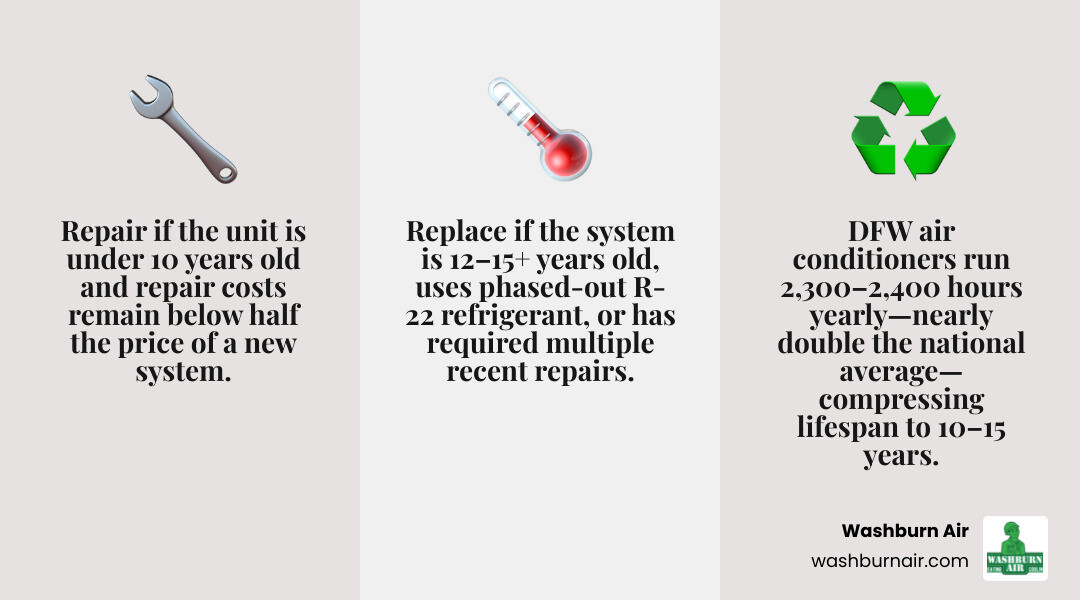
- Repair if your system is under 10 years old, the issue is minor, and repair costs stay well below half the price of a new system
- Evaluate carefully if your system is 10–12 years old or has needed multiple repairs recently
- Replace if your system is 12–15+ years old, repair costs are high relative to replacement, it uses R-22 refrigerant, or it’s been failing repeatedly
Here’s why this matters more in North Texas than almost anywhere else: DFW air conditioners run roughly 2,300–2,400 hours per year — nearly double the national average. That kind of workload compresses what would be a 15–20 year lifespan in a moderate climate down to just 10–15 years in Texas heat. A system that still has years left on paper may already be operating on borrowed time here.
The wrong call in either direction costs real money. Repairing a system that’s nearly done wastes the repair bill and delays an inevitable purchase — usually into an emergency. Replacing a system that had years of reliable life left means spending money you didn’t need to spend yet.
This guide walks you through the decision frameworks, warning signs, refrigerant changes, and financial factors that actually matter for DFW homeowners right now, in June 2026.
Decision Frameworks: The 50% Rule, the $5,000 Rule, and Texas Heat
When you are standing in a warm living room in Arlington or Southlake waiting for a technician to arrive, you want an objective way to make your decision. Fortunately, the HVAC industry uses two primary mathematical frameworks to take the emotion out of the choice.
The first is the 50% Rule. This rule states that if the cost of a single repair exceeds 50% of the price of a brand-new replacement system, replacement is almost always the smarter financial choice. For example, if you are facing a massive repair bill on a mid-life system, sinking that much capital into aging equipment rarely makes sense. You can read more about how this applies to North Texas homes in our detailed breakdown, Should I Repair or Replace My AC in North Texas?.
The second framework is the $5,000 Rule. To use this rule, you multiply the age of your air conditioning system (in years) by the exact repair quote you received. If the resulting number is higher than 5,000, you should replace the unit. If it is lower, repairing the system is usually justified.
Let’s look at how this math plays out in real-world scenarios:
- Scenario A: You have a 6-year-old system in Irving that needs a moderate repair. Multiplying 6 years by the repair quote yields a number well under the 5,000 threshold. The rule suggests you repair.
- Scenario B: You have a 12-year-old system in Highland Park facing a major component failure. Multiplying 12 years by a high-end repair quote easily pushes you past the 5,000 mark. The rule suggests you replace.
In North Texas, these rules carry even more weight because of the sheer volume of operating hours our systems endure. Our extended cooling season — stretching from April through October — subjects condensers and compressors to relentless wear and tear.
Neglecting minor issues on an older system can accelerate its demise, causing a cascade of failures. For a deeper look at how minor wear turns into major system failure, read about The Impact of Neglecting AC Inspections and Repairs on Your System.
To help you visualize where your system stands, we have put together a quick-reference decision table:
| Decision Factor | Lean Toward Repair | Lean Toward Replacement |
|---|---|---|
| System Age | Under 10 years old | 12 to 15+ years old |
| Repair Cost Math | Age × Repair Cost is under 5,000 | Age × Repair Cost is over 5,000 |
| Refrigerant Type | R-410A (in good condition) | R-22 (completely phased out) |
| Operating Efficiency | Utility bills remain steady and normal | Utility bills are climbing rapidly |
| Breakdown History | First major issue in several years | Third service call in the last 24 months |
| Comfort Levels | Consistent cooling throughout the home | Persistent hot spots and high indoor humidity |
System Lifespan: Refrigerant Changes and Warning Signs
The environmental and regulatory landscape surrounding home cooling has shifted dramatically over the last few years. If your home comfort system was installed over a decade ago, it likely relies on chemistry and technology that are no longer supported by modern manufacturing.
Navigating Refrigerant Changes in an ac repair vs replace — decision guide for dfw homeowners
One of the most critical factors in your decision-making process is the type of refrigerant your air conditioner uses.
- R-22 (Freon): If your system was installed before 2010, it likely runs on R-22. The EPA completely banned the production and import of R-22. Consequently, the remaining supply is incredibly scarce, and recharging a leaking R-22 system has become astronomically expensive. If your R-22 system develops a refrigerant leak, repairing it is almost never a viable option.
- R-410A (Puron): This has been the industry standard for the past fifteen years. However, under the EPA’s AIM Act, R-410A is undergoing a strict phasedown. By 2026, production of R-410A has been significantly cut, driving up the cost of servicing these systems.
- A2L Refrigerants (R-454B and R-32): As of the latest environmental regulations, new residential air conditioning systems utilize next-generation A2L refrigerants. These modern alternatives offer superior heat transfer efficiency, meaning they work exceptionally well in extreme Texas heat.
Because A2L systems operate under different pressures and require advanced safety features — such as integrated leak detection systems — you cannot simply drop A2L refrigerant into an older R-410A or R-22 system. Doing so would require replacing virtually every major component. When you choose a modern replacement, you are future-proofing your home against the rising “refrigerant tax” associated with older, phased-out gases.
Recognizing Warning Signs: An ac repair vs replace — decision guide for dfw homeowners
How do you know when your air conditioner is sending out its final SOS? Beyond a complete system shutdown, there are several physical indicators that your equipment is approaching the end of its useful life.
One classic warning sign is frozen evaporator coils. While sometimes caused by a simple clogged filter, recurring ice buildup on your indoor or outdoor unit often points to a refrigerant leak or a failing blower motor. You can learn more about identifying these symptoms in our guide on Air Conditioner Repair Warning Signs.
If you are trying to figure out if your current issue is a quick fix or a major catastrophe, our resource on Common AC Issues and How to Troubleshoot Them Effectively can help you rule out simple thermostat or breaker issues before you call in the professionals.
Keep an eye out for these five critical warning signs:
- High Breakdown Frequency: If you have had to call an HVAC technician out to your home three or more times over the last two summers, your system is caught in a cycle of sequential component failure.
- Uneven Cooling: Are the bedrooms in your Grapevine home sweltering while the living room feels like an icebox? An aging compressor often struggles to distribute cool air evenly.
- Constant Running: When outdoor temperatures in Westlake or Trophy Club soar past 100 degrees, your system should run frequently. However, if it runs continuously without ever reaching your thermostat’s set temperature, it has lost its cooling capacity.
- Rising Energy Bills: If your summer electric bills have jumped significantly compared to the same months in previous years — despite similar weather patterns — your system’s efficiency has degraded.
- Poor Humidity Control: A properly functioning air conditioner is designed to dehumidify your home. If your indoor air feels clammy, sticky, or smells musty, the system is no longer managing moisture effectively.
Sizing, Efficiency, and the Financial Impact of Replacement
If the math and the warning signs point toward replacement, the next step is understanding how a modern system impacts your monthly operating expenses.
Many homeowners in older DFW neighborhoods have systems that were never properly sized for their homes. When we install a new system, we perform a precise Manual J load calculation. This scientific calculation factors in your home’s square footage, insulation levels, window orientations, and local climate data to determine the exact cooling capacity your home requires.
An oversized system will “short-cycle,” turning on and off rapidly, which ruins humidity control and wears out the compressor. An undersized system will run constantly, driving up your energy bills and burning out prematurely.
By upgrading to a modern, properly sized system — particularly one with an ENERGY STAR certification — you can drastically reduce your monthly energy consumption. Modern high-efficiency systems use significantly less electricity to deliver the same amount of cooling as a system built a decade ago.
Over a 15-year lifespan, the cumulative energy savings of a high-efficiency system, combined with the elimination of frequent repair bills, can easily offset your initial replacement investment. When you are ready to explore your options, you can learn more about our seamless AC Replacement process.
If you are wondering about the logistics of the upgrade, we have put together a helpful timeline guide: How Long Does AC Replacement Take in DFW?.
To ensure you get the absolute most out of your investment, here is a list of critical factors to discuss with your technician during your consultation:
- Ask about a Manual J Load Calculation: Ensure your contractor calculates your home’s actual heat load rather than simply matching the tonnage of your old system.
- Discuss System Matching: Confirm that both the indoor evaporator coil and the outdoor condenser are being replaced together. Mismatched systems will not achieve their rated efficiency and can void your manufacturer warranty.
- Evaluate Ductwork Integrity: Ask the technician to inspect your ductwork for leaks, static pressure issues, or design flaws that could restrict airflow and damage your new system.
- Inquire About Variable-Speed Technology: Ask if a two-stage or variable-speed compressor is right for your home. These systems run at lower, highly efficient speeds to provide superior comfort and humidity control in the DFW climate.
- Verify Warranty Details: Double-check the length of the parts warranty (typically 10 years when registered) and ask about the labor warranty coverage.
FAQs: ac repair vs replace — decision guide for dfw homeowners
Making the right choice can feel overwhelming. Here are the answers to the most common questions we hear from homeowners across the Dallas-Fort Worth metroplex.
Is it worth repairing a system that is over 10 years old?
It depends entirely on the nature of the repair. If your 10-year-old system needs a simple, low-cost component like a capacitor or a contactor, repairing it is usually a smart way to squeeze a few more years of life out of the unit. However, if the compressor has failed, the evaporator coil is leaking refrigerant, or the system has a history of frequent breakdowns, investing in a repair is rarely worth it. In the intense DFW climate, a 10-year-old system has already completed the vast majority of its useful life.
How does the current refrigerant transition affect my repair options?
Because of the ongoing EPA phasedown of R-410A and the complete ban on R-22, the cost of repairing older systems that require refrigerant is rising rapidly. If your older system has a refrigerant leak, you are facing a double expense: paying to find and patch the leak, and paying for increasingly expensive, phased-out refrigerant. New systems utilize modern, eco-friendly A2L refrigerants like R-454B and R-32, which are highly efficient, readily available, and future-proof.
Should I replace my furnace at the same time as my air conditioner?
In most cases, yes. Your furnace and air conditioner share the same blower motor and indoor evaporator coil. Replacing both units at the same time ensures they are perfectly matched for maximum energy efficiency and system performance. Plus, installing them together saves you money on labor costs compared to replacing them separately, and it gives you a single, unified warranty timeline for your entire home comfort system.
Conclusion
Deciding whether to repair or replace your air conditioner doesn’t have to be a guessing game. By applying objective frameworks like the 50% Rule and the $5,000 Rule, keeping an eye out for critical warning signs, and understanding the financial impact of modern refrigerant changes, you can make a confident, data-driven decision for your home.
At Washburn Air, we bring Grapevine-based, 24/7 local expertise to homeowners across Dallas, Fort Worth, Arlington, Irving, Southlake, Westlake, Trophy Club, and Highland Park. We believe in providing honest, transparent recommendations based on what your home actually needs. Whether you need a fast, reliable AC Repair to get your system back up and running, or a comprehensive comfort audit to plan a high-efficiency replacement, our team is here to support you every step of the way.
Don’t wait for the peak of summer heat to make a high-pressure decision. Contact us today to schedule a professional system diagnostic and find the perfect comfort solution for your home.
{“@context”: “https://schema.org”, “@graph”: [{“@type”: “Article”, “headline”: “AC Repair vs Replace Guide for DFW Homes | Washburn Air”, “description”: “Use our ac repair vs replace decision guide for DFW homeowners to weigh age, repair costs, refrigerant and Texas heat. Call Washburn Air.”, “author”: {“@type”: “Person”, “name”: “Washburn Air”}, “publisher”: {“@type”: “Organization”, “name”: “Washburn Air”, “logo”: {“@type”: “ImageObject”, “url”: “https://washburnair.com/wp-content/uploads/2024/09/washburn-air-logo-800-400×261.png”}}, “datePublished”: “2026-07-21T02:33:34+00:00”, “dateModified”: “2026-07-21T02:33:45.636829”, “mainEntityOfPage”: {“@type”: “WebPage”, “@id”: “https://washburnair.com/blog/ac-repair-vs-replace-decision-guide-for-dfw-homeowners/”}, “image”: “https://images.bannerbear.com/direct/4mGpW3zwpg0ZK0AxQw/requests/000/150/986/209/P0ev7XDZrzqPwyZdYMjR9og8N/74eb0a0be469292d8a73b7c6eaeb7e2fccbf27c4.jpg”}, {“@type”: “FAQPage”, “mainEntity”: [{“@type”: “Question”, “name”: “Should I repair or replace my AC in DFW?”, “acceptedAnswer”: {“@type”: “Answer”, “text”: “Most DFW homeowners should repair an AC that is under 10 years old, has a minor issue, and has repair costs well below half the price of replacement. Replacement is usually better if the system is 12–15+ years old, has repeated failures, uses R-22 refrigerant, or needs repairs that are expensive compared with a new system.”}}, {“@type”: “Question”, “name”: “How does the 50% rule help decide whether to repair or replace an AC?”, “acceptedAnswer”: {“@type”: “Answer”, “text”: “The 50% rule says that if a single AC repair costs more than 50% of the price of a new replacement system, replacement is usually the smarter financial choice. This helps homeowners avoid putting too much money into aging equipment.”}}, {“@type”: “Question”, “name”: “Why do air conditioners wear out faster in DFW?”, “acceptedAnswer”: {“@type”: “Answer”, “text”: “DFW air conditioners run about 2,300–2,400 hours per year, nearly double the national average. Because of this heavy workload in Texas heat, a system that might last 15–20 years in a milder climate may only last 10–15 years in North Texas.”}}, {“@type”: “Question”, “name”: “When should DFW homeowners evaluate an AC repair more carefully?”, “acceptedAnswer”: {“@type”: “Answer”, “text”: “Homeowners should evaluate carefully when an AC system is around 10–12 years old or has needed multiple recent repairs. At that point, the system may still have useful life left, but the risk of repeated breakdowns and rising repair costs becomes more important.”}}, {“@type”: “Question”, “name”: “What are signs it may be time to replace an AC instead of repairing it?”, “acceptedAnswer”: {“@type”: “Answer”, “text”: “Replacement is recommended when the AC is 12–15 years old or older, repair costs are high compared with replacement, the unit uses R-22 refrigerant, or it has been failing repeatedly. Continuing to repair a system that is near the end of its life can waste money and delay an inevitable replacement.”}}]}]}