Is a Mini Split Worth It for a Garage or Room Addition in the DFW Area?
Is a mini split worth it for a garage or room addition in the DFW area? For most DFW homeowners, the answer is yes — especially when the space has no existing ductwork, faces heavy solar gain, or sits far from the main air handler.
Quick answer based on your situation:
| Your Situation | Best Option |
|---|---|
| Garage conversion with no existing ducts | Mini split — strong fit |
| Room addition far from the air handler | Mini split — strong fit |
| Small addition close to existing duct runs | Duct extension may work |
| Existing HVAC system already at capacity | Mini split — required |
| Finished attic or bonus room above garage | Mini split — strong fit |
| Budget is the only concern, ducts are nearby | Duct extension worth evaluating |
If you’ve ever walked into a converted garage in August and felt like you’d stepped into a preheated oven, you already understand the problem. Garages in North Texas absorb heat through concrete slabs, minimal insulation, and large garage doors facing the sun for hours every day. Standard central HVAC systems were never designed to handle that kind of load — and stretching ductwork to reach these spaces often makes the rest of the house uncomfortable too.
Room additions face a similar challenge. Adding square footage to a home puts new demand on a system that was sized for the original floor plan. If your existing HVAC doesn’t have room to grow, the new space ends up hot in summer, cold in winter, and uncomfortable year-round.
This guide walks through exactly when a mini split makes sense for DFW homes — and when a duct extension might still be the smarter call.
Evaluating Your Options: Is a Mini Split Worth It for a Garage or Room Addition in the DFW Area?
When evaluating how to cool a newly finished space, we have to look closely at the unique physics of North Texas homes. It is June 2026, and we have just come through another intense spring transition into our signature Texas summer heat. If you are converting a garage or building an addition, you are dealing with spaces that have vastly different thermal profiles than the rest of your home.
Garages are particularly notorious. They are typically built on a thick concrete slab that acts as a giant thermal sponge, absorbing daytime heat and radiating it back into the space long after the sun goes down. Add to that a massive, uninsulated metal garage door acting as a giant radiator, and you have a recipe for extreme heat loads.
Standard room additions often suffer from similar, albeit less extreme, issues. They frequently have three exposed exterior walls and a roof line that isn’t shaded by the main house. Forcing your central heating and air conditioning system to cover these spaces can lead to major comfort issues.
Before we look at the logistics of extending ductwork, it is crucial to understand how ductless technology differs fundamentally from traditional split systems. If you want to dive deeper into the basic mechanical differences, check out our comprehensive guide on Ductless AC vs Central AC.
Comparing Ductwork Extensions and Ductless Systems
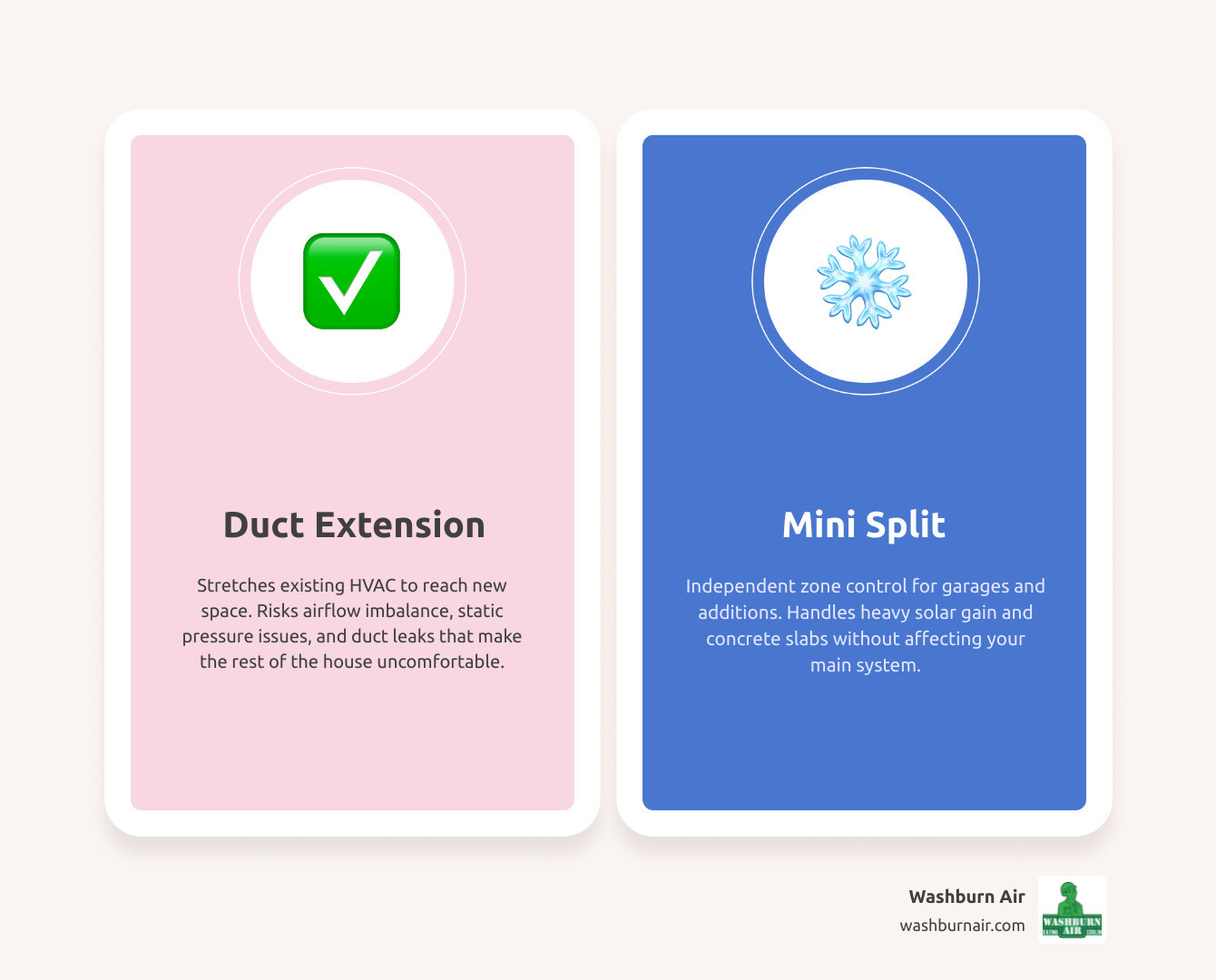
Many DFW homeowners initially assume that simply extending the existing ductwork is the easiest and most cost-effective path. However, HVAC systems operate on a delicate balance of airflow and static pressure.
Your central air conditioner was sized specifically for the original square footage of your home. When you tap into the existing trunk line to run new ducts to a garage or room addition, you are asking the blower motor to push air further than designed. This can result in:
- System Imbalance: The original rooms in your home lose airflow, causing them to become warmer.
- Static Pressure Issues: The blower motor works harder, leading to premature wear and potential system failure.
- Duct Leaks: According to the EPA, ductwork leaks can cause homeowners to pay 30% to 40% more than necessary for heating and cooling. Adding more ductwork through unconditioned attics or crawlspaces only increases the potential for these efficiency-robbing leaks.
To help you weigh the practical differences, we have put together a comparison of how these two approaches stack up across key performance metrics.
| Feature | Ductwork Extension | Ductless Mini-Split |
|---|---|---|
| Upfront Installation Complexity | High (Requires drywall cuts, framing, and balancing) | Low (Requires only a small 3-inch wall penetration) |
| Energy Efficiency | Subject to 20-30% duct loss in hot attics | Up to 30% more efficient (Zero duct loss) |
| Temperature Control | Tied to the main home’s thermostat | Completely independent zone control |
| Indoor Air Quality | Can pull dust and allergens from old ducts | Multi-stage filtration in each room unit |
| System Lifespan | Tied to existing central system | 15 to 20 years with proper maintenance |
| Timeline to Install | Often takes several days of construction | Typically completed in 4 to 8 hours |
Sizing and Efficiency: Is a Mini Split Worth It for a Garage or Room Addition in the DFW Area?
If you decide that a ductless system is the right fit, proper sizing is the most critical step to ensure long-term comfort. Under-sizing a unit means it will run constantly without ever cooling the space down, while over-sizing leads to short-cycling, which leaves the air humid and clammy.
When we perform a Mini Split AC Installation, we do not rely on simple square footage rules. We conduct a detailed load calculation that factors in:
- The R-value of your wall and ceiling insulation.
- Whether the garage door is insulated.
- The number and orientation of windows (west-facing glass in Texas requires extra capacity).
- Ceiling height and lighting loads.
As a general rule of thumb, while a standard home interior might require 20 BTUs per square foot, a North Texas garage or bonus room often requires closer to 25 BTUs per square foot due to the extreme heat load. For example, a typical three-car garage (ranging from 600 to 900 square feet) generally requires a mini-split system with a capacity of 18,000 to 24,000 BTUs to maintain a comfortable 72°F when it is 105°F outside.
The efficiency of these systems is measured by their SEER2 (Seasonal Energy Efficiency Ratio) ratings. While standard central air conditioners typically range from 14 to 18 SEER2, premium mini-split systems can achieve ratings of 20 to over 30 SEER2.
This incredible efficiency is largely due to inverter technology. Traditional AC compressors operate like a light switch — they are either 100% on or completely off. Inverter-driven compressors behave more like a dimmer switch. They modulate their speed continuously, running at 30%, 50%, or 90% capacity depending on the exact cooling demand. This eliminates the massive energy spikes associated with starting up a traditional compressor and keeps the temperature incredibly stable.
Installation and Comfort: Is a Mini Split Worth It for a Garage or Room Addition in the DFW Area?
One of the greatest benefits of choosing a mini split for your room addition or garage conversion is how minimally invasive the installation process is.
To connect the indoor air handler to the outdoor condenser, we only need to run a copper line set, electrical wiring, and a condensate drain line. These components are bundled together in a protective casing. Mini-split systems are highly flexible, supporting up to 98 feet of line set per indoor unit, with a maximum elevation difference of 49 feet. This means the outdoor unit can be tucked away discreetly on the side of your home, far from your outdoor living spaces.
The physical connection requires only a single 3-inch hole through the exterior wall. There is no major construction, no drywall dust, and no need to repaint your entire room. A single-zone installation is incredibly fast, typically taking our experienced teams just 4 to 8 hours to complete.
Once installed, the level of comfort is unmatched. Because the system is dedicated entirely to that single room, you enjoy true independent zone control. If you want to keep your garage workshop at a cool 70°F while you work on a project, you can do so without freezing out the rest of your family inside the main house.
Key Considerations for North Texas Homeowners
Before moving forward with any climate control upgrade, we always recommend evaluating a few key structural and electrical factors in your home.
First, look at your insulation. If you are installing a high-efficiency mini split in a garage, but the garage door is uninsulated sheet metal, you are essentially letting your conditioned air escape. Taking the time to insulate your garage door and blow insulation into the garage ceiling will pay massive dividends. It allows you to install a smaller, more cost-effective mini-split unit and keeps your monthly operating costs to a absolute minimum.
Second, check your electrical panel. Mini splits require a dedicated circuit. While smaller 9,000 to 12,000 BTU units can sometimes run on 115V, larger systems (18,000 BTUs and up) require a 230V connection. During our initial site assessment, we always inspect your electrical panel to ensure there is physical space and electrical capacity for a new double-pole breaker.
Finally, consider the age and condition of your primary HVAC system. If your main central air conditioner is nearing the end of its lifespan, it is wise to look at your home comfort strategy holistically. You can explore our expert decision-making framework in our article, Should I Repair or Replace My AC in North Texas?, to see how a targeted mini split might fit into a larger AC Replacement plan.
Frequently Asked Questions About DFW Mini Splits
Can a mini-split handle extreme Dallas summer heat?
Yes, premium mini-split systems are engineered to perform exceptionally well in extreme climates. While budget brands can struggle and lose capacity when outdoor temperatures climb, high-quality systems are rated to provide reliable cooling even when ambient outdoor temperatures exceed 115°F.
Because we experience some of the most intense summer heat in the country here in Dallas, we always size our systems with a slight safety margin to account for those consecutive weeks of triple-digit July and August afternoons.
Do mini-splits provide heating during North Texas winters?
Absolutely. Modern mini splits are heat pumps, meaning they can run in reverse to provide highly efficient heating during our chilly winter months.
Traditional electric space heaters rely on resistance heating, which has a Coefficient of Performance (COP) of 1.0 (meaning 1 unit of electricity produces 1 unit of heat). In contrast, inverter-driven heat pumps move heat rather than creating it, achieving efficiencies of 300% to 400% even during freezing temperatures in Fort Worth. Most premium units maintain full heating capacity down to 5°F, easily handling our coldest winter nights.
How much maintenance does a ductless system require?
Mini splits are highly reliable, but they do require consistent basic care because they recirculate the air within a single room.
- Filter Cleaning: The indoor unit contains reusable mesh filters that should be popped out, rinsed, and dried every 2 to 4 weeks during heavy use. This keeps the airflow strong and prevents dust buildup on the delicate coil.
- Drain Line Flushing: Running vinegar or a dedicated drain cleaner down the condensate line every few months prevents algae buildup and clogs.
- Professional Tune-ups: We recommend scheduling a professional maintenance visit once a year. We will deep-clean the coils, check refrigerant pressures, inspect electrical connections, and make sure the system is operating at peak efficiency. If you ever run into issues with airflow or cooling performance, our team is always ready to assist with prompt Mini Split AC Repair.
Conclusion
When you add up the benefits of zero duct loss, whisper-quiet operation, independent zone control, and a quick, non-invasive installation, it is easy to see why a mini split is one of the smartest investments you can make for your DFW home addition or garage conversion. It transforms unlivable, sweltering spaces into comfortable, year-round rooms without compromising the performance of your main home’s HVAC system.
At Washburn Air, we are proud to be the trusted local HVAC experts based in Grapevine, TX. We serve homeowners across the entire Dallas-Fort Worth metroplex, including Arlington, Irving, Southlake, Westlake, Trophy Club, and Highland Park. Our team is committed to providing honest, pressure-free advice and flawless installations tailored to the unique demands of our Texas climate.
Ready to reclaim your garage or perfectly cool your new room addition? Reach out to us today to schedule your professional Mini Split AC Installation consultation!
{“@context”: “https://schema.org”, “@graph”: [{“@type”: “Article”, “headline”: “Mini Split for DFW Garage or Room Addition | Washburn Air”, “description”: “Wondering if a mini split is worth it for a garage or room addition in the DFW area? Learn pros, costs, and when to call Washburn Air.”, “author”: {“@type”: “Person”, “name”: “Washburn Air”}, “publisher”: {“@type”: “Organization”, “name”: “Washburn Air”, “logo”: {“@type”: “ImageObject”, “url”: “https://washburnair.com/wp-content/uploads/2024/09/washburn-air-logo-800-400×261.png”}}, “datePublished”: “2026-07-15T02:31:18+00:00”, “dateModified”: “2026-07-15T02:31:29.662498”, “mainEntityOfPage”: {“@type”: “WebPage”, “@id”: “https://washburnair.com/blog/all-about-mini-split-value-for-garages-and-room-additions-in-dfw/”}, “image”: “https://images.bannerbear.com/direct/4mGpW3zwpg0ZK0AxQw/requests/000/150/384/114/0eb715rd3zLb1wx9QBPpEmKay/a94d2f946aeb4a2b61e3ba35fdb9b2fb40f8e360.jpg”}, {“@type”: “FAQPage”, “mainEntity”: [{“@type”: “Question”, “name”: “Is a mini split worth it for a garage or room addition in the DFW area?”, “acceptedAnswer”: {“@type”: “Answer”, “text”: “Yes, for most DFW homeowners a mini split is worth it, especially when the space has no existing ductwork, has heavy solar gain, or is far from the main air handler.”}}, {“@type”: “Question”, “name”: “When is a mini split the best option for a garage conversion?”, “acceptedAnswer”: {“@type”: “Answer”, “text”: “A mini split is a strong fit for a garage conversion with no existing ducts because garages in North Texas absorb significant heat through concrete slabs, minimal insulation, and large garage doors exposed to the sun.”}}, {“@type”: “Question”, “name”: “Should I use a mini split or extend ducts for a room addition?”, “acceptedAnswer”: {“@type”: “Answer”, “text”: “A mini split is usually best for a room addition that is far from the air handler or when the existing HVAC system is already at capacity. If the addition is small and close to existing duct runs, a duct extension may be worth evaluating.”}}, {“@type”: “Question”, “name”: “Why do garages in the DFW area get so hot?”, “acceptedAnswer”: {“@type”: “Answer”, “text”: “Garages in North Texas often get very hot because concrete slabs absorb daytime heat and radiate it back later, while large garage doors and minimal insulation add to the heat load.”}}, {“@type”: “Question”, “name”: “Can my existing central HVAC cool a garage or room addition?”, “acceptedAnswer”: {“@type”: “Answer”, “text”: “Standard central HVAC systems are often not designed for the extra load of a converted garage or added square footage. Stretching ductwork to these spaces can make both the new area and the rest of the house uncomfortable.”}}]}]}