Navigating the Late-Summer Indoor Dust Spike
August in Texas brings two guarantees: relentless triple-digit temperatures and the chaotic back-to-school transition. If you find yourself wiping down the coffee table every other day, you are likely experiencing the back-to-school air quality drop: why indoor dust increases in August comes down to a perfect storm of seasonal household activity and continuous mechanical cooling. Right as your family’s schedule ramps up, you might notice a sudden spike in indoor dust, an uptick in morning sneezes, and AC filters that seem to clog rapidly out of nowhere.
This is not your imagination. It is a measurable drop in your home’s indoor air quality. The late-summer transition creates a very specific decision point for homeowners: figuring out how to adjust HVAC filter replacement schedules to handle this sudden dust surge without suffocating an air conditioning system that is already working overtime. The goal is to capture these new allergens and improve the air your family breathes, all while keeping your cooling equipment safe from damaging airflow restrictions.
To successfully navigate this August back-to-school transition, you first have to understand the connection between increased household activity and the mechanical strain placed on your HVAC system. It is a dual threat that catches many homeowners off guard, leaving them with dusty vents, struggling air conditioners, and compromised indoor air.
The Dual Threat: Increased Foot Traffic Meets Constant AC Operation
The sudden decline in indoor air quality during late summer is rarely caused by a single factor. Instead, it is the result of a behavioral shift colliding directly with a mechanical reality. We call this the “back-to-school effect.” Every day, kids and parents transition from schoolyards, athletic fields, and carpools back into the house. With every entry, they bring in microscopic dirt, playground sand, pollen, and classroom allergens on their shoes, backpacks, and clothing.
In a mild climate, this extra dust might settle harmlessly on the floor. However, in Grapevine TX, the extreme August heat means your air conditioning unit is running almost constantly. This continuous operation pulls airborne dust into your return vents at a dramatically accelerated rate compared to spring or fall. When your system runs around the clock to combat the Texas heat, it also acts as a giant vacuum, continuously recirculating those newly introduced particulates throughout your living spaces. If your home lacks dedicated air purification solutions, your standard paper filter becomes the only line of defense against this daily onslaught of debris.
How Continuous Blower Operation Accelerates Dust Buildup
To understand why your home gets so dusty so fast, you have to look at the physics of a system running 24/7. Your HVAC blower motor is designed to move a specific volume of air—often over a thousand cubic feet per minute, depending on the size of your home. When the thermostat calls for cooling continuously, that massive volume of air is constantly circulating.
The recirculation cycle: More air volume moving through the system means more particulate matter hits the filter every single day. Dust that would normally settle on the floor overnight is instead kept suspended in the air currents, eventually being sucked into the return registers. Because the blower rarely cycles off during the hottest parts of the afternoon, the filter loads up with debris at a highly accelerated pace, rapidly reducing its effectiveness and allowing bypass dust to coat your home’s interior.
Top Contaminants Hitching a Ride into Your Home This Season
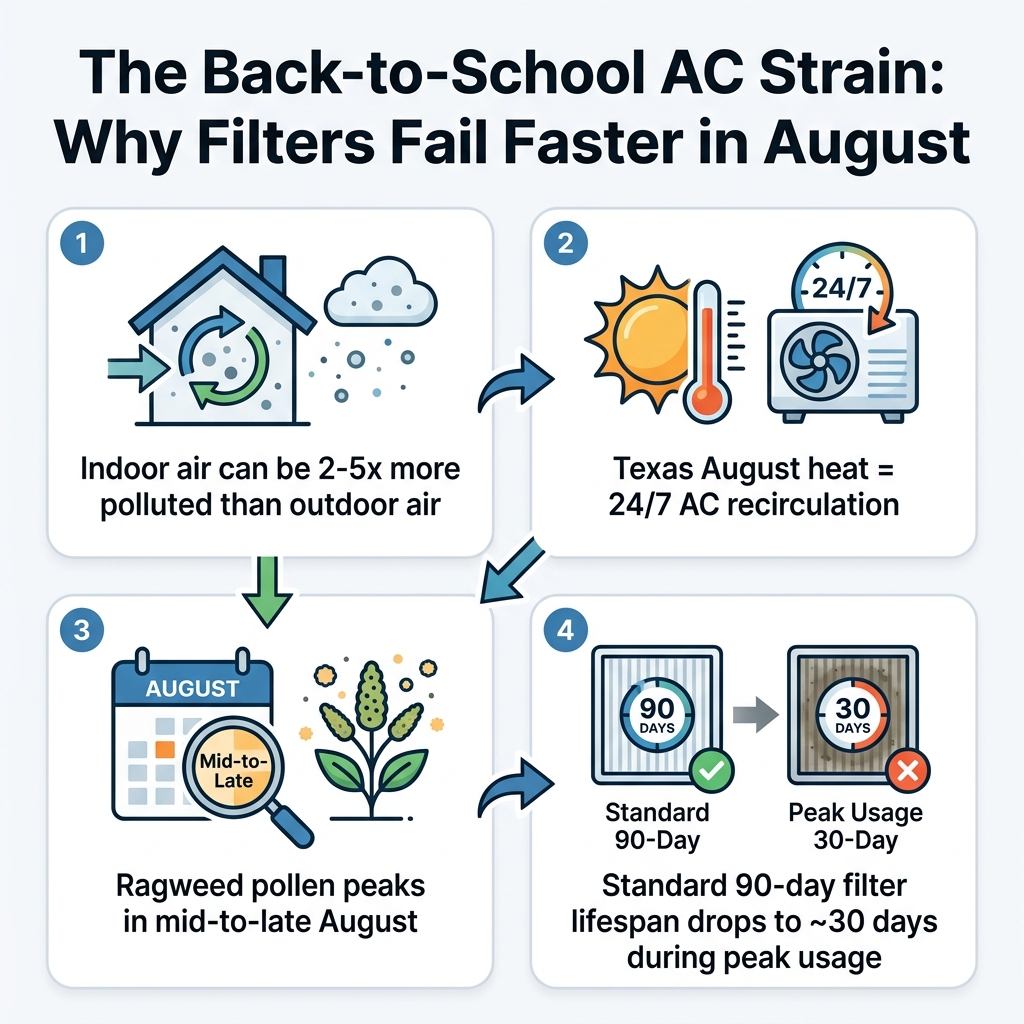
The dust coating your shelves in late August is rarely just dead skin cells and fabric fibers. The August back-to-school transition introduces a complex mix of outdoor and institutional pollutants into your private living space. According to the EPA, indoor air can actually be two to five times more polluted than outdoor air, and this concentration peaks when new contaminants are introduced to a tightly sealed, air-conditioned home.
Here are the primary contaminants hitching a ride into your home this season:
- Ragweed Pollen: Unlike spring tree pollen, ragweed typically begins its peak season in Texas in mid-to-late August. Its microscopic spores easily attach to hair and clothing, making the journey from the bus stop straight into your living room.
- Playground Dirt and Sand: Recess and outdoor athletic practices introduce fine particulate soil into the home. This ultra-fine dirt is easily kicked up into the air as kids run through the house, where the AC return vents immediately pull it into the ductwork.
- Classroom Allergens: Schools are high-density environments. Viruses, bacteria, and institutional dust settle on backpacks and jackets. When these items are dropped on the kitchen counter or living room floor, those particulates are released into your home’s air.
- Stirred-Up Pet Dander: While your pets may stay home, the sudden increase in afternoon foot traffic stirs up pet hair and dander that had previously settled into the carpets. The continuous AC operation then circulates this dander through every room.
These physical particulates don’t just create a mess; they interact with other indoor pollutants, including cleaning chemicals and off-gassing furniture. Understanding how VOCs impact indoor air quality alongside these physical allergens is critical for maintaining a truly healthy home environment during the late summer months.
Why the Standard 90-Day Filter Rule Fails in Late Summer
One of the most persistent myths in home maintenance is the “change your filter every 90 days” rule. While that generic advice is perfectly fine for a vacant guest house or a home in a mild, temperate climate, it completely fails during the August back-to-school transition in Texas.
The 90-day recommendation assumes average, moderate climate usage where the AC cycles on and off gently throughout the day. Maximum HVAC runtime during our peak heat heavily compresses a filter’s lifespan. Furthermore, the DFW metroplex frequently experiences late-summer ozone alert days. On these high-ozone days, families are forced to stay indoors with the windows tightly shut, further increasing the household’s reliance on the home’s HVAC filtration system to keep the air breathable.
When you combine 24/7 runtimes, ozone-alert confinement, and back-to-school dust, a standard filter can easily reach its maximum capacity in just three to four weeks. If you wait the full 90 days, you risk severe airflow restriction. You should watch for these critical warning signs of a clogged filter:
- Weaker airflow at the registers: If the air barely trickles out of your ceiling or floor vents, the filter is likely suffocating the blower.
- Longer cooling cycles: The system has to run significantly longer to satisfy the thermostat because it cannot move enough chilled air into the rooms.
- Excess dust on vent covers: When a filter is completely impacted, air pressure forces dust to bypass the filter frame, blowing directly out of your supply vents.
- Unusual whistling noises: A heavily clogged filter forces the system to pull air through tiny gaps in the return housing, creating a high-pitched whistling sound.
During this transitional month, we advise a temporary shift to bi-weekly filter checks. Pull the filter out and hold it up to a light source. If you cannot see light shining through the media, it is time for a monthly replacement, regardless of what the packaging says.
The MERV Rating Trap: Protecting Your AC from Suffocation
When homeowners notice an increase in indoor dust, their first instinct is often to drive to the hardware store and purchase the most expensive, thickest allergen filter on the shelf. This well-intentioned move often leads straight into the MERV rating trap.
MERV stands for Minimum Efficiency Reporting Value. It is a scale that rates how effectively a filter captures microscopic particles. While higher numbers mean better filtration, they also mean significantly higher air resistance. The fibers in a high-MERV filter are woven tightly together to catch tiny particles like smoke and viruses. However, if your HVAC system’s blower motor was not designed to push air through such a restrictive barrier, you can cause severe mechanical damage.
The danger of using overly thick, restrictive filters to combat back-to-school dust is twofold. First, it strains the blower motor, leading to premature failure and higher energy bills. Second, and more immediately dangerous, restricted airflow prevents enough warm house air from blowing over your indoor evaporator coil. Without that warm air, the refrigerant inside the coil drops below freezing, causing condensation to turn into a solid block of ice. A frozen coil stops cooling entirely and can lead to water damage when it eventually thaws.
As part of our commitment to honest advice, Washburn Air always warns homeowners against the equipment-damaging mistake of blindly buying the highest MERV filter available. Finding the balance between capturing back-to-school allergens and maintaining healthy system airflow is crucial.
| MERV Rating Range | Typical Uses & Capture Ability | Airflow Impact on Standard ACs |
|---|---|---|
| MERV 1 – 4 | Basic fiberglass filters; captures large dust, lint, and insects. | Very low restriction; excellent airflow, but poor air quality improvement. |
| MERV 5 – 8 | Pleated filters; captures mold spores, pet dander, and household dust. | Moderate; generally safe for most residential systems while providing good baseline protection. |
| MERV 9 – 12 | High-quality pleated; captures auto emissions, fine dust, and ragweed pollen. | High restriction; requires monitoring. May cause airflow issues in older or undersized ductwork. |
| MERV 13 – 16 | Hospital-grade; captures bacteria, smoke, and microscopic allergens. | Severe restriction; often requires specialized HVAC equipment or heavily modified ductwork to prevent system freezing. |
The smart approach: We recommend consulting a professional to determine the maximum MERV rating your specific system can handle safely. In many cases, a MERV 8 filter paired with a dedicated whole-home air purifier is a much safer, more effective strategy than forcing a MERV 13 filter into a standard return grille.
Your Late-Summer HVAC Checklist for Cleaner Air
Managing the August back-to-school transition requires a proactive approach. You cannot simply wait for the dust to settle; you have to actively manage the contaminants entering your home and ensure your cooling system has the support it needs. Following a structured checklist can help you maintain comfort, protect your equipment, and keep the air fresh.
- Establish a dedicated “drop zone”: Create a specific area near the entryway or in the mudroom for backpacks, shoes, and sports equipment. Having kids remove their shoes immediately upon entering prevents playground dirt and ragweed pollen from being tracked across carpets and pulled into the HVAC return vents.
- Inspect your HVAC filter immediately: If you haven’t checked your filter since early summer, do it today. Pull it out and inspect the pleats. If it is caked in gray dust or if you cannot see light through the media, replace it immediately with a clean filter of an appropriate MERV rating.
- Keep return air vents unblocked: Back-to-school season often means new furniture arrangements, stacked boxes of supplies, or temporary clutter. Walk through your home and ensure that no couches, rugs, or piles of gear are blocking your supply or return vents. Blocked vents starve the system of air, compounding the problems caused by a dirty filter.
- Schedule professional system care: Filters only catch what passes through them. Dust that bypasses a clogged filter settles on the blower motor and the sensitive evaporator coil. Professional AC maintenance is required to safely clean these internal components, ensuring they operate efficiently through the remainder of the cooling season.
Frequently Asked Questions About Late-Summer Air Quality
Why is my house suddenly so dusty in August?
Your house is suddenly dusty in August due to the combination of increased foot traffic and constant AC operation. When kids return to school, they bring in outside dirt, playground sand, and pollen daily. Because the Texas heat demands continuous air conditioning, your HVAC system acts like a vacuum, constantly recirculating these newly introduced contaminants throughout your home instead of letting them settle.
Does running the AC make the house dusty?
Running the AC itself does not create dust, but a neglected system will spread it. If your air filter is clogged, air pressure forces the existing household dust to bypass the filter frame and blow directly out of your vents. Continuous blower operation simply keeps the dust suspended in the air, making it more noticeable on your furniture and in the sunlight.
How often should I change my AC filter during Texas summers?
During the peak continuous operation of a Texas summer, you should check your filter every two weeks and expect to replace it every 30 days. The standard 90-day recommendation only applies to mild climates with minimal system runtime. When your AC runs around the clock, the filter processes vastly more air and loads up with debris much faster.
Can dirty air filters make my AC stop working?
Yes, a severely dirty air filter can absolutely cause your AC to stop working. When a filter becomes impacted with dust, it restricts the vital airflow needed to keep the indoor evaporator coil warm. Without sufficient warm air passing over it, the refrigerant causes the coil to freeze into a block of ice, which forces the system to shut down and stops the cooling process entirely.
What is the best way to reduce back-to-school allergens at home?
The best way to reduce back-to-school allergens is to combine behavioral habits with smart HVAC management. First, establish a strict drop zone at the front door to contain shoes and backpacks. Second, upgrade your filter cautiously, ensuring it captures pollen without restricting airflow. Finally, maintain continuous, clean airflow by scheduling a professional tune-up to clean the internal components that filters cannot protect.
Protect Your Home’s Air Through the Fall Transition
Managing the back-to-school dust surge is not a one-time chore; it requires both behavioral adjustments at the front door and smart, consistent HVAC care. As the seasons slowly begin to shift, your cooling system will still carry a heavy workload. Ensuring that it has a clean, properly rated filter is the first step in protecting your family’s indoor air quality and your equipment’s longevity.
However, a filter can only do so much. Professional oversight ensures that the internal components of your system—the blower motor, the evaporator coil, and the condensate drain—are free of the bypass dust that accumulates during the August back-to-school transition. A thoroughly cleaned system handles the seasonal shift smoothly, providing better humidity control, cleaner air, and lower energy bills. We encourage you to explore proactive options to keep your home’s air clean and your equipment safe by looking into professional HVAC maintenance plans. Staying ahead of the dust means you can breathe easier all season long.