Why Poor Attic Insulation Makes Your AC Run Nonstop in North Texas
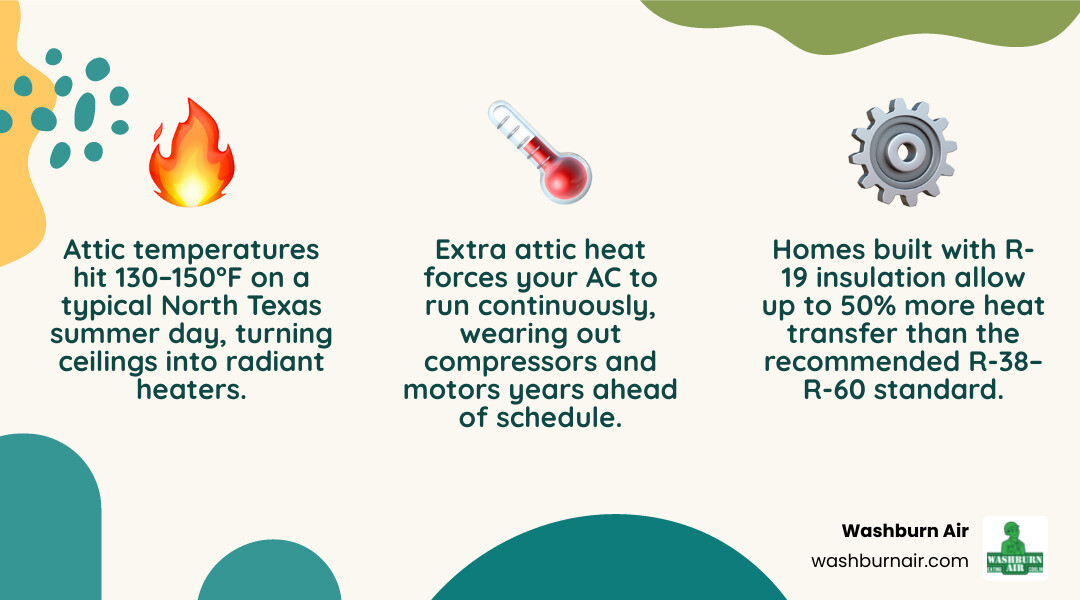
How poor attic insulation makes AC run constantly in a North Texas home comes down to one straightforward problem: when your attic turns into a 140°F oven every afternoon, that heat pushes straight through your ceiling into your living spaces — and your air conditioner never gets a break trying to fight it back.
Here’s the short answer:
- Extreme attic heat (130–150°F in North Texas summers) conducts through under-insulated ceilings into your home
- Your AC must remove both the heat your family generates and the heat pouring in from above
- The system runs longer because heat re-enters faster than the AC can remove it
- Older DFW homes (many built with only R-19 or R-22 insulation) are especially vulnerable, since those levels are well below the R-38 to R-60 recommended for this climate
- The result is a system that runs almost continuously, drives up energy bills, and wears out years ahead of schedule
For North Texas homeowners, this isn’t a minor inconvenience — it’s one of the most common and most overlooked reasons an otherwise functional AC system simply can’t keep up. Learn more about how the local climate compounds this challenge in our guide on How North Texas Heat and Humidity Affect Your AC System.
On a 103°F July afternoon in the DFW area, your attic isn’t just warm — it’s pushing temperatures that rival a commercial oven. And if the insulation between that space and your living room is thin, settled, or full of gaps, your ceiling becomes less of a barrier and more of a radiator. That’s the hidden reason so many homeowners assume their AC is failing when the real problem is sitting right above their heads.
How Poor Attic Insulation Makes AC Run Constantly in a North Texas Home

To understand how poor attic insulation makes AC run constantly in a North Texas home, we have to look at the attic as a giant thermal battery. During our brutal summer months, the sun beats down on dark roof shingles, raising the temperature of the roof deck to well over 150°F. Without a robust thermal barrier, this massive heat load has nowhere to go but down.
Your ceiling represents a large, continuous thermal plane. Unlike a single window or door, which only covers a small surface area, your ceiling spans the entire footprint of your home. If your insulation is thin, degraded, or unevenly distributed, heat continuously migrates through this plane.
When attic temperatures hover between 130°F and 150°F, the ceiling drywall itself can become warm to the touch. This turns your ceiling into a radiant heating panel. Your air conditioning system is designed to cycle on, cool the air to your thermostat’s set point, and cycle off. However, when heat is constantly radiating downward through the ceiling, your home warms up within minutes of the AC turning off. This forces the system to start up again immediately, leading to near-continuous operation. To make sure your system is physically prepared to handle these grueling run times, keeping up with regular maintenance is essential. You can prepare your system by reading about Get Ready for the Heat: The Importance of an AC Tune-Up.
The Science Behind How Poor Attic Insulation Makes AC Run Constantly in a North Texas Home
Heat transfer occurs in three ways: conduction, convection, and radiation. In a North Texas attic, all three are working against your comfort:
- Radiation: The sun heats your roof shingles, which radiate intense infrared heat downward into the attic space, heating up the air, the joists, and any ductwork located there.
- Convection: Air inside the attic heats up and expands. If the attic is poorly ventilated, this superheated air sits directly on top of your ceiling joists and drywall.
- Conduction: Heat moves directly from the hot attic air and joists through your ceiling materials and into your cooled rooms.
Insulation works by slowing down conduction. It traps tiny pockets of air, resisting the natural flow of heat. When insulation is inadequate, conduction happens rapidly. Your AC is forced into endless run cycles because it is fighting a losing battle against the laws of thermodynamics: heat will always move toward a cooler space.
Why Older DFW Homes Suffer from This Hidden Insulation Deficit
If you live in an older home in Grapevine, Irving, or Highland Park, your attic insulation may have been installed under outdated building codes. Many homes built in the 1980s, 1990s, or early 2000s were insulated to levels of R-19 or R-22. At the time, this was considered acceptable, but it is far below modern energy standards.
Over the years, insulation also suffers from settling. Loose-fill fiberglass and cellulose naturally lose fluffiness and density over time, which directly reduces their R-value. Additionally, pest activity, roof leaks, and past utility work can leave physical gaps or compressed areas in the insulation. If you can climb into your attic and easily spot the wooden ceiling joists, your insulation is too thin to protect your home from the North Texas summer.
The Impact of Inadequate Insulation on HVAC Performance and Longevity
When attic insulation fails to do its job, your HVAC system pays the ultimate price. Air conditioners are mechanical systems with moving parts that are subject to physical wear and tear. They are designed to handle seasonal heat, but they are not built to run 24 hours a day without a break. To learn more about what happens when these warning signs are ignored, check out The Impact of Neglecting AC Inspections and Repairs on Your System.
How Poor Attic Insulation Makes AC Run Constantly in a North Texas Home and Shortens Equipment Lifespan
An air conditioner that runs constantly experiences accelerated wear on its most critical (and expensive) components:
- The Compressor: Located in the outdoor unit, the compressor is the heart of your AC. Continuous operation causes it to run hot, breaking down the lubricating oil inside and leading to mechanical failure.
- The Blower Motor: The indoor fan motor must run constantly to circulate air. Overworking this motor leads to electrical failure or burnt-out bearings.
- The Condenser Fan Motor: Like the compressor, the outdoor fan motor operates under high-stress, high-heat conditions for hours on end, shortening its lifespan.
Additionally, when your AC is forced to run nonstop, it struggles to manage indoor humidity. In North Texas, high humidity levels make the air feel warmer than it actually is. When your system is constantly running but failing to lower the temperature, it cannot cycle long enough at a stable rate to properly dehumidify the home, leaving you with a sticky, uncomfortable indoor environment. Keeping up with routine AC Maintenance is one of the best ways to protect your equipment from these extreme workloads.
Can Upgrading Insulation Reduce the Need for a Larger HVAC System?
When homeowners find that their AC runs constantly and struggles to keep the house cool, their first instinct is often to assume they need a larger air conditioner. However, installing a larger system without fixing your insulation is a major mistake.
Your home’s heating and cooling load is determined by how much heat enters and leaves the building envelope. Upgrading your attic insulation directly lowers this load. By keeping the heat out, your existing AC system can easily maintain your target temperature without running constantly. In fact, if you upgrade your insulation before replacing an aging AC, you may find that your home now requires a smaller, less expensive unit than before. Properly sizing your equipment to a well-insulated home ensures maximum efficiency and comfort. If you want to make sure your current system is operating at peak efficiency before making these decisions, scheduling HVAC Tune-Ups is a highly effective first step.
Restoring Attic Efficiency: Insulation, Air Sealing, and Ventilation
Achieving a comfortable, energy-efficient home in the DFW area requires a three-pronged approach in the attic: quality insulation, comprehensive air sealing, and proper ventilation. Relying on insulation alone is like wearing a warm wool sweater on a windy day without a windbreaker—the air will still blow right through it. To ensure your home’s thermal boundary is completely secure, it helps to work with a professional team offering Reliable HVAC Maintenance Services in Dallas.
Recommended R-Values and Insulation Types for North Texas Attics
For the North Texas climate zone, the U.S. Department of Energy recommends insulating attics to an R-value of R-38 to R-60. The “R” stands for thermal resistance; the higher the R-value, the better the material resists heat flow.
To achieve an R-38 to R-60 rating, you generally need about 12 to 18 inches of insulation, depending on the material used:
- Blown-In Fiberglass: Excellent for filling tight spaces, corners, and gaps around attic joists. It does not settle as much as other materials and maintains its R-value well over time.
- Blown-In Cellulose: Made from recycled paper treated with fire retardants. It is denser than fiberglass and offers excellent thermal performance, though it can settle slightly over the years.
- Fiberglass Batts: Pre-cut blankets of insulation. While common, they are difficult to install perfectly in attics with lots of wiring, plumbing, and irregular joist spacing. Any gaps between batts allow thermal bridging, where heat bypasses the insulation entirely.
Recognizing the Warning Signs of Weak Attic Insulation
How do you know if your attic is the reason your AC is working overtime? Look for these classic warning signs in your home:
- Warm Ceilings: Walk around your home on a hot afternoon and gently touch your ceilings. If they feel warm to the touch, heat is actively conducting through your attic.
- The “Hot Second Floor” Syndrome: If you have a two-story home in Southlake or Arlington, and the upstairs feels like a completely different climate zone than the downstairs, poor attic insulation is almost always to blame.
- Rapid Warming: If your home warms up by several degrees within 10 to 15 minutes of the AC cycling off, your home is failing to retain its cooled air.
- Spiking Energy Bills: If you notice your electricity bills climbing significantly compared to the same month in previous years, your AC is running much longer to achieve the same results. You can easily estimate how much you could be saving with a well-maintained, efficient setup by reading about How to Estimate AC Tune-Up Savings in DFW.
To help you determine whether your comfort struggles are caused by poor insulation or an actual mechanical issue with your air conditioner, refer to the comparison table below:
| Symptom | Likely Insulation Issue | Likely Mechanical AC Failure |
|---|---|---|
| Ceiling Temperature | Ceilings feel warm or hot to the touch on sunny afternoons. | Ceilings remain cool or at room temperature. |
| Airflow Temperature | Air blowing from vents is ice-cold, but rooms warm up quickly. | Air blowing from vents feels lukewarm or weak. |
| Room-to-Room Balance | Rooms directly under the attic (or upstairs) are significantly hotter. | All rooms feel warm, regardless of their location. |
| Thermostat Accuracy | Thermostat eventually reaches set point but AC turns back on immediately. | Thermostat never reaches the set point, even on milder days. |
| System Behavior | AC runs long, steady cycles to combat continuous radiant heat. | AC short-cycles (turns on and off every few minutes) or won’t start. |
Frequently Asked Questions About Attic Insulation and AC Performance
How do I know if my attic insulation is hurting my HVAC performance?
The easiest way to check is a simple visual inspection. Grab a flashlight, open your attic hatch, and look inside. If the insulation is level with or below your wooden floor joists, you do not have enough insulation. You should also look for uneven coverage, bare spots, or areas where the insulation has been compressed by storage boxes. If your home has drafty attic access doors, hot and cold spots in different rooms, or an AC that runs continuously on 95-degree days, your insulation is likely underperforming.
Should I upgrade my attic insulation before replacing my HVAC system?
Yes, in almost every scenario, upgrading your insulation and performing air sealing should come first. Improving your home’s thermal envelope reduces the overall cooling load. If you replace your HVAC system first, you may end up purchasing a larger, more expensive unit than your home actually needs once it is properly insulated. A well-insulated home keeps your HVAC system running efficiently and extends its lifespan.
Why does my house stay warm at night even when it cools down outside?
This is a common and highly counterintuitive issue. When you upgrade your attic to high insulation levels (such as R-60), the insulation does an incredible job of keeping daytime heat out. However, it also prevents heat from escaping. Your home generates internal heat from cooking, appliances, electronics, lighting, and human bodies.
In an under-insulated home, this heat passively escapes through the roof at night. Once you add heavy insulation, that escape route is closed. If you leave your windows closed, that internal heat gets trapped inside, forcing your AC to run even when outdoor temperatures drop into the low 70s. To manage this, homeowners can use strategic ventilation, whole-house fans, or run their AC on a mild nighttime setting to handle internal heat loads.
Conclusion
When your air conditioner runs nonstop during a North Texas summer, the culprit is often hiding right above your head. Inadequate attic insulation turns your ceiling into a giant radiator, forcing your cooling system to work twice as hard to maintain comfortable indoor temperatures. By upgrading your insulation to modern standards and sealing hidden air leaks, you can protect your HVAC equipment, lower your monthly energy bills, and restore true comfort to your home.
At Washburn Air, we are proud to serve homeowners across the Dallas-Fort Worth area, including Grapevine, Fort Worth, Arlington, Irving, Southlake, Westlake, Trophy Club, and Highland Park. We provide comprehensive heating, cooling, and indoor air quality services designed to keep your home comfortable year-round.
Protect your HVAC investment and keep your system running smoothly with our customized HVAC Maintenance Plans. Ready to stop your AC from running nonstop? Schedule professional AC repair and attic evaluation with Washburn Air today, and let our local experts restore efficiency to your home.
{“@context”: “https://schema.org”, “@graph”: [{“@type”: “Article”, “headline”: “Poor Attic Insulation Makes AC Run Nonstop | Washburn Air”, “description”: “Learn how poor attic insulation makes AC run constantly in North Texas homes, raises bills, and strains your system. Call Washburn Air.”, “author”: {“@type”: “Person”, “name”: “Washburn Air”}, “publisher”: {“@type”: “Organization”, “name”: “Washburn Air”, “logo”: {“@type”: “ImageObject”, “url”: “https://washburnair.com/wp-content/uploads/2024/09/washburn-air-logo-800-400×261.png”}}, “datePublished”: “2026-07-22T02:32:53+00:00”, “dateModified”: “2026-07-22T02:33:06.440650”, “mainEntityOfPage”: {“@type”: “WebPage”, “@id”: “https://washburnair.com/blog/beginner-mistakes-causing-constant-ac-running/”}, “image”: “https://images.pexels.com/photos/1628417/pexels-photo-1628417.jpeg?auto=compress&cs=tinysrgb&h=650&w=940”}, {“@type”: “FAQPage”, “mainEntity”: [{“@type”: “Question”, “name”: “Why does poor attic insulation make my AC run constantly in North Texas?”, “acceptedAnswer”: {“@type”: “Answer”, “text”: “Poor attic insulation allows extreme attic heat, often 130–150°F in North Texas summers, to conduct through the ceiling into living spaces. The AC has to keep removing heat that is constantly re-entering from above, so it runs much longer and may seem nonstop.”}}, {“@type”: “Question”, “name”: “How hot does an attic get in North Texas during summer?”, “acceptedAnswer”: {“@type”: “Answer”, “text”: “On very hot North Texas summer afternoons, attic temperatures can reach about 130–150°F. The article notes that roof decking can rise to well over 150°F when the sun beats down on dark shingles.”}}, {“@type”: “Question”, “name”: “What attic insulation level is recommended for North Texas homes?”, “acceptedAnswer”: {“@type”: “Answer”, “text”: “The article states that many older DFW homes were built with only R-19 or R-22 insulation, which is below the recommended R-38 to R-60 range for the North Texas climate. Homes with lower insulation levels are more vulnerable to attic heat entering the living space.”}}, {“@type”: “Question”, “name”: “Can poor attic insulation make it seem like my AC is failing?”, “acceptedAnswer”: {“@type”: “Answer”, “text”: “Yes. When insulation is thin, settled, degraded, or full of gaps, the ceiling can act more like a radiator than a barrier, allowing heat to pour into the home and making an otherwise functional AC seem unable to keep up.”}}, {“@type”: “Question”, “name”: “What problems can constant AC operation from poor attic insulation cause?”, “acceptedAnswer”: {“@type”: “Answer”, “text”: “Constant AC operation caused by attic heat can drive up energy bills and make the system wear out years ahead of schedule. It also leaves the AC struggling to keep indoor spaces comfortable during extreme North Texas heat.”}}]}]}