The Costly Illusion of Shutting Vents to Save Energy
Closing off a guest bedroom or formal dining room doesn’t save energy—and if you want to know why closing vents in unused rooms actually damages your blower motor, the answer comes down to basic physics. It is a common misconception that blocking airflow to an empty space will force more cold air into the rooms you actually use, ultimately lowering your utility bills. On the surface, this homeowner assumption seems perfectly logical. If nobody is sleeping in the spare bedroom, why pay to cool it? It is a question our Washburn Air technicians hear almost every week during the intense Texas summer.
This creates a critical decision point for many homeowners, especially when utility bills start to climb. You have to decide whether to shut vents in an attempt to reduce cooling costs, or leave them open to protect your system’s internal mechanics. The harsh reality is that modern central air conditioning systems do not work like a water hose. When you close a register, you are not redirecting air; you are choking the system’s delicate return and supply balance.
Doing this during Peak July summer heat in Grapevine accelerates wear and tear on your equipment right when it is already working at maximum capacity. When the Texas sun is beating down on your roof, your air conditioner needs every cubic foot of airflow it can get to cool your home efficiently. By shutting down vents, you inadvertently force your system to work harder, consume more electricity, and push critical components toward premature failure. If your system is struggling to keep up with the heat, the solution isn’t to close vents, but rather to explore professional HVAC services to address the root cause of the inefficiency. Before you block off another room, it is always best to contact our HVAC technicians to evaluate your home’s unique airflow needs.
The ‘Pinched Straw’ Effect: Understanding Static Pressure Physics
To understand why a closed vent is so dangerous to your air conditioner, you first need to understand a concept called static pressure. In residential HVAC systems, static pressure is simply the resistance to airflow within the ductwork. Your duct system is a closed loop, and the equipment is designed to push against a very specific, calculated amount of resistance.
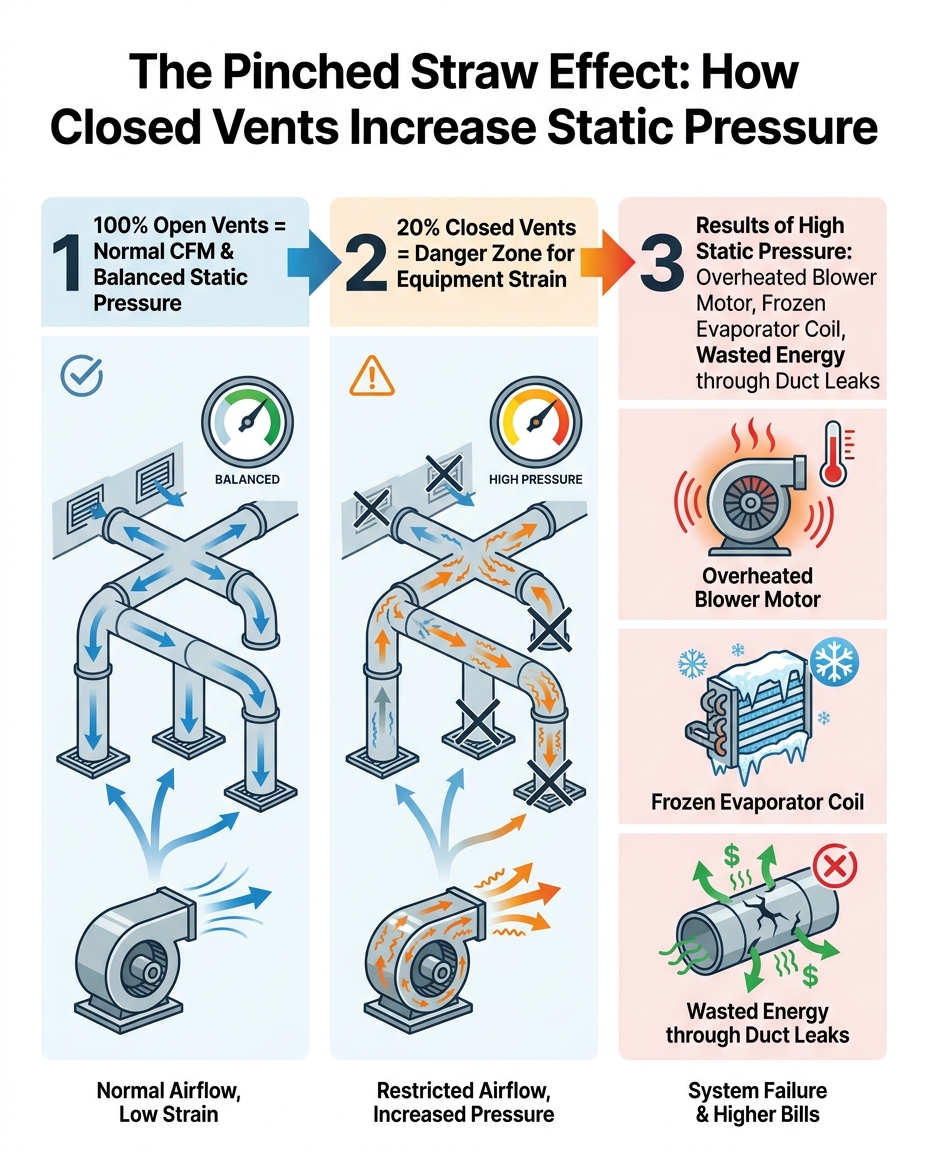
The quick fix to understanding this: When our team performs static pressure tests in Grapevine homes, we often use a simple analogy. Think of your HVAC system like drinking a thick milkshake through a straw. Under normal conditions, you can draw the liquid up smoothly. But if you pinch the middle of the straw, you have to suck much harder to get the same amount of liquid, and the sides of the straw might even collapse. This is exactly what happens when you close vents. You are pinching the straw, creating High static pressure that forces the system to push air against a blocked path.
Modern central air systems are meticulously balanced for a specific cubic feet per minute (CFM) of airflow. This CFM rating is based on your home’s total square footage, layout, and thermal load. Closing vents doesn’t communicate with your air conditioner and tell it to produce less air. The blower motor continues to generate the exact same volume of conditioned air, but now that air is trapped in a smaller, restricted space, causing pressure to skyrocket inside the ducts.
How HVAC Systems Balance Supply and Return Air
Your home’s heating and cooling system operates on a closed-loop principle. The amount of air drawn in through the return grilles must precisely equal the amount of air pushed out through the supply registers. It is a continuous cycle of breathing in warm air and breathing out cold air.
- The Return Side: Pulls warm, humid air from your living spaces into the ductwork and across the air filter.
- The Supply Side: Pushes the newly cooled, dehumidified air back into your rooms through the vents.
- The Balance: The blower motor sits between these two sides, acting as the heart that keeps the circulation moving smoothly.
When you close a supply vent in a bedroom, you disrupt this balance. You artificially shrink the home’s thermal footprint. The system was engineered to heat and cool a 2,500-square-foot house, but by closing off several rooms, you are forcing it to operate as if it is cooling a 1,800-square-foot house. The equipment cannot automatically resize itself to match this new, smaller footprint, which completely confuses the system’s engineered design and leads to severe mechanical strain.
What Happens to Your Blower Motor Under Strain
The blower motor is the hardest-working component inside your indoor air handler or furnace. It is responsible for circulating every cubic foot of conditioned air throughout your home. When you introduce High static pressure by closing vents, the blower motor bears the immediate brunt of the damage.
Different types of motors react to this strain in different, yet equally destructive, ways. Older HVAC systems typically use PSC (Permanent Split Capacitor) motors. When a PSC motor pushes against closed vents, the resistance causes the motor to slow down. As it slows, it struggles to move air, runs longer, and rapidly overheats. Newer, high-efficiency systems use ECM (Electronically Commutated Motors). An ECM is a “smart” motor designed to maintain a constant airflow. When it senses the resistance of closed vents, it automatically ramps up its RPMs, spinning faster and consuming significantly more electricity as it desperately tries to overcome the blockage. Ultimately, it works itself to death.
In our years of diagnosing AC failures across Grapevine, our technicians at Washburn Air frequently see the aftermath of this exact scenario. Our dedication to honest, preventative education means we want to explain the mechanical ‘why’ behind these failures, saving you from self-inflicted breakdowns. Blower motor replacement is a complex, professional-level repair that requires electrical troubleshooting, precise recalibration, and specialized tools. It is not a weekend DIY project, and it is a situation homeowners should actively avoid by simply leaving their vents open. If you are already noticing uneven temperatures, it might be related to duct design rather than vent position, which is why 90s homes in Grapevine struggle with upstairs cooling even when the system is running perfectly.
The Danger of Overheating During Continuous Cycles
Blower motors generate a significant amount of heat while operating. To keep from burning up, they rely entirely on the continuous flow of cool return air passing over their metal housings to regulate their own temperature. Restricting airflow effectively eliminates this built-in self-cooling mechanism.
Because the motor is working exponentially harder against the resistance of closed vents, it generates excess internal heat. During long cooling cycles, this compounding heat has nowhere to go. Prolonged operation without adequate airflow leads to melted internal wiring, blown run capacitors, or complete motor burnout. Once the motor windings melt, the entire component is ruined and must be replaced by a licensed professional.
Beyond the Motor: Frozen Coils and Compressor Damage
While the blower motor takes a direct hit from restricted airflow, the secondary damage to your system can be even more catastrophic. The problem doesn’t just stop at the blower; it fundamentally disrupts the thermodynamics happening at the indoor evaporator coil.
The evaporator coil is the A-shaped component inside your ductwork that actually removes heat from your home. It gets incredibly cold as refrigerant cycles through it. For the coil to function properly, it requires a constant, high volume of warm return air blowing over it. This warm air transfers its heat to the cold refrigerant, preventing the coil from dropping below freezing. When you close vents and restrict airflow, you prevent enough warm air from reaching the coil.
Without sufficient warm air to absorb the intense cooling energy, the natural condensation forming on the outside of the coil begins to freeze solid. It is a harsh irony that an air conditioning system can literally freeze over into a solid block of ice during the most extreme Peak July summer heat in Texas—a scenario our service team responds to time and time again—simply due to blocked airflow.
| Component | Normal Airflow (Vents Open) | Restricted Airflow (Vents Closed) |
|---|---|---|
| Blower Motor | Cools itself with passing air; uses normal electricity. | Overheats, draws excessive amps, risks premature burnout. |
| Evaporator Coil | Absorbs heat efficiently; condensation drips into pan. | Lacks warm air to absorb cooling; freezes into a block of ice. |
| Ductwork | Maintains balanced static pressure; minimal air leakage. | Spikes in pressure; forces cold air out of duct seams into the attic. |
| Compressor (Outdoor) | Receives refrigerant as a warm gas, as designed. | Receives liquid refrigerant (slugging), risking total failure. |
Once a block of ice forms on the coil, it physically blocks whatever airflow was left, creating a vicious cycle of system strain. Worse, because the refrigerant didn’t absorb enough heat to turn fully into a gas, liquid refrigerant can flow backward through the copper lines into the outdoor compressor. This is a condition known as “slugging.” Compressors are designed to pump gas, not liquid. Slugging liquid refrigerant into a compressor is like pouring water into a car’s engine cylinders—it causes immediate, catastrophic, and permanent failure of the outdoor unit.
The 20 Percent Rule: How Many Vents Can You Safely Close?
Homeowners often ask if there is a safe threshold for closing vents. The short answer is that you should aim to keep all vents open, but industry data provides a stark warning about just how little restriction it takes to cause damage.
When our Washburn Air technicians perform airflow diagnostics on local homes, we often find that closing even 20% of a home’s supply registers is enough to push static pressure into the danger zone, a fact backed by building science organizations like Lawrence Berkeley National Laboratory (LBNL). To put that into perspective, a typical single-family home might have 10 to 15 supply vents in total. Closing off just two or three rooms completely disrupts the engineered airflow balance and creates High static pressure.
- 10 Total Vents: Closing 2 vents equals a 20% restriction (Danger Zone).
- 15 Total Vents: Closing 3 vents equals a 20% restriction (Danger Zone).
- 20 Total Vents: Closing 4 vents equals a 20% restriction (Danger Zone).
Beyond equipment damage, this pressure spike has a severe impact on your ductwork. Residential duct systems are rarely 100% airtight. They are assembled in sections and sealed at the seams. When pressure builds up inside the ducts because vents are closed, that trapped conditioned air looks for the path of least resistance. The increased pressure forces your expensive, newly cooled air out of minor leaks in the duct seams and directly into your sweltering 130-degree attic or crawlspace. Instead of saving energy, you are actively paying to air condition the outside of your house.
If you absolutely must reduce airflow to a specific room—perhaps it gets uncomfortably cold compared to the rest of the house—advise keeping the vent at least partially open. Adjusting the louvers so they are 75% open allows the room to receive less direct air without creating a hard blockage that spikes system pressure.
Safer Alternatives for Improving Cooling Efficiency
If your original goal was to save energy and lower your utility bills during Peak July summer heat, shutting vents is not the answer. However, there are several highly effective, safe alternatives that improve cooling efficiency without putting your expensive HVAC equipment at risk.
- Upgrade to a Multi-Zone HVAC System: If you frequently have unused rooms, the best solution is a zoned system. Professional zoning uses a specialized control panel, multiple thermostats, and smart bypass dampers inside the ductwork. Unlike simply shutting a vent, a zoned system is designed to safely handle pressure changes and redistribute air without straining the blower motor.
- Utilize Ceiling Fans in Occupied Rooms: Instead of trying to force cold air into specific rooms by blocking others, use ceiling fans in the rooms you are actively using. Fans create a wind-chill effect on your skin, making the room feel up to four degrees cooler. This allows you to set your main thermostat a few degrees higher, saving significant energy without altering static pressure.
- Maintain Rigorous Filter Changes: A severely clogged air filter mimics the exact same static pressure problems as closed vents. It chokes the return airflow, starving the blower motor and risking a frozen coil. Check your filter monthly during the summer and replace it the moment it looks visibly dirty.
- Install Thermal Curtains or Window Tinting: If a guest room gets too much direct sunlight and heats up the rest of the house, stop the heat at the source. Adding blackout thermal curtains or UV-blocking window tinting prevents solar heat gain. The room stays naturally cooler, which means your HVAC system doesn’t have to work as hard to maintain the temperature, all while keeping your vents safely open.
Additionally, keeping up with seasonal maintenance ensures your system is running at peak efficiency. While we cannot quote specific incentive amounts, many local utility programs and federal tax credits may apply to qualifying high-efficiency equipment upgrades or smart thermostat installations. It is always worth checking with your utility provider to see what energy-saving programs are currently active in your area.
Frequently Asked Questions About Airflow and Vents
Does closing vents save money on AC?
No, closing vents does not save money on your air conditioning bills. It actually increases High static pressure inside your ductwork, forcing the blower motor to work harder and consume more electricity. Additionally, the excess pressure often forces cold air out of duct leaks into your attic, wasting the energy you just paid for.
Can closing vents cause AC to freeze up or break?
Yes, restricting airflow is one of the leading causes of frozen evaporator coils. When vents are closed, there isn’t enough warm return air blowing over the indoor coil to absorb the cooling energy. The condensation on the coil freezes into a block of ice, which can eventually lead to catastrophic compressor failure.
What happens to the blower motor when vents are closed?
The blower motor experiences severe mechanical strain due to the blocked airflow. Older motors will slow down and overheat, while newer variable-speed motors will ramp up to dangerously high speeds trying to overcome the resistance. Without adequate airflow to cool the motor’s internal components, it will eventually burn out.
How do I know if my HVAC system has high static pressure?
Common symptoms of high static pressure include a system that runs constantly but struggles to cool the home, unusually loud airflow noise at the return grilles, hot and cold spots throughout the house, and frequent blower motor failures. A licensed technician can measure your exact static pressure using specialized diagnostic tools.
Is it safe to close doors to unused rooms if the vents are open?
Closing interior doors can still disrupt airflow if the room does not have its own dedicated return vent. When a door is closed, the supply air pumped into that room has no easy path back to the main return grille, causing the room to pressurize. It is generally best to leave interior doors open or slightly ajar to promote balanced air circulation.
Protect Your HVAC System from Premature Wear
Our team at Washburn Air always tells our customers: the simplest rule of thumb for maximizing the lifespan of your air conditioner is to let it breathe. Leaving interior doors and vents open is the easiest, most effective way to protect your system’s mechanical components from unnecessary strain. During Peak July summer heat, your equipment needs unrestricted airflow to keep the blower motor cool, prevent the evaporator coil from freezing, and ensure your home cools evenly.
Proper airflow is the foundation of a healthy, efficient HVAC system. When you allow the air to circulate as it was engineered to do, you reduce your energy consumption and help your equipment reach its full expected lifespan. If you are struggling with stubborn hot and cold spots, or if you suspect your ductwork is improperly sized, do not resort to blocking off vents. Instead, reach out to a professional for a comprehensive airflow evaluation to solve the problem safely and permanently.