Why Your Summer Remodel Smells Stronger Than Expected
Your throat feels scratchy, your eyes are watering, and a distinct, sharp chemical odor is lingering in your living room. You just finished a major renovation project or brought in a brand-new sectional sofa, but instead of enjoying the fresh space, you are dealing with a frustrating headache. This is a common scenario when you uncover the hidden link between high indoor humidity and VOC off-gassing in summer. Those fresh interior paints, new engineered hardwood floors, and plush upholstery materials are releasing volatile organic compounds (VOCs) directly into your breathing air.
During a peak July Texas summer, this problem becomes incredibly difficult to manage. You face a tough decision: how do you clear that heavy, polluted air without opening the windows and letting in the oppressive outdoor heat? Trying to ventilate naturally seems like the obvious choice, but introducing that thick, humid air often makes the indoor environment far worse. Managing this issue requires a deep understanding of how your HVAC system’s moisture control directly impacts chemical emission rates inside your home. It is not just about keeping the temperature down; it is about controlling the unseen atmospheric conditions that dictate how fast those materials release gases into your living space.
Understanding the Chemical Reaction in Your Living Room
To solve the odor problem, you first need to understand exactly what is happening on a microscopic level. Volatile organic compounds are carbon-based chemicals that easily evaporate at room temperature. They are heavily present in common household sources, including fresh interior paints, new carpets, engineered wood products, cabinetry adhesives, and the foam inside modern upholstery.
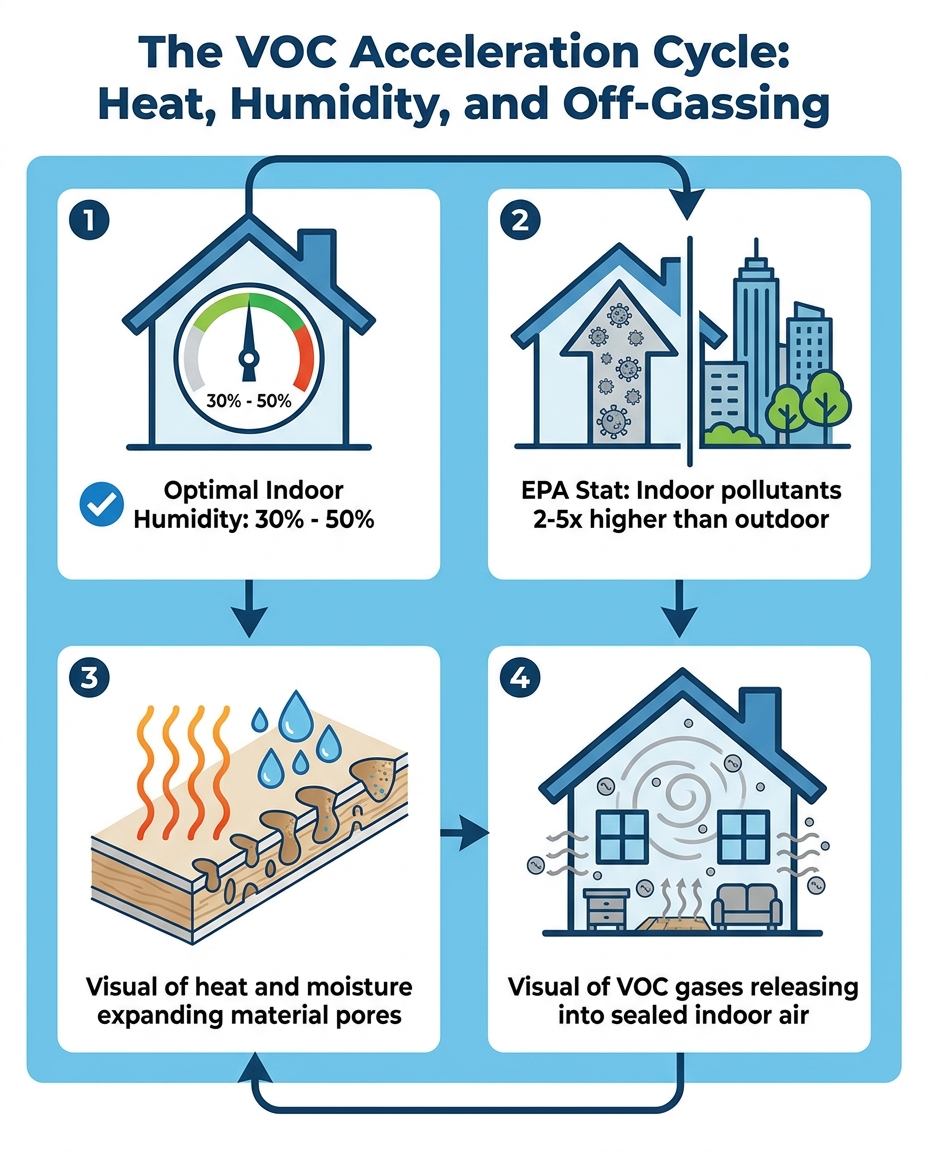
According to data from the Environmental Protection Agency (EPA), indoor pollutant levels can frequently be two to five times higher than outdoor levels. This concentration spikes dramatically in tightly sealed, air-conditioned Grapevine TX area homes. Because modern homes are built to be highly energy-efficient, they trap that conditioned air inside—but they also trap the chemical emissions.
The core chemical reaction: Elevated indoor humidity and heat act as powerful catalysts, expanding material pores and accelerating the release of trapped VOC gases into the air. When the air is thick with moisture, it interacts with the chemical solvents in your new furniture or flooring, causing them to vaporize much faster than they would in a dry environment.
| Common Household Material | Typical VOCs Emitted | Impact of High Summer Humidity |
|---|---|---|
| Fresh Interior Paint | Benzene, Toluene | Moisture prevents proper curing, extending the emission timeline. |
| Engineered Hardwood & Carpets | Formaldehyde | Pores expand in heat, releasing trapped adhesive gases rapidly. |
| New Upholstered Furniture | Flame Retardants, Polyurethane | Foam absorbs ambient moisture, pushing chemical vapors outward. |
While off-gassing is a natural process that happens year-round, the emission rate increases exponentially with temperature and moisture. A new rug that might take six months to fully off-gas in a cool, dry winter can release a massive concentration of chemicals in just a few weeks during a humid summer. This chemical reaction turns your comfortable living room into an active emission zone.
The Danger of Opening Windows During Extreme Heat
When faced with a strong chemical smell, the standard advice is almost always to “open the windows and ventilate.” On a mild spring day, flushing the house with fresh air is an excellent strategy. However, this method completely fails during a peak July Texas summer when the outdoor dew points are exceedingly high.
The dew point measures the absolute amount of moisture in the air. When you open your windows during extreme summer heat, you are not just letting in warm air; you are inviting gallons of atmospheric water vapor into your home. Bringing unconditioned, moisture-heavy outside air into your living space drastically spikes your indoor relative humidity.
The humidity trap: As that thick outdoor air enters your home, it saturates your walls, your new furniture, and your fresh paint. Because we know that moisture acts as a catalyst for chemical emissions, this influx of humidity actually accelerates the VOC off-gassing process rather than resolving it. You might temporarily dilute the smell while the wind blows through, but the moment you close the windows and turn the AC back on, the off-gassing rate will be higher than before. The materials have absorbed the outdoor moisture, and the chemical reaction speeds up. Natural ventilation during extreme heat ruins your indoor humidity levels and ultimately makes your air quality worse.
How Your AC Acts as a First Line of Defense Against Pollutants
If opening the windows is off the table, you must rely on your home’s mechanical systems to clean the air. Most homeowners view their air conditioner strictly as a temperature control device. In reality, your AC is a critical dehumidification tool and your first line of defense against indoor pollutants.
ASHRAE (the American Society of Heating, Refrigerating and Air-Conditioning Engineers) guidelines strongly recommend keeping indoor relative humidity between 30% and 50%. Maintaining this specific range is essential to minimize pollutant impact, prevent mold growth, and maximize human comfort. In Grapevine TX area homes, hitting that target during the summer requires active, continuous dehumidification.
Your air conditioner performs two distinct jobs: sensible cooling (lowering the temperature you can read on a thermometer) and latent cooling (removing the invisible water vapor from the air). When dealing with VOCs, the latent cooling capacity is actually the more important function.
The mechanics of moisture removal: When warm, humid indoor air is pulled through your return vents, it passes over the freezing cold evaporator coils inside your HVAC unit. As the air touches these cold coils, the moisture in the air condenses into liquid water—just like water droplets forming on the outside of a cold glass of iced tea. This liquid water drips into a drain pan and is channeled safely out of your house. By constantly extracting moisture from the air, your cooling coils indirectly slow down the VOC emission rate. Lowering the humidity shrinks the pores of your building materials and reduces the vaporization of chemical solvents. This process bridges the gap between standard temperature control and active chemical off-gassing mitigation.
The Threat of Short-Cycling to Air Quality
Your air conditioner can only extract moisture if it runs long enough to process the air. This brings us to the severe threat of short-cycling. Short-cycling occurs when an AC unit turns on and off too quickly to complete a full cooling and dehumidification cycle.
When a system short-cycles, the air blowing out of the vents might feel temporarily cool, but the moisture remains trapped in the house. The evaporator coil never gets cold enough, for long enough, to extract a meaningful amount of water vapor. This leaves the indoor environment heavily saturated and ripe for accelerated off-gassing. During a peak July Texas summer, a short-cycling system will completely fail to protect your indoor air quality.
Several factors cause short-cycling, including improper airflow, clogged air filters, or having an oversized AC unit that cools the space too rapidly. This lack of moisture removal leaves distant rooms particularly vulnerable. In fact, understanding airflow and moisture distribution is a big part of why older Grapevine homes struggle with upstairs cooling. The upstairs rooms trap the heat and humidity, creating a localized greenhouse effect that speeds up chemical emissions from upstairs carpets or bedroom furniture. Emphasizing long, consistent cooling cycles is critical for proper moisture extraction.
Signs Your System Isn’t Removing Enough Moisture
You can usually feel when your HVAC system is struggling to dehumidify the space. Watch for these distinct warning signs that your indoor air quality is at risk:
- Clammy feeling in the air: The room feels damp, heavy, and sticky despite low thermostat settings.
- Condensation on windows: Moisture building up on the inside of the glass, often accompanied by musty odors mixing with the chemical smells.
- Frequent, brief bursts of air conditioning: The unit kicks on for five minutes, shuts off, and turns right back on a few minutes later, rather than operating in sustained, efficient cycles.
- Lingering odors: Cooking smells, pet odors, and chemical off-gassing hang in the air for hours instead of dissipating.
Actionable Steps to Safely Clear Chemical Odors Without Compromising Comfort
You do not have to suffer through the headaches and irritation of a freshly remodeled home. By managing your indoor environment mechanically, you can neutralize VOCs safely. Here are the most effective, HVAC-focused solutions to manage humidity and filter your air without relying on natural ventilation.
- Keep windows and doors tightly sealed: The first rule of summer indoor air quality in Grapevine TX area homes is to lock out external humidity. Keep the building envelope closed so your air conditioner can establish a controlled, dry environment.
- Utilize air purifiers equipped with activated carbon filters: Standard fiberglass air filters will not stop chemical gases. You need activated carbon (or charcoal) filters, which are specifically designed to trap and absorb VOC gases at the molecular level. Running a standalone heavy-duty carbon air purifier in the room with the new furniture will drastically reduce odors.
- Ensure the HVAC fan is set to ‘Auto’ rather than ‘On’: Check your thermostat settings. If the fan is set to “On,” it will continue blowing air over the wet evaporator coil even after the cooling cycle finishes. This blows the moisture right back into the house. Setting it to “Auto” ensures the fan only runs when the system is actively cooling and dehumidifying.
- Monitor your air with a digital hygrometer: You cannot manage what you do not measure. Place an inexpensive digital hygrometer in the room with the new furniture to track the exact relative humidity percentage. Aim to keep it below 50%.
- Consider whole-home dehumidification systems: If your AC alone cannot maintain the 30% to 50% relative humidity target, a dedicated whole-home dehumidifier is the ultimate solution. These systems tie directly into your existing ductwork and pull gallons of water out of the air independently of the cooling cycle. Local expertise in balancing IAQ with extreme cooling loads is vital here; a professional can show you how to manage indoor air quality without overworking your primary AC unit.
Frequently Asked Questions About Summer Humidity and Air Quality
Does high humidity make VOCs worse?
Yes, high humidity significantly accelerates the release of VOCs from household materials. The airborne moisture interacts with the chemical solvents in paints, glues, and foams, causing them to vaporize much faster than they would in dry conditions. Keeping your indoor humidity low is the absolute best way to slow down this chemical off-gassing process and protect your air quality.
How do you get rid of VOCs in a hot house?
The most effective method is to use your air conditioning to aggressively dehumidify the space while running air purifiers equipped with activated carbon filters. Do not open the windows if it is hot and humid outside, as the unconditioned air will only speed up the chemical emissions. Keeping the house cool, dry, and actively filtered will neutralize the odors safely without ruining your comfort.
Can air conditioning help with VOCs?
Air conditioning helps indirectly by extracting the moisture that VOCs need to rapidly off-gas into your living space. As the cooling coils pull humidity out of the indoor air, the building materials dry out and their pores shrink, which dramatically slows down the emission rate. An AC running long, consistent cycles is a powerful tool for stabilizing indoor air quality during the summer.
How long does it take for VOCs to off-gas in summer?
The timeline varies heavily based on the material, but peak July Texas summer conditions can force the bulk of off-gassing to occur within a few weeks if the home is poorly conditioned. In a tightly climate-controlled environment, the process is slower but much safer for your daily breathing air. Most strong odors will dissipate within a month if the indoor humidity remains consistently below 50%.
Why do new floors smell stronger on humid days?
New engineered floors and laminates contain heavy adhesives that react strongly to moisture in the air. On humid days, the moisture penetrates the microscopic seams of the flooring, expanding the material slightly and pushing the trapped chemical gases out into the room. Lowering the humidity immediately reduces this expansion effect and traps the odors.
Are carbon filters necessary for summer air quality?
If you have recently remodeled or bought new furniture, carbon filters are absolutely necessary. Standard pleated HVAC filters are designed to catch physical particles like dust and pollen, but they cannot stop microscopic chemical gases from passing through. Activated carbon is required to chemically bind and remove VOC odors from your living space.
Take Control of Your Indoor Air Quality This Summer
Managing the air you breathe requires more than just lowering the thermostat. As you can see, neutralizing VOCs and chemical odors means controlling indoor moisture just as aggressively as you control the temperature. If you recently updated your Grapevine TX area home, make it a habit to monitor your indoor humidity levels closely after bringing in those new materials.
Do not let a beautiful summer remodel turn into a source of daily irritation and headaches. By utilizing your HVAC system’s dehumidification power and keeping the harsh outdoor climate at bay, you can enjoy a fresh, clean, and safe living space. If chemical odors, sticky air, or high humidity persist despite your best efforts, it is time to explore professional indoor air quality solutions to restore the comfort and health of your home.