When Your Reliable May Cooling Meets a Brutal Texas July
With the arrival of July peak summer, you might be wondering exactly how 100-degree days in Tarrant County change your AC’s refrigerant pressures and why your home suddenly feels so warm. In our years serving Grapevine and the surrounding communities, our technicians at Washburn Air see this exact scenario play out every summer. Just a few weeks ago, your air conditioner likely cycled on and off with ease, keeping your living space perfectly chilled. But as the rapid onset of severe heatwaves typical to our region takes hold, that same reliable system might now be running non-stop, struggling to drop the thermostat below 76 degrees.
The sudden shift: This jarring transition from mild spring weather to extreme summer heat creates a frustrating dilemma for homeowners. You find yourself listening to the unit run continuously and wondering if a critical component has failed, or if the system is simply losing a battle against physics. When the outdoor temperature crosses into triple digits, the physical properties of the gases inside your air conditioner begin to change.
Before you panic and assume your system requires a major overhaul, it helps to understand what is happening behind the scenes. The extreme weather places immense physical stress on your home’s infrastructure. By learning how thermal load affects your equipment, you can make an informed decision about whether your system is genuinely broken or just temporarily overwhelmed by the relentless Texas sun.
The Science of Heat Rejection in Residential Air Conditioning
To understand why your system behaves differently in peak summer, we first need to shift how we think about cooling. Air conditioners do not actually “make” cold air. Instead, they act as heat transfer machines, aggressively moving thermal energy from inside your home to the outside environment.
This process relies on a continuous refrigerant loop. Inside your home, the evaporator coil acts as a sponge, absorbing the heat and humidity from your indoor air. Once that heat is captured, the refrigerant travels outside to the compressor. The compressor’s job is to heavily pressurize the gas, raising its temperature significantly so that it can successfully release that stored indoor heat through the outdoor condenser.
The Importance of Temperature Differentials
The entire refrigeration cycle depends on a basic law of physics: heat naturally flows from warmer areas to cooler areas. For your outdoor unit to successfully dump the heat it pulled from your living room, the pressurized refrigerant inside the condenser coils must be hotter than the outside air.
Why this matters: If the outside air is 85 degrees, the system easily creates a temperature differential, allowing heat to dissipate quickly into the yard. But when you introduce a 100-degree ambient temperature into the equation, the outside air is no longer “cool” compared to the refrigerant. The system must work significantly harder to force that heat transfer to occur, changing the fundamental operating pressures of the entire unit.
Why 100-Degree Ambient Temperatures Spike Refrigerant Head Pressures
The core problem: As outside air temperatures soar, the refrigerant inside your outdoor condenser naturally expands. This physical expansion, combined with the shrinking temperature differential between the hot refrigerant and the blazing 100-degree ambient temperature outside, causes the system’s internal head pressure to spike dramatically.
The underlying cause: Residential heating and cooling systems are engineered using ACCA Manual J standards. According to these national design guidelines, most standard air conditioners are sized and built to operate efficiently up to a 95-degree maximum outdoor temperature. When the Texas heat pushes past that threshold, the system crosses its maximum design limit. Prolonged streaks of triple-digit heat create a massive, cumulative thermal load on your home’s structure. Your attic bakes, your walls absorb solar radiation, and your AC is forced to operate at maximum pressure for extended periods just to keep up.
The solution: At Washburn Air, our team understands exactly how regional climate extremes push standard systems past their generic design limits. Having serviced thousands of systems across Tarrant County, we know that high head pressure is often a natural physical reaction to extreme heat—not necessarily a mechanical defect. Recognizing this can save you a lot of worry. The key is ensuring your system has maximum airflow to help it cope with these elevated pressures.
The Limits of Standard System Design
When a system operates at its absolute maximum design limit, it inevitably loses efficiency. The compressor strains against the high head pressure, drawing more electricity and working longer cycles. This is why a system that easily maintained 70 degrees in May might only be able to hold 76 degrees during a July peak summer heatwave. The equipment is doing exactly what it was designed to do, but the thermal load of the house is replacing the heat just as fast as the AC can remove it.
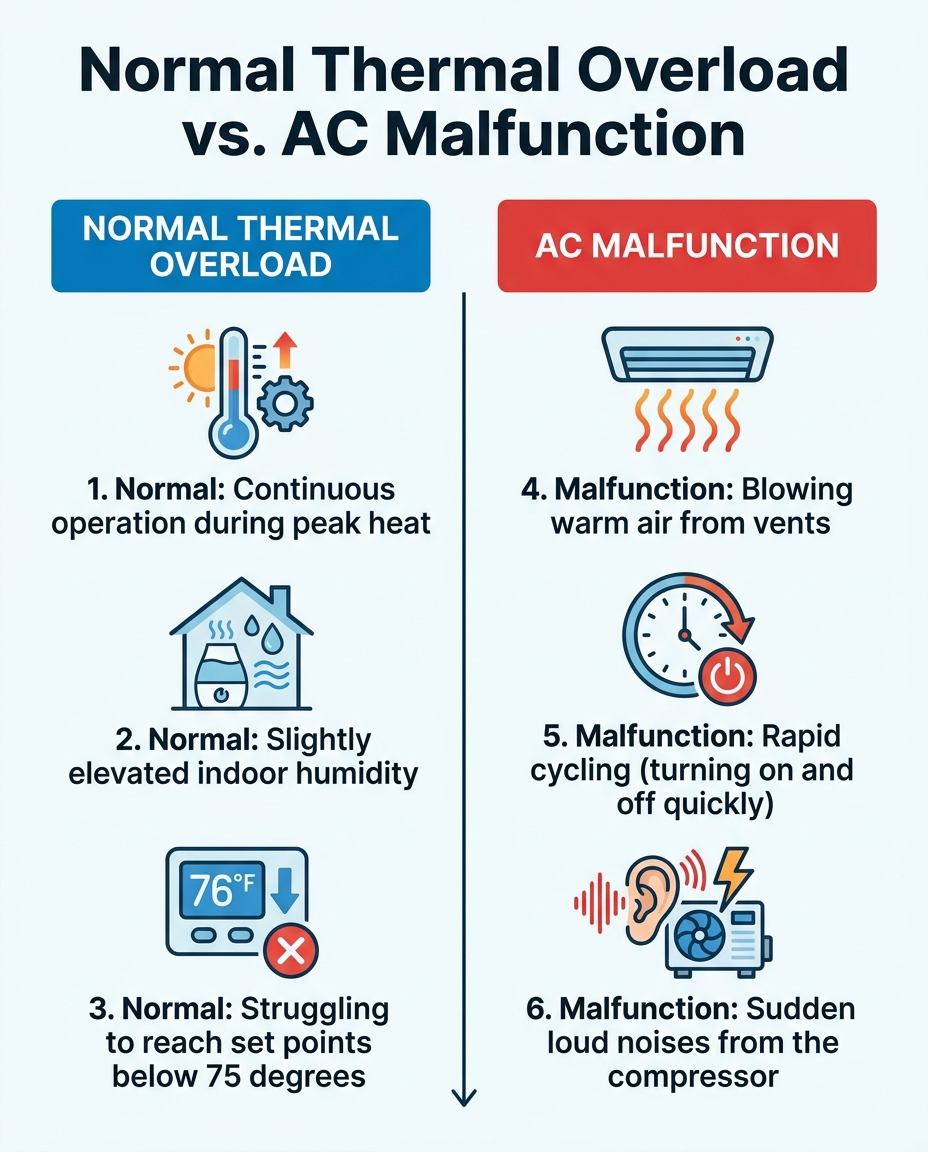
Grapevine’s Climate Extremes: Normal Overload vs. Actual Malfunction
Living in Grapevine TX / Tarrant County means accepting that your air conditioner will be pushed to the brink every summer. However, it is deeply important to distinguish between a system that is operating normally under extreme stress and one that is actively malfunctioning and requires professional repair.
A pattern we see often during our July service calls is that extreme heat exacerbates any underlying structural issues in your home. Poor insulation, leaky ductwork, or inadequate attic ventilation will make the system work even harder, often making it feel like the AC is failing when the real culprit is thermal heat gain. If you often struggle with upstairs cooling during July heatwaves, you are likely experiencing the effects of cumulative thermal load rather than a broken compressor.
| System Behavior | Diagnosis | What It Means for Your Home |
|---|---|---|
| Running continuously during the afternoon | Normal Overload | The system is working at peak capacity to match the extreme heat gain from the sun. |
| Struggling to reach set points below 75°F | Normal Overload | Standard systems cannot overcome a 25+ degree temperature differential during peak heat. |
| Slightly elevated indoor humidity | Normal Overload | The coil is overwhelmed by heat and cannot extract moisture as efficiently. |
| Blowing actively warm air from vents | Actual Malfunction | The compressor may have tripped on high pressure, or the system lacks refrigerant. |
| Rapid cycling (turning on and off quickly) | Actual Malfunction | A safety switch is triggering to protect the equipment from catastrophic failure. |
| Sudden loud noises from the outdoor unit | Actual Malfunction | The compressor is mechanically failing under the strain of high head pressures. |
When to Monitor and When to Call
Before assuming you have a catastrophic refrigerant failure, check the basics. A dirty air filter restricts airflow, which severely compounds the stress of high head pressures.
- Check your thermostat setting: Keep it at a reasonable temperature (76-78°F) during the hottest part of the day.
- Inspect your air filter: Replace it immediately if it is visibly gray or clogged with dust.
- Feel the vent air: If the air is cool (even if the house isn’t cooling down fast enough), the refrigerant cycle is working. If it is blowing warm air, turn the system off and call for help.
The Paradox of Summer Heat: Why Your AC Might Freeze Up
One of the most confusing sights for a homeowner during a July peak summer heatwave is finding a thick layer of solid ice covering their indoor AC coil or the copper lines outside. The technicians at Washburn Air routinely field frantic calls about this exact issue. It seems entirely counterintuitive: how can an air conditioner freeze solid when it is boiling hot outside?
The answer lies in the relationship between extreme heat, constant operation, and airflow. When the thermal load on your house is massive, your thermostat tells the AC to run constantly. Because the system never shuts off, the indoor evaporator coil is continuously chilling. It relies on a steady, strong flow of warm indoor air blowing across it to keep its temperature above freezing.
The freezing trigger: If there is even a minor airflow restriction—such as a slightly dirty filter, closed vents in unused bedrooms, or a failing blower motor—there isn’t enough warm air moving over the coil to counteract the constant chilling effect. The coil’s temperature drops below 32 degrees, and the natural condensation it pulls from the air instantly freezes. While low refrigerant can certainly cause a system to freeze, in peak summer, it is very often a combination of heavy thermal load forcing non-stop operation and poor airflow.
The Dangers of DIY Refrigerant Diagnostics
When an air conditioner struggles, some homeowners are tempted to buy a set of manifold gauges online to check their own refrigerant levels. As licensed HVAC professionals, we strongly warn against attempting to measure or adjust refrigerant pressures yourself.
Regulatory and safety risks: Refrigerant handling is strictly regulated by the EPA and requires professional licensing. Releasing these chemicals into the atmosphere is illegal and environmentally harmful. Beyond the legalities, there are severe physical dangers associated with interacting with highly pressurized systems. When a 100-degree ambient temperature has already spiked the internal head pressures of your system, connecting gauges improperly can result in dangerous blowbacks that cause severe frostbite or chemical burns.
The risk of catastrophic failure: Attaching gauges without proper training can easily introduce outside air or moisture into the sealed refrigerant loop. Even a tiny amount of non-condensable air in the system will cause head pressures to skyrocket further, often leading to catastrophic compressor failure. Furthermore, pressure readings are highly dynamic. A specific pressure reading is completely meaningless unless you know how to calculate it against the current ambient temperature, indoor wet-bulb temperature, and the specific subcooling or superheat requirements of that exact model.
Frequently Asked Questions About Texas Summer AC Performance
Does outside temperature affect AC refrigerant pressure?
Yes, outside temperature has a direct and significant impact on refrigerant pressure. As the ambient temperature rises, the refrigerant inside the condenser expands, causing the head pressure to increase naturally. A system operating on a 100-degree day will register much higher pressures than the exact same system operating on an 80-degree day.
Why is my AC freezing up when it’s 100 degrees outside?
Your AC freezes in extreme heat because it is running non-stop, which continuously chills the indoor coil. If airflow is restricted by a dirty filter or closed vents, there isn’t enough warm air passing over the coil to keep it above freezing. The condensation on the coil turns to ice, eventually blocking all airflow.
What happens to AC pressure when it is hot outside?
When it is hot outside, the pressure inside the AC’s high side (the condenser) spikes. The compressor has to work much harder to squeeze the refrigerant hot enough to reject heat into an already hot environment. This elevated pressure forces the system to consume more electricity and increases mechanical wear and tear.
How do I know if my AC is broken or just struggling with the heat?
If your AC is running constantly and blowing cool air but struggling to reach 72 degrees, it is likely just fighting the extreme heat load. However, if the system is blowing actively warm air, making loud grinding noises, or rapidly turning on and off every few minutes, it is exhibiting clear signs of a mechanical breakdown, and we recommend calling for professional service.
Should I turn my AC off if it’s running constantly in the summer?
No, you should not turn it off unless it is blowing warm air or frozen solid. Continuous operation is normal and expected during extreme heatwaves in Grapevine TX / Tarrant County. Turning it off will allow the house to absorb massive amounts of heat, and the system will have to work even harder to recover once you turn it back on.
Getting Professional Help for Your Tarrant County Home
While the laws of physics explain why your system is straining under the brutal summer sun, professional diagnostics are the only safe and accurate way to confirm your equipment’s true health. If you have checked your filters and verified that your vents are open, but your system is still exhibiting signs of an actual malfunction, it is time to call in our local experts at Washburn Air.
Understanding how 100-degree days in Tarrant County change your AC’s refrigerant pressures gives you the knowledge to monitor your system confidently. If you suspect your unit has crossed the line from normal thermal overload into a genuine mechanical failure, schedule a professional inspection with our team. A licensed technician can safely assess the dynamic pressures, ensuring your home returns to a comfortable, reliable state without risking damage to the compressor.