Why North Texas Heat and Humidity Are So Hard on Your AC System
How North Texas heat and humidity affect your air conditioning system is one of the most pressing concerns for DFW homeowners — and for good reason. Summers here push AC equipment harder than almost anywhere else in the country, with temperatures regularly topping 100°F for weeks at a time and outdoor dew points climbing into the mid-70s from May through October.
Here is a quick summary of the key ways North Texas climate impacts your AC:
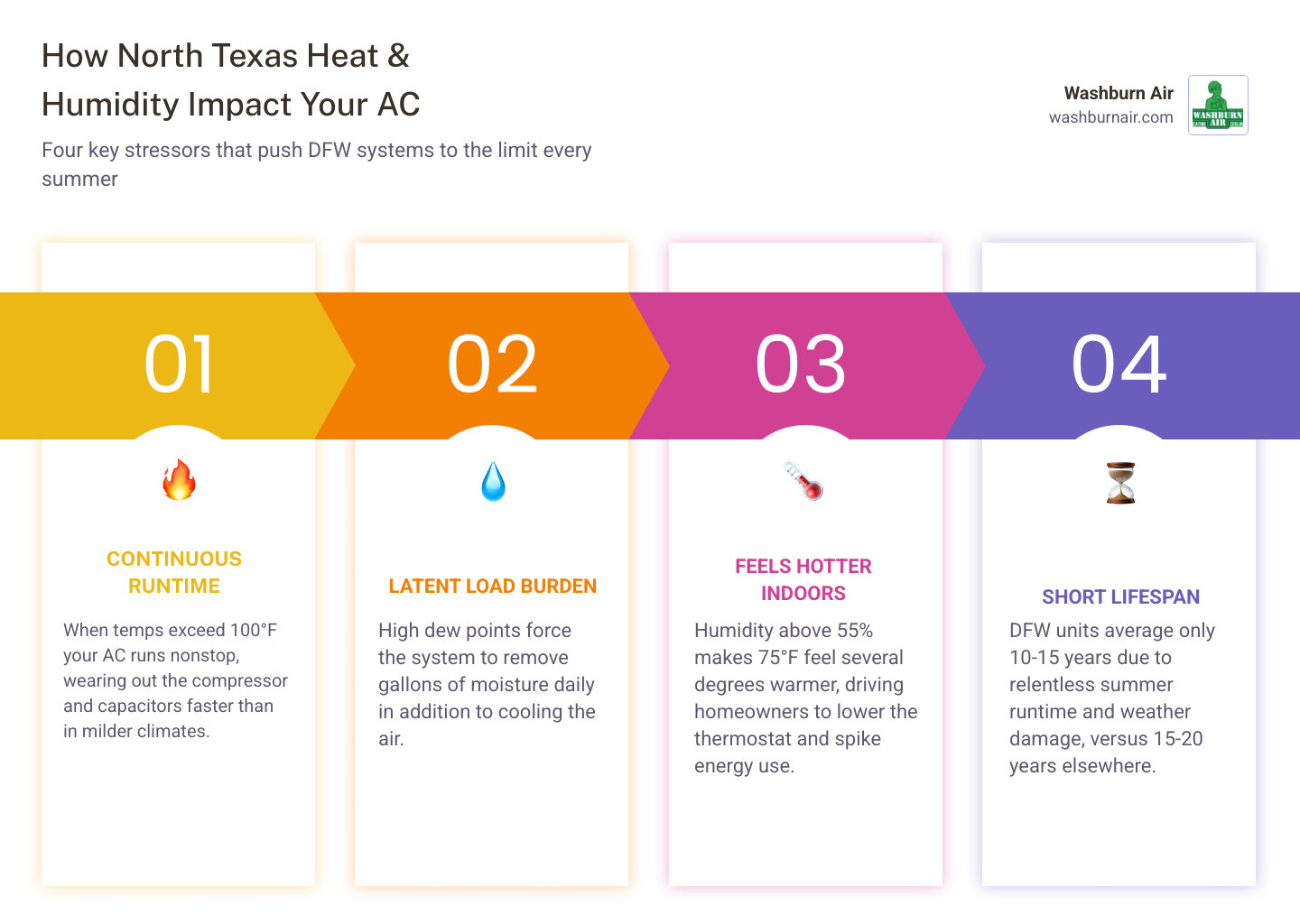
- Extreme heat forces continuous operation — When outdoor temps exceed 100°F, your AC runs almost nonstop, accelerating wear on the compressor, capacitors, and other components.
- High humidity adds a second workload — Your AC must remove moisture from the air (called the latent load) on top of simply cooling it down, which strains the system further.
- Homes feel warmer than the thermostat reads — Indoor humidity above 55% makes the air feel several degrees warmer, causing many homeowners to crank the thermostat down and drive up energy use.
- Short cycling in shoulder seasons — In spring and fall, moderate temps cause the AC to cycle too briefly to remove meaningful moisture, leaving homes feeling clammy.
- Component lifespan is shorter — DFW air conditioners typically last 10 to 15 years, compared to 15 to 20 years in milder climates, largely due to the relentless runtime demands of Texas summers.
- Severe weather adds physical damage risk — Hailstorms, dust storms, and lightning strikes all threaten outdoor equipment and can cause sudden failures.
North Texas does not just test your AC — it systematically wears it down season after season. Understanding why this happens is the first step toward protecting your home, your comfort, and your equipment investment.
The Thermodynamic Reality: How North Texas Heat and Humidity Affect Your Air Conditioning System
To truly understand what your air conditioner goes through during a typical June, July, or August in the DFW metroplex, we have to look at the science of cooling. An air conditioner is not actually a “cold air creator.” Instead, it is a heat transporter. It absorbs heat from inside your home and rejects it outdoors.
However, this heat transfer process relies heavily on the laws of thermodynamics. The greater the temperature difference between the indoor air and the outdoor air, the harder the system has to work to dump that heat outside. When outdoor temperatures soar past 100°F in communities like Arlington, Irving, and Fort Worth, the air outside is already saturated with thermal energy. This makes it incredibly difficult for your outdoor condenser unit to release the heat it carried from your living room.
On top of this temperature barrier, your AC must manage two distinct types of heat loads:
- Sensible Heat: This is the heat you can measure with a standard thermometer. It is the actual temperature of the air.
- Latent Heat: This is the hidden heat stored in water vapor. High humidity represents a massive latent load. Before your AC can lower the sensible temperature of your home, it must first condense and remove this moisture from the air.
This dual battle against temperature and moisture creates massive thermal stress on your entire system. To learn more about how local weather dynamics influence this process, check out our guide on Understanding HVAC Dallas Fort Worth Summer.
The 20-Degree Rule and Continuous Operation
Many homeowners in Southlake and Grapevine get frustrated when their thermostat is set to 71°F, but the indoor temperature refuses to budge below 75°F on a blistering 102°F afternoon. This is not necessarily a sign of a broken system; rather, it is a reflection of the “20-degree rule.”
Standard air conditioning systems are engineered to create a maximum temperature differential of about 15 to 20 degrees between the outdoor air and the indoor air. If it is 100°F outside, your system is running at peak capacity just to keep your home at 80°F. When you demand a 30-degree difference, your AC will run continuously without a break to bridge that gap.
This continuous runtime places immense strain on your compressor—the heart of your cooling system. While standard systems in moderate climates might run for 1,000 to 1,400 hours per year, a typical DFW system operates for upwards of 2,200 hours annually. This relentless operation can cause critical parts like fan motors and capacitors to overheat and fail when you need them most. For tips on managing your settings during these peak periods, read about What AC Temperature in Summer is best for balancing comfort and efficiency.
The Latent Load Battle: How North Texas Heat and Humidity Affect Your Air Conditioning System Performance
Humidity is the invisible force that turns a hot day into an oppressive one. In North Texas, our humidity is driven by warm, moist air traveling up from the Gulf of Mexico, compounded by local factors like our numerous regional reservoirs and extensive suburban irrigation.
As warm, humid air is pulled across your indoor evaporator coil, the cold surface of the coil causes the moisture in the air to condense into liquid water—much like condensation forming on a cold glass of sweet tea on a July afternoon. This water collects in the drain pan and exits your home through the condensate line.
Under steady operation, a standard 2-ton air conditioning system can remove approximately 6 pounds (nearly a gallon) of water from your indoor air every single hour. However, if the outdoor dew points are in the 70s, the moisture load can easily overwhelm a system that is not operating at peak efficiency. If your coils are dirty or your refrigerant charge is even 10% low, your system’s ability to tackle this latent load drops dramatically, leaving your indoor air feeling thick and muggy.
The Sticky Truth: Why High Humidity Makes Your Home Feel Warmer
Have you ever wondered why 75°F feels perfectly crisp on a dry day, but sticky and suffocating when it is humid? The answer lies in how the human body cools itself.
Our bodies rely on sweat evaporation to reject heat. When the surrounding air is dry, sweat evaporates quickly, cooling our skin. But when indoor relative humidity rises above 55%, the air is already crowded with water vapor, and evaporation slows down. This raises your personal “heat index,” making you feel 3 to 5 degrees warmer than the actual thermostat reading.
To cope, many DFW homeowners lower their thermostats to 70°F or even lower. While this might make you feel cooler, it forces your AC to run longer, skyrocketing your utility bills and accelerating system wear. Managing moisture is the key to true comfort and efficiency. You can explore more about managing your home’s air environment by visiting our page on Indoor Air Quality.
The Impact of High Humidity on Indoor Air Quality
When indoor humidity levels consistently linger above 60%, your home becomes a breeding ground for biological contaminants. Mold and mildew can begin growing in your ductwork, on drywall, and around your AC registers in as little as 24 to 48 hours under the right conditions.
Furthermore, dust mites thrive in environments where relative humidity stays above 50%. If you or your family members suffer from seasonal allergies or asthma, elevated indoor humidity can trigger frequent flare-ups, respiratory discomfort, and musty odors that make your home feel less than clean. To combat these issues, check out our practical tips on How to Improve Indoor Air Quality.
How North Texas Heat and Humidity Affect Your Air Conditioning System Lifespan
In the HVAC industry, we often talk about the “dog year” effect on Texas air conditioners. Because of the extreme multi-seasonal stress of 100°F+ summers, rapid temperature swings, and high humidity, DFW air conditioners age much faster than systems in other parts of the country.
While a system in a milder northern state might easily last 15 to 20 years, a system in Dallas, Fort Worth, or Grapevine typically has a functional lifespan of just 10 to 15 years. The constant thermal expansion and contraction, combined with high electrical demand during afternoon peaks, leads to accelerated component fatigue. Neglecting minor issues under these conditions can lead to catastrophic system failure. Learn more about the dangers of skipping service by reading The Impact of Neglecting AC Inspections and Repairs on Your System.
Common HVAC Problems Triggered by North Texas Weather Extremes
The combination of intense heat and thick humidity acts like a magnifying glass for any underlying weakness in your cooling system. Several common issues tend to crop up repeatedly during our hottest seasons. To learn how to spot and handle these issues early, review our guide on Common AC Issues and How to Troubleshoot Them Effectively.
Clogged Condensate Drains and Water Leaks
Because your AC acts as a massive dehumidifier, it produces gallons of water daily. This water flows through a narrow PVC condensate drain line. Over time, the warm, dark, and damp environment inside this drain line becomes the perfect environment for algae, slime, and mold to grow.
If this biological buildup clogs the line, the water has nowhere to go but backward. It will overflow the drain pan, which can lead to severe water damage to your ceilings, drywall, and flooring. If you notice water pooling around your indoor unit, you need to act quickly. Read our troubleshooting guide on Why Your AC Is Leaking Water: How to Fix It to understand the steps to resolve this common headache.
Outdoor Unit Failures and Electrical Issues
Your outdoor condenser unit is exposed to the elements 24/7. During a heatwave, the air temperature surrounding the unit can easily exceed 110°F, especially if it is located on the west side of your home or surrounded by dense landscaping.
Under these extreme temperatures, the electrical components inside the outdoor unit are pushed to their limits:
- Capacitor Failure: Capacitors store electrical energy and help start the compressor and fan motors. Extreme heat is the number-one killer of capacitors, causing them to swell and lose their charge.
- Compressor Overheating: If the outdoor coils are coated in dirt, pollen, or lawn debris, the compressor cannot shed heat. It will eventually trip its internal thermal overload switch and shut down to prevent permanent damage.
If your system is struggling to stay on or shutting off unexpectedly, you can read more about Why Your Outdoor AC Unit Keeps Shutting Off. If the problem persists, it is time to schedule a professional AC Repair to restore reliable cooling.
System Sizing and Dehumidification Solutions
When it comes to managing both heat and humidity in North Texas, the type of air conditioning system you have makes a massive difference.
| System Type | Temperature Control | Humidity Control | Efficiency under Peak Load | Best Suited For |
|---|---|---|---|---|
| Single-Stage AC | Good (but runs on/off at 100% capacity) | Poor (often short-cycles in shoulder seasons) | Standard | Budget-conscious installations, smaller homes |
| Variable-Speed AC | Excellent (adjusts capacity in 1% increments) | Outstanding (runs longer at lower speeds to pull out moisture) | Very High | DFW homes seeking maximum comfort and lower energy bills |
| Whole-Home Dehumidifier | None (relies on AC for cooling) | Perfect (precisely controls humidity independently) | High (reduces workload on AC) | Homes with persistent dampness, crawlspaces, or dust allergies |
One of the most common mistakes in North Texas is installing an oversized air conditioner. Many people assume that “bigger is better” when it comes to cooling. However, an oversized system will quickly cool your home to the target temperature and shut off before it has completed a long enough cycle to remove moisture. This is called “short cycling.” It leaves your home feeling cold but clammy, like a cave.
To avoid this, we perform precise Manual J load calculations to ensure your system is sized perfectly for your home’s unique layout, insulation, and window orientation. If you are trying to decide whether your current unit is worth saving or if it is time for an upgrade, explore our resource on Should I Repair or Replace My AC in North Texas?.
When to Consider a Whole-Home Dehumidifier
While a variable-speed AC is fantastic at moisture removal, there are times when your cooling system simply cannot manage the humidity on its own. This is especially true during our “shoulder seasons”—those weeks in spring and fall when the outdoor temperature is a pleasant 72°F, but the humidity is at 80%. Because your AC does not need to run to cool the house, the indoor air becomes incredibly muggy.
A whole-home dehumidifier integrates directly with your existing ductwork. It monitors indoor air quality and pulls moisture out of the air independently of your air conditioner. This allows you to maintain a perfect 45% to 50% relative humidity year-round, enabling you to set your thermostat 3 to 5 degrees higher in the summer without any loss of comfort.
Proactive Maintenance Strategies for Texas Summers
You would not drive your car on a road trip across the desert without checking the oil and coolant first. Similarly, you should not expect your AC to survive a North Texas summer without proper preparation.
Here are the most critical maintenance tasks to protect your system from the heat:
- Replace Filters Monthly: A dirty filter restricts airflow, forcing your system to work harder and reducing its ability to dehumidify. During peak summer, check your filters every 30 days.
- Clean the Outdoor Coils: Dust, grass clippings, and cottonwood seeds clog the delicate fins of your outdoor condenser, trapping heat inside. Gently spray the coils with a garden hose to keep them clear.
- Clear the Condensate Drain: Pour a cup of vinegar down your condensate drain line every few months to discourage algae growth and prevent costly clogs.
- Maintain Clearance: Keep shrubs, weeds, and outdoor storage at least two to three feet away from your outdoor unit to ensure proper airflow.
By taking these simple steps, you can prevent minor issues from turning into major breakdowns. To get your system fully prepared for the brutal summer months, read our guide on Get Ready for the Heat: The Importance of an AC Tune-Up.
The Role of Regular Tune-Ups
While DIY maintenance is incredibly helpful, there are some things only a trained professional can do. A comprehensive professional inspection includes checking refrigerant levels, measuring electrical draw on motors, inspecting contactors for pitting, and chemically cleaning the coils.
Scheduling professional maintenance twice a year—once in the spring for your AC and once in the fall for your heating system—is the single best way to maximize efficiency and extend your equipment’s lifespan. To find a plan that fits your home’s needs, check out our options for AC Maintenance, schedule one-time HVAC Tune-Ups, or explore our long-term HVAC Maintenance Plans.
Frequently Asked Questions About North Texas AC Performance
Why does my AC run constantly when it is over 95°F outside?
As outdoor temperatures rise, the rate of heat transfer through your walls, windows, and roof increases dramatically. Because of the 20-degree rule, your system must run continuously to keep up with this massive influx of heat. If your home has poor attic insulation or leaky ductwork, the system may run 24/7 just to maintain a comfortable indoor temperature.
What is the ideal indoor humidity level for a North Texas home?
For optimal comfort, health, and home preservation, you should aim to keep your indoor relative humidity between 40% and 55%. Keeping it below 50% is ideal for preventing dust mites and mold growth, while keeping it above 40% prevents dry skin and static electricity.
How do severe storms and dust impact my outdoor AC unit?
North Texas spring and summer storms bring high winds, lightning, hail, and dust. Hail can dent the delicate aluminum fins on your outdoor unit, restricting airflow and reducing efficiency. Lightning strikes can cause massive electrical surges that destroy your compressor or control board. Dust and dirt from West Texas dust storms coat outdoor coils, acting like an insulating blanket that traps heat inside the unit.
Conclusion
Living in the Dallas-Fort Worth metroplex means accepting that our summer weather is a force to be reckoned with. The combination of triple-digit temperatures and heavy humidity places an extraordinary burden on your air conditioning system. From continuous runtimes and electrical strain to the constant battle against indoor moisture, your AC works incredibly hard to keep your family safe and comfortable.
At Washburn Air, we have spent years helping our neighbors in Grapevine, Dallas, Fort Worth, Arlington, Irving, Southlake, Westlake, Trophy Club, and Highland Park navigate these exact climate challenges. We understand the unique thermodynamic demands of North Texas homes, and we are committed to providing the local expertise and 24/7 support you need to keep your home cool and your air clean.
Whether you need a quick repair, a seasonal tune-up, or a complete system upgrade to variable-speed technology, our team is always here to help. Explore our HVAC Maintenance Plans or schedule your next AC Maintenance service with us today to ensure your home remains a refreshing oasis all summer long!