Why DFW Homeowners Need to Know How Often to Service Their AC
How often should you service your air conditioner in the DFW area depends on a few key factors — but here’s the short answer most homeowners need:
Quick Answer: AC Service Frequency in DFW
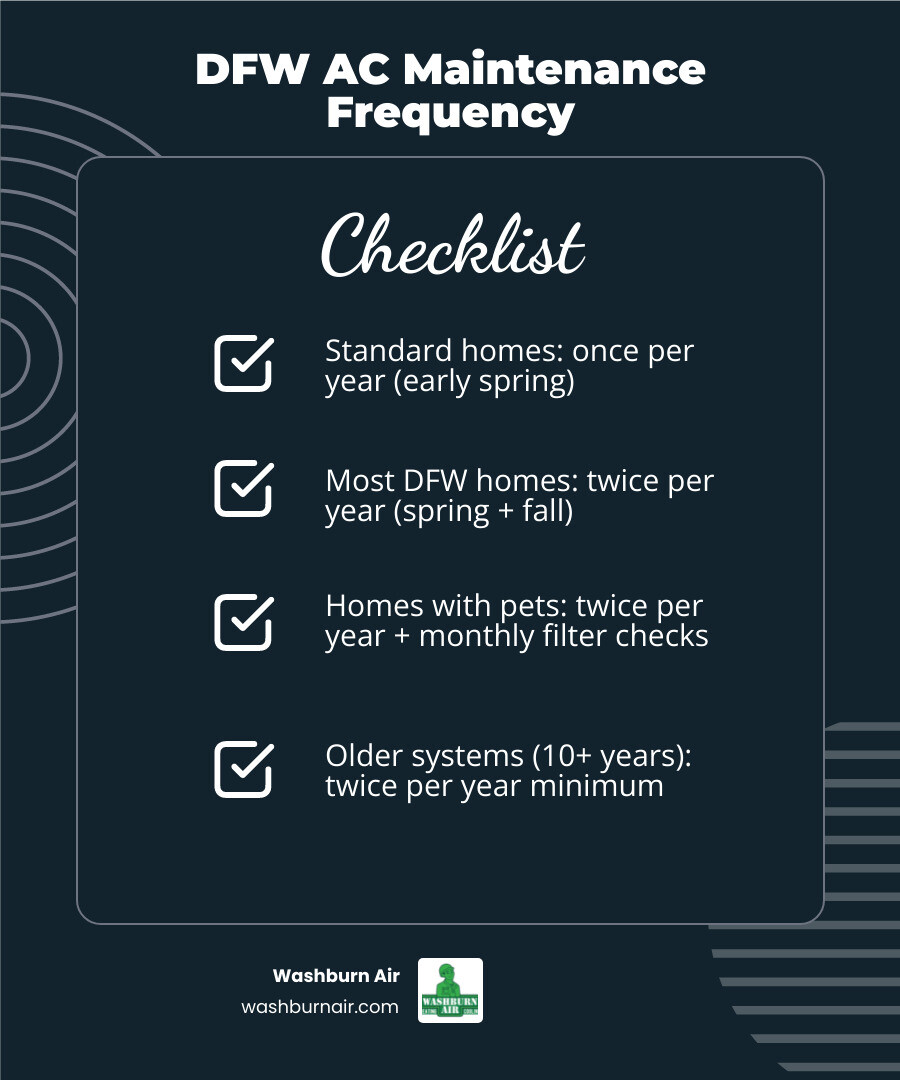
| Household Type | Recommended Service Frequency |
|---|---|
| Standard home, newer system (under 10 years) | Once per year, in early spring |
| Most DFW homes | Twice per year (spring + fall) |
| Homes with pets or allergy concerns | Twice per year, with monthly filter checks |
| Older systems (10+ years) | Twice per year minimum |
| Heat pumps | Twice per year minimum |
Dallas-Fort Worth summers are brutal. Temperatures routinely climb past 100°F for weeks at a time, and your AC doesn’t get a break from roughly May through October. That’s 6 to 7 months of near-constant runtime — far more than most cooling systems anywhere else in the country were built to handle. Add in attic temperatures that can reach 140 to 160°F and you’ve got conditions that accelerate wear on every component in your system.
The result? AC systems in Texas typically last just 12 to 15 years, compared to 15 to 20 years in milder climates. And according to industry data, 85% of HVAC repairs are directly tied to a lack of proper maintenance. Skipping service doesn’t just cost you comfort on the hottest day of the year — it quietly chips away at your system’s efficiency and lifespan every single season.
This guide walks you through exactly how often to service your AC in DFW, what that service should include, and what you can do between visits to keep things running smoothly.
How Often Should You Service Your Air Conditioner in the DFW Area?
For most homeowners living in Grapevine, Southlake, Highland Park, or anywhere else in the metroplex, the standard baseline is to schedule professional AC Maintenance at least once a year. Ideally, this should take place in the early spring, between March and May, before the true Texas heat waves arrive.
However, because our cooling season is exceptionally long, many HVAC experts recommend a bi-annual schedule as the gold standard. This means booking a dedicated cooling tune-up in the spring and a separate heating safety check in the fall. If your home relies on a heat pump system, which works hard year-round to both heat and cool your home, twice-yearly professional servicing is absolutely essential to prevent premature wear and tear.
Think of your air conditioner like a car. If you drove your car across a dusty, hot desert for 12 to 16 hours a day, you wouldn’t wait years to change the oil or inspect the brakes. Proactive preventative care is the only way to ensure your system can handle the sheer volume of work we demand from it.
Determining How Often Should You Service Your Air Conditioner in the DFW Area Based on System Age
As your air conditioning system ages, its maintenance needs naturally increase. If you have a brand-new system, a single annual professional tune-up is usually sufficient to keep it in peak condition (and to satisfy the manufacturer’s warranty requirements).
Once your system crosses the 10-year mark, however, the components begin to experience significant fatigue. Electrical connections can loosen, fan motors draw more amperage, and capacitors weaken. For systems over a decade old, switching to a bi-annual or even quarterly inspection routine is highly recommended. Catching a weak capacitor during a routine spring visit can save you from a major compressor failure in July. If you are starting to notice frequent minor issues with an aging unit, it may be time to evaluate whether a replacement is more practical by reading our guide on Should I Repair or Replace My AC in North Texas?.
How Often Should You Service Your Air Conditioner in the DFW Area If You Have Pets?
If you share your home with dogs, cats, or other furry family members, your air conditioner has to work twice as hard to maintain indoor air quality. Pet hair and dander are constantly pulled into the return vents, where they can quickly clog your air filters and bypass them to accumulate directly on the indoor evaporator coils.
For pet owners in the DFW area, we strongly advise scheduling professional HVAC Tune-Ups twice a year. Additionally, you should check your air filters every 30 days. When dander builds up on the evaporator coil, it creates an insulating barrier that restricts heat absorption. This restricted airflow forces your system to run longer cycles, increasing your utility bills and putting extra strain on the compressor.
How the Texas Climate Affects Your Cooling System
The North Texas climate is uniquely demanding. Unlike northern states where air conditioners are only turned on during a few humid weeks in July, DFW homeowners routinely run their systems from late spring well into autumn. Understanding the specific local climate challenges helps explain why regular maintenance is so critical. To dive deeper into how our local weather shapes your system’s performance, check out our resource on Understanding HVAC Dallas Fort Worth Summer.
Extreme Attic Temperatures and Extended Runtimes
In cities like Irving, Arlington, and Fort Worth, summer temperatures frequently exceed 100°F. While that is hot enough on its own, the temperature inside your attic is far worse. Because of solar radiation, DFW attics regularly reach a staggering 140°F to 160°F.
Since many local homes have their indoor air handlers and ductwork installed directly in the attic, the system must operate in an oven-like environment. The thermal stress on the blower motor, electrical wiring, and duct connections is immense. This extreme heat forces the system to run for extended cycles — often 12 to 16 hours a day — to keep your living spaces comfortable.
The Impact of High Humidity and Dust
DFW summers are not just hot; they can also be incredibly humid. Your air conditioner is responsible for both cooling the air and removing excess moisture. When warm, humid indoor air passes over the cold evaporator coil, water condenses on the metal surfaces and drains away.
However, if your home has high levels of airborne dust or pollen, this debris mixes with the condensation. Over time, this creates a thick, gelatinous buildup often referred to as “Texas slime” inside your condensate drain line. Without regular flushing, this slime will clog the drain, leading to water backups that can cause extensive ceiling and water damage in your home.
What a Professional AC Maintenance Visit Includes
A true professional tune-up is not a quick visual inspection. It is an intensive, multi-point technical audit designed to optimize energy efficiency, ensure safety, and catch minor wear before it turns into a system breakdown. If you are looking for local support, you can learn more about booking Reliable HVAC Maintenance Services in Dallas.
Here is what a comprehensive, professional AC maintenance visit should always include:
- Thermostat Calibration: Verifying that your thermostat reads the indoor temperature accurately so your system doesn’t run longer than necessary.
- Electrical Connection Tightening: Inspecting and tightening all wire connections to prevent short circuits and electrical failures.
- Capacitor and Contactor Testing: Measuring electrical storage capacity and checking contact points for pitting or burn marks.
- Condensate Drain Cleaning: Flushing the drain line to remove algae, dust, and slime buildup.
- Refrigerant Level Verification: Checking the system’s charge to ensure there are no slow leaks.
- Coil Cleaning: Cleaning the outdoor condenser coils to allow for optimal heat transfer.
- Blower Motor Inspection: Measuring amp draw and lubricating moving parts if needed.
Outdoor Condenser Unit Inspection
The outdoor unit (the condenser) bears the brunt of the elements. During a maintenance visit, our technicians focus heavily on cleaning the condenser coils. Dirt, pollen, grass clippings, and leaves collect on these coils, acting as an insulating blanket that prevents the system from releasing heat.
We also carefully inspect the electrical components. The capacitor is the small cylindrical device that gives your compressor and fan motor the electrical boost they need to start up. In the extreme heat of Southlake and Westlake summers, capacitors are often the first components to fail. Testing them during a spring visit allows us to replace a weak capacitor before it dies and leaves you without cooling on a Saturday afternoon.
Indoor Evaporator and Airflow Calibration
Inside your home, the focus shifts to airflow and heat absorption. We inspect the indoor evaporator coil to ensure it is clean and free of dust. We also evaluate the blower motor, measuring its power draw and checking the fan wheel for balance.
Refrigerant levels must be checked precisely. An undercharged system is a clear indicator of a leak, which must be located and repaired in compliance with environmental standards. Finally, we test the system’s static pressure to make sure air is moving freely through your ductwork without placing undue stress on the blower motor.
Signs Your Home Needs Immediate AC Service or Repair
While scheduling routine maintenance is the best way to prevent issues, you should always keep an eye out for warning signs that your system is struggling. Ignoring these minor symptoms can lead to severe component damage. For a detailed look at the consequences of putting off service, read about The Impact of Neglecting AC Inspections and Repairs on Your System.
Weak Airflow and Warm Air Blowing
If you stand under a supply vent and feel only a weak trickle of air, or if the air blowing out feels lukewarm, your system needs immediate attention. Restricted airflow is often caused by a severely clogged air filter or a failing blower motor.
When airflow is restricted, the temperature of the evaporator coil can drop below freezing, causing the moisture on the coil to turn to ice. If you notice ice forming on the brass refrigerant lines outside or on the indoor unit, turn the system off immediately and call for professional service. Running an AC with a frozen coil can destroy the compressor. Additionally, studies show that the average home loses 20% to 30% of its conditioned air through leaks and gaps in the ductwork, which can also contribute to poor airflow and hot spots.
Strange Noises and Frequent Cycling
Your air conditioner should operate with a predictable, low-level hum. If you start hearing unusual sounds, it is time to investigate:
- Squealing or Screeching: Often points to a failing belt or a blower motor bearing that has worn out.
- Grinding or Clanging: Usually indicates a loose fan blade or a failing compressor piston.
- Clicking: A rapid clicking sound when the system tries to turn on often points to an electrical issue, such as a failing contactor or relay.
Frequent cycling (also known as short cycling) occurs when your AC turns on and off every few minutes without completing a full cooling cycle. This places tremendous strain on the compressor and consumes an immense amount of electricity, as the startup phase is the most energy-intensive part of system operation.
The Benefits of Regular AC Maintenance in North Texas
Investing in regular maintenance is one of the smartest decisions you can make as a homeowner. It is not just about avoiding a hot house; it is about financial stewardship and protecting one of the most expensive mechanical systems in your home. To learn more about getting your system ready for summer, see our post on Get Ready for the Heat: The Importance of an AC Tune-Up.
Preserving Manufacturer Warranties
Many DFW homeowners do not realize that almost every major HVAC manufacturer (such as Trane, Carrier, and Lennox) requires proof of annual professional maintenance to keep your parts warranty valid.
If a major component like your compressor fails within the warranty period, the manufacturer may request service records showing the system was professionally maintained every year. If you cannot provide this documentation, they may deny your warranty claim, leaving you responsible for the full cost of the replacement part. Regular maintenance is quite literally your insurance policy against expensive component failures.
Maximizing Energy Efficiency and Lifespan
A neglected HVAC system can use up to 25% more energy than one that receives regular care. Over time, dust buildup on the coils and minor electrical degradation force the system to run longer and work harder to achieve the same cooling output.
By contrast, a well-maintained system can use 10% to 30% less energy, saving you a substantial amount on your monthly utility bills. Routine care can also extend your equipment’s life by 3 to 5 years or more, helping you defer the cost of a new system installation.
| System Condition | Average Energy Efficiency | Average Lifespan in Texas | Risk of Summer Breakdown |
|---|---|---|---|
| Well-Maintained | Optimal (Uses 10-30% less energy) | 12 to 15+ Years | Extremely Low (Under 5%) |
| Neglected | Poor (Loses 5% efficiency per year) | 8 to 10 Years | High (Over 80% of repairs are maintenance-related) |
DIY Maintenance Tasks to Perform Between Professional Visits
While major technical tasks must be left to licensed professionals, there are several simple maintenance steps you can take to support your system between our visits.
Replacing Air Filters Regularly
Changing your air filter is the single most important DIY task you can perform. A dirty filter blocks airflow, forces your blower motor to work harder, increases your energy bills by 5% to 15%, and is the leading cause of frozen evaporator coils.
- 1-Inch Filters: Replace every 30 to 45 days during peak cooling season (May through September).
- Media Filters (3 to 5-inch): Inspect every 3 months and replace every 6 to 12 months.
- Pet Owners: Check your filters every 30 days regardless of thickness.
When selecting a filter, look for a MERV (Minimum Efficiency Reporting Value) rating between 8 and 11. Filters with extremely high MERV ratings (13+) can actually restrict airflow in standard residential systems unless the system was specifically designed to handle them.
Clearing Debris Around the Outdoor Unit
Your outdoor condenser unit needs plenty of space to breathe. If air cannot flow freely through the sides of the unit, it cannot reject heat efficiently.
- Maintain Clearance: Keep at least 2 feet of clear space around the entire perimeter of the outdoor unit. Trim back bushes, weeds, and tree branches.
- Clear the Top: Ensure there are no overhanging branches or patio covers directly above the unit that could block the upward airflow.
- Gentle Rinsing: Every spring, use a standard garden hose (never a pressure washer, which will bend the delicate aluminum fins) to gently rinse away dust, grass clippings, and pollen from the exterior coils.
Frequently Asked Questions about DFW AC Maintenance
What happens if I skip regular AC maintenance in Texas?
Skipping regular maintenance in our harsh climate is a recipe for high utility bills and sudden system failures. Without regular cleaning and calibration, your system will lose roughly 5% of its operating efficiency every year. Dust will accumulate on the coils, causing the system to run longer cycles and consume more power.
Additionally, uncleaned condensate drains will eventually clog with algae and dust, leading to water backups that can ruin ceilings and drywall. Most importantly, minor issues like a weak capacitor or a slow refrigerant leak will go unnoticed, eventually causing catastrophic damage to your compressor.
When is the best time of year to schedule an AC tune-up?
The absolute best time to schedule your AC tune-up is in the early spring, specifically between March and May. Booking your service during this window ensures your system is clean and fully optimized before the intense summer heat arrives.
Scheduling early also offers the benefit of flexible appointment times. Once the summer heat hits in June, HVAC companies are flooded with emergency repair calls, making it much harder to book a routine maintenance visit at a time that is convenient for you.
Should I repair or replace my older AC unit?
To help make this decision, we often recommend using the “$5,000 Rule.” Multiply the age of your system by the cost of the recommended repair. If the total exceeds $5,000, replacing the system is usually the more cost-effective long-term choice.
For example, if a 12-year-old system needs a major repair, the math ($500 x 12 = $6,000) suggests that investing in a modern, energy-efficient system is a smarter financial move. This is especially true now in 2026, as older systems running on R-410A refrigerant face skyrocketing maintenance costs due to environmental phaseouts, making new high-efficiency systems much more appealing.
Conclusion
Taking care of your air conditioner in the Dallas-Fort Worth area isn’t just about luxury — it’s about keeping your home safe, comfortable, and efficient during our long, scorching summers. By sticking to an annual spring baseline (or a bi-annual schedule for older systems and homes with pets), you can protect your investment, lower your energy bills, and avoid the stress of a mid-summer breakdown.
At Washburn Air, we provide 24/7 local expertise and full-service support across Grapevine, Southlake, Westlake, Trophy Club, Colleyville, Highland Park, and the surrounding DFW communities. Our team is dedicated to keeping your home comfortable all year round.
Ready to secure your peace of mind before the next big heatwave? Explore our convenient HVAC Maintenance Plans or schedule your premium cooling tune-up today by visiting our HVAC Tune-Ups service page. We are always here to help you stay cool!
{“@context”: “https://schema.org”, “@graph”: [{“@type”: “Article”, “headline”: “How Often to Service Your AC in DFW | Washburn Air”, “description”: “Wondering how often should you service your air conditioner in the DFW area? See DFW AC maintenance tips and schedule service today.”, “author”: {“@type”: “Person”, “name”: “Washburn Air”}, “publisher”: {“@type”: “Organization”, “name”: “Washburn Air”, “logo”: {“@type”: “ImageObject”, “url”: “https://washburnair.com/wp-content/uploads/2024/09/washburn-air-logo-800-400×261.png”}}, “datePublished”: “2026-07-13T02:32:47+00:00”, “dateModified”: “2026-07-13T02:33:04.574329”, “mainEntityOfPage”: {“@type”: “WebPage”, “@id”: “https://washburnair.com/blog/how-often-to-service-your-ac-in-dfw/”}, “image”: “https://images.bannerbear.com/direct/4mGpW3zwpg0ZK0AxQw/requests/000/150/373/551/jMVrobL3AQ5DGEEy6G9ReqJW5/ac66c46391ef19fe40458aff0dbfe0d3842b5f99.jpg”}, {“@type”: “FAQPage”, “mainEntity”: [{“@type”: “Question”, “name”: “How often should you service your AC in the DFW area?”, “acceptedAnswer”: {“@type”: “Answer”, “text”: “Most DFW homeowners should service their AC at least once per year, ideally in early spring between March and May. Because the cooling season is so long, many HVAC experts recommend twice-yearly service in spring and fall.”}}, {“@type”: “Question”, “name”: “When is the best time to schedule AC maintenance in Dallas-Fort Worth?”, “acceptedAnswer”: {“@type”: “Answer”, “text”: “The best time to schedule AC maintenance in DFW is early spring, between March and May, before the hottest Texas weather arrives. A fall heating safety check is also recommended for many homes.”}}, {“@type”: “Question”, “name”: “Do older AC systems in DFW need service more often?”, “acceptedAnswer”: {“@type”: “Answer”, “text”: “Yes, AC systems that are 10 years old or older should be serviced at least twice per year. More frequent maintenance helps reduce premature wear and supports reliable performance during long Texas summers.”}}, {“@type”: “Question”, “name”: “How often should homes with pets or allergies service their AC?”, “acceptedAnswer”: {“@type”: “Answer”, “text”: “Homes with pets or allergy concerns should schedule professional AC service twice per year and check filters monthly. This helps maintain airflow and indoor air quality.”}}, {“@type”: “Question”, “name”: “Why is AC maintenance especially important in the DFW area?”, “acceptedAnswer”: {“@type”: “Answer”, “text”: “Dallas-Fort Worth AC systems often run nearly constantly from May through October in extreme heat, which accelerates wear on components. The article notes that Texas AC systems typically last 12 to 15 years, and many HVAC repairs are tied to lack of proper maintenance.”}}]}]}