I’m looking to replace my home’s air conditioning in the Dallas-Fort Worth area. Do you need a permit to replace AC in Texas?
If you’re wondering do you need a permit to replace ac in texas, the answer is almost always yes. Most Texas homeowners are required to obtain a mechanical permit before replacing an AC system — even if it’s the same size, in the same spot, replacing the exact same equipment.
Here’s a quick breakdown:
| Scenario | Permit Required? |
|---|---|
| Full AC system replacement | Yes |
| Same-tonnage unit, same location | Yes (in most jurisdictions) |
| Heat pump conversion | Yes |
| Ductwork modification | Yes |
| Replacing a capacitor or contactor | No |
| Replacing a thermostat | No |
| Portable or window AC unit | No |
Texas HVAC permitting is governed by two layers of authority: the Texas Department of Licensing and Regulation (TDLR), which oversees smaller municipalities, and local municipal building departments in larger cities. Where you live in Texas — Grapevine, McKinney, Frisco, or an unincorporated rural area — can affect exactly which rules apply to your project.
Skipping the permit process might seem like a way to save time. But the real-world consequences can be steep. One Texas homeowner had a home sale fall through after an inspector flagged unpermitted HVAC work — the seller had to pay substantial retroactive permitting fees to get the deal back on track. In another case, an insurance company denied a major claim after a house fire because the HVAC installation had never been permitted or inspected.
This guide walks you through everything you need to know: when permits are required, who’s responsible for pulling them, what inspectors look for, and how to protect yourself as a homeowner in the Dallas-Fort Worth area.
Do You Need a Permit to Replace AC in Texas?
To understand why a permit is legally required for an air conditioning replacement, we have to look at how building codes are organized in the Lone Star State. Texas utilizes a combination of state-level oversight and local municipal amendments.
At the state level, the Texas Department of Licensing and Regulation (TDLR) sets the baseline rules and regulates the licensing of HVAC professionals under the Texas Engineering Practice Act. For technical building standards, Texas adopts the International Mechanical Code (IMC) alongside the International Residential Code (IRC).
According to section R105.1 of the IRC, a permit is required for any installation, alteration, repair, replacement, or addition to any mechanical system. Because an air conditioner relies on high-voltage electricity, chemical refrigerants, and complex drainage systems, a full AC Replacement is never considered a simple appliance swap. Local building departments in cities like Dallas, Fort Worth, and Grapevine enforce these codes to protect public safety and ensure structural integrity.
When is a Permit Required for Texas AC Replacements?
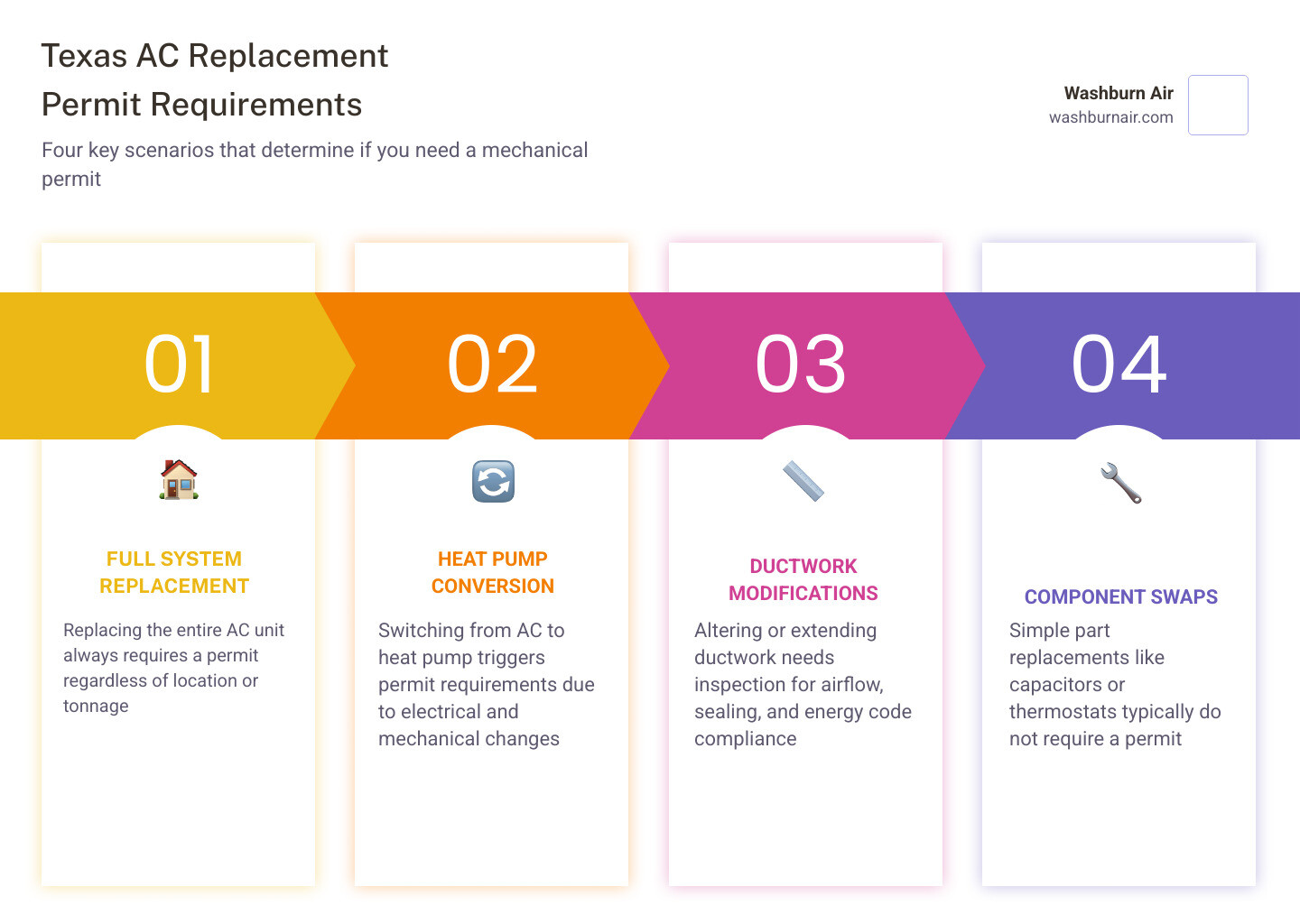
A mechanical permit must be secured before any major installation work begins. The following scenarios strictly require a permit in North Texas:
- Full System Replacement: Replacing both the indoor evaporator coil and the outdoor condenser unit.
- Heat Pump Conversions: Changing a standard air conditioner and gas furnace setup over to an electric heat pump system. This involves both mechanical permits and electrical sub-permits because of the changes in electrical load requirements.
- Ductwork Modifications: Altering, extending, or replacing the structural ductwork throughout your home.
- Refrigerant Line Changes: Installing new line sets or altering existing lines that handle high-pressure chemical refrigerants.
When deciding whether it is time to upgrade your system, reviewing resources like our guide on Should I Repair or Replace My AC in North Texas? can help you plan for these mandatory compliance steps.
When Do You Need a Permit to Replace AC in Texas for Minor Repairs?
While major system overhauls require formal city approval, everyday maintenance and minor repairs do not. You do not need to pull a permit for like-for-like component replacements. These minor repairs include:
- Swapping out a bad capacitor or contactor.
- Replacing a worn-out fan motor or blower motor.
- Installing a new thermostat.
- Changing air filters or cleaning dirty coils.
However, if you are dealing with a major component failure that requires an AC Compressor Replacement, the line between a simple repair and a permit-triggering alteration can occasionally blur depending on your local city ordinances. It is always safest to consult with a licensed professional to verify local rules.
Who is Responsible for Pulling the HVAC Permit?
In the state of Texas, the responsibility for pulling a mechanical permit falls squarely on the licensed HVAC contractor. Homeowners are generally restricted from pulling mechanical, electrical, or plumbing permits for major HVAC replacements.
The TDLR requires anyone performing air conditioning and refrigeration work to hold a valid Texas Air Conditioning and Refrigeration Contractor (TACL) license. Municipal building departments in cities like Arlington, Irving, and Southlake will only issue mechanical permits to contractors who are registered with the city and hold an active TACL license in good standing.

| Responsibility | Licensed Contractor | Homeowner |
|---|---|---|
| Verify local building codes | Yes | No |
| Submit permit application & plans | Yes | No |
| Pay municipal permit fees | Yes (usually bundled in the service) | No |
| Perform installation to code | Yes | No |
| Schedule the city inspection | Yes | No |
| Provide proof of passed inspection | Yes | No |
When you partner with us for your HVAC Services, we handle the entire permitting process from start to finish. This ensures that your system is fully compliant with local codes and that the paperwork is filed correctly with your local municipality.
Risks of Replacing an AC Unit Without a Permit
Some unlicensed installers or cut-rate handymen might suggest skipping the permit process to save time. However, going this route exposes you to severe financial, legal, and safety risks:
- Insurance Claim Denial: If an unpermitted AC system is installed incorrectly and causes an electrical fire or water damage from a clogged condensate line, your homeowner’s insurance provider has the right to deny your claim.
- Home Sale Complications: During property transactions in Texas, buyers hire independent home inspectors. If the inspector discovers a newly replaced AC system with no record of a permit or final inspection, it can stall the sale, force you to pay for retroactive permitting, or cause the buyer to walk away entirely.
- Safety Hazards: Unpermitted work lacks the critical safety check of a city inspector. Improperly installed gas furnaces or heat pumps can lead to carbon monoxide leaks, structural damage, or electrical fires.
- Code Violations and Fines: City code enforcement officers can issue stop-work orders during installation or levy heavy fines if they discover unpermitted equipment.
To avoid these headaches, you can learn more about planning for a proper, fully permitted installation by reading our guide on AC Replacement.
What to Expect During a Texas City HVAC Inspection
Once the installation is complete, the job isn’t officially done until it passes a physical inspection by a city representative. During a typical residential HVAC inspection in the DFW area, the municipal inspector will check:
- Equipment Sizing and Matching: Verifying that the outdoor unit and indoor coil are properly matched according to AHRI standards.
- Electrical Compliance: Ensuring the disconnect box, whip, and breaker sizes match the electrical requirements listed on the unit’s nameplate.
- Gas Line Safety: If a gas furnace was replaced alongside the AC, the inspector will check the gas shut-off valve, sediment trap, and vent flue pipe clearances.
- Duct Sealing and Insulation: Verifying compliance with the International Energy Conservation Code (IECC) standards, which mandate proper duct sealing to prevent energy loss in unconditioned attic spaces.
- Condensate Drainage: Checking that the primary drain line is properly trapped and that an auxiliary emergency drain pan with a safety float switch is installed.
Once the inspector is satisfied, they will issue a final sign-off, closing out the permit.
How to Verify Your Contractor Pulled the Required Permit
Unfortunately, some dishonest contractors claim they will pull a permit but skip the step to pocket the fee. Here is how you can verify that your project is fully legal:
- Ask for the Permit Number: Before our team or any contractor starts work, ask for the physical permit number issued by the city.
- Use Online City Portals: Most DFW municipalities—including Fort Worth, Arlington, and Grapevine—have online building permit portals. You can type in your home address to verify that an active mechanical permit has been issued under your contractor’s business name.
- Confirm the Inspection Schedule: Your contractor should coordinate with you to schedule the city inspector’s visit. If the contractor claims an inspection “isn’t necessary,” this is a major red flag.
- Watch for Red Flags: Be wary of contractors who demand cash-only payments, refuse to provide their TACL license number, or ask you to sign paperwork claiming you are doing the work yourself as a “self-installer.”
Why Do You Need a Permit to Replace AC in Texas for Long-Term Safety?
Beyond legal compliance, permits protect your investment. Major HVAC manufacturers require proof of professional installation by a licensed contractor—and often require proof of code compliance—to honor their 10-year parts warranties. A permitted and inspected installation guarantees that your system operates safely, efficiently, and under full warranty protection for years to come.
Frequently Asked Questions about Texas AC Permits
Can a homeowner pull their own HVAC permit in Texas?
No. In Texas, municipal building departments only issue residential mechanical permits to licensed Air Conditioning and Refrigeration Contractors (TACL holders). Because HVAC systems involve high-voltage electrical work, pressurized refrigerants, and structural modifications, homeowners cannot pull these permits themselves.
What happens if I sell a house with unpermitted AC work in Texas?
You are legally required to disclose unpermitted improvements on the Texas Seller’s Disclosure Notice. If unpermitted work is discovered during the buyer’s home inspection, you may have to hire a licensed contractor to inspect the system, bring it up to current codes, pull a retroactive permit, and pass a city inspection before the sale can close.
How long does it take to get an HVAC permit approved in North Texas?
For standard residential replacements, most North Texas cities—such as Grapevine, Southlake, and Westlake—issue mechanical permits within 1 to 5 business days. Many municipalities offer online portals that allow licensed contractors to secure same-day or next-day permit approvals for straightforward like-for-like replacements.
Conclusion
When it comes to replacing your home’s air conditioning system, cutting corners on permits is never worth the risk. Ensuring that your system is properly permitted and inspected protects your family’s safety, preserves your home’s value, and keeps your manufacturer’s warranty fully intact.
At Washburn Air, we bring year-round comfort and local expertise to homeowners across the Dallas-Fort Worth area, including Grapevine, Southlake, Westlake, Trophy Club, and Highland Park. We take care of the entire permitting and inspection process for you, ensuring your new system is installed safely and in perfect compliance with all Texas codes.
If you are ready to upgrade your home comfort system, contact us today to schedule your AC Replacement and ask about our flexible Financing options to help make your project stress-free.
{“@context”: “https://schema.org”, “@graph”: [{“@type”: “Article”, “headline”: “Do You Need a Permit to Replace AC in Texas | Washburn Air”, “description”: “Do you need a permit to replace AC in Texas? Learn Texas HVAC permit rules, risks, and who pulls permits. Call Washburn Air today.”, “author”: {“@type”: “Person”, “name”: “Washburn Air”}, “publisher”: {“@type”: “Organization”, “name”: “Washburn Air”, “logo”: {“@type”: “ImageObject”, “url”: “https://washburnair.com/wp-content/uploads/2024/09/washburn-air-logo-800-400×261.png”}}, “datePublished”: “2026-07-03T02:30:41+00:00”, “dateModified”: “2026-07-03T02:30:50.940336”, “mainEntityOfPage”: {“@type”: “WebPage”, “@id”: “https://washburnair.com/blog/how-to-check-permit-requirements-for-ac-replacement-in-texas/”}, “image”: “https://images.bannerbear.com/direct/4mGpW3zwpg0ZK0AxQw/requests/000/150/373/632/jMDOvP3KezRL0bp9Qlqoyk8AW/d23992cfc42205e23a29698bde8ffc96da083047.jpg”}, {“@type”: “FAQPage”, “mainEntity”: [{“@type”: “Question”, “name”: “Do you need a permit to replace an AC in Texas?”, “acceptedAnswer”: {“@type”: “Answer”, “text”: “Yes, most Texas homeowners are required to obtain a mechanical permit before replacing an AC system, even if the new unit is the same size and in the same location. Texas rules generally require permits for installation, alteration, repair, replacement, or addition to a mechanical system.”}}, {“@type”: “Question”, “name”: “What AC replacement projects require a permit in Texas?”, “acceptedAnswer”: {“@type”: “Answer”, “text”: “A full AC system replacement, same-tonnage replacement in the same location, heat pump conversion, and ductwork modification typically require a permit. Smaller repairs like replacing a capacitor, contactor, thermostat, or using a portable or window AC unit generally do not require a permit.”}}, {“@type”: “Question”, “name”: “Who regulates HVAC permits in Texas?”, “acceptedAnswer”: {“@type”: “Answer”, “text”: “Texas HVAC permitting is governed by both the Texas Department of Licensing and Regulation and local municipal building departments. The exact rules can vary depending on whether you live in a city such as Grapevine, McKinney, or Frisco, or in an unincorporated rural area.”}}, {“@type”: “Question”, “name”: “What can happen if you replace an AC without a permit in Texas?”, “acceptedAnswer”: {“@type”: “Answer”, “text”: “Skipping the permit process can lead to serious consequences, including retroactive permitting fees, problems during a home sale, or insurance claim issues. The article gives examples of a home sale being delayed by unpermitted HVAC work and an insurance claim being denied after a fire because the installation was not permitted or inspected.”}}, {“@type”: “Question”, “name”: “What building codes apply to AC replacement permits in Texas?”, “acceptedAnswer”: {“@type”: “Answer”, “text”: “Texas uses state-level oversight and local municipal amendments, with technical standards based on the International Mechanical Code and International Residential Code. IRC section R105.1 requires a permit for installation, alteration, repair, replacement, or addition to a mechanical system.”}}]}]}