How Ductless Mini Splits Cool Specific Rooms During North Texas Heat Waves
Understanding how ductless mini splits cool specific rooms during North Texas heat waves comes down to a few key ideas. Here’s a quick breakdown:
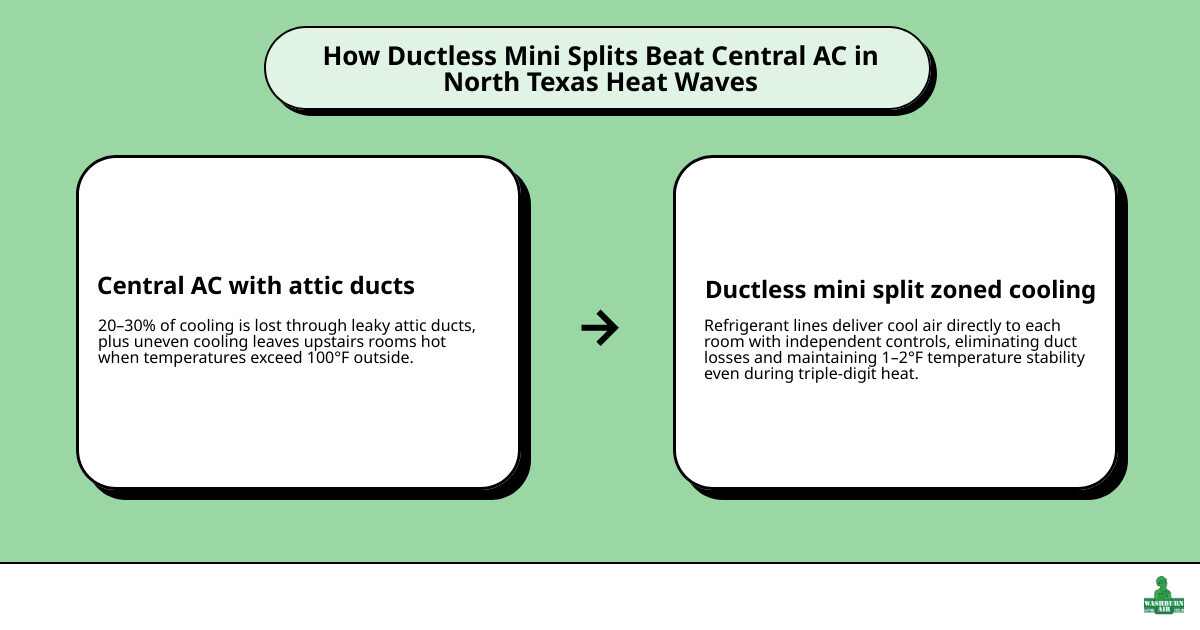
- No ductwork, no duct losses. Mini splits deliver cooled air directly into a room, skipping the leaky attic ducts that drain 20-30% of your central AC’s output before it ever reaches you.
- Each room gets its own unit. A wall-mounted indoor air handler pulls warm room air across refrigerant coils, transfers that heat outside, and pushes cool air back — all for that one space.
- Inverter-driven compressors modulate continuously. Instead of switching on and off, the system ramps up or down to match the actual load, keeping temperatures within 1-2°F of your set point even when it’s over 100°F outside.
- Zoning means you only cool what you’re using. Multi-zone systems connect 2-5 indoor units to a single outdoor condenser, each controlled independently so an empty bedroom doesn’t drive up your bill.
- Texas-specific sizing matters. North Texas homes need 25-30 BTU per square foot — well above the national baseline — to handle sustained triple-digit heat.
If you’re a DFW homeowner dealing with a room that your central AC simply can’t keep up with during a heat wave, a ductless mini split is one of the most direct solutions available. North Texas summers are brutal — Grapevine and the surrounding DFW area routinely see outdoor temperatures push past 100°F for days at a stretch. Central AC systems labor under that kind of sustained heat, especially in rooms far from the air handler or above a sun-baked attic. Ductless mini splits approach the problem differently, cooling specific rooms directly and efficiently without depending on a duct system that may already be losing a significant portion of its output before it reaches you.
The Limits of Central AC in Extreme Texas Heat
To understand why a ductless system works so well, we first have to look at why traditional central systems struggle when June, July, and August roll around in places like Arlington, Irving, and Grapevine.
Traditional central air conditioners rely on a vast network of metal or flexible ducts to distribute conditioned air throughout your home. In North Texas, these ducts are almost always routed through the attic. During a typical 100°F+ summer day, attic temperatures can easily soar past 120°F, sometimes reaching a sweltering 130°F or higher.
This extreme attic heat gain creates two major issues for your central AC:
- Conductive Heat Transfer: Even well-insulated ducts absorb heat from the superheated attic air. By the time the cooled air travels from your indoor coil to a far bedroom, it has already warmed up significantly.
- Duct Leakage: The U.S. Department of Energy reports that traditional ducted systems lose an average of 20% to 30% of their conditioned air through minor leaks, loose connections, and poor insulation.
This results in uneven room temperatures and notorious second-floor hot spots. Master bedrooms with west-facing windows, home offices packed with electronics, and bonus rooms sitting directly above uninsulated garages become virtually unusable during a heat wave. To learn more about how these two system designs stack up, read our detailed comparison on Ductless AC vs Central AC.
How Ductless Mini Splits Cool Specific Rooms During North Texas Heat Waves

Ductless mini splits bypass the attic entirely. Instead of forcing air through a complicated web of ducts, they place the cooling equipment directly inside the room you want to condition. This targeted room cooling allows you to establish independent temperature control exactly where you need it most.
Whether you are trying to cool down a sun-drenched sunroom in Southlake or keep a converted garage comfortable in Fort Worth, ductless technology delivers immediate relief. Discover how we can help you customize your home’s zoning with our comprehensive HVAC Services.
The Science of How Ductless Mini Splits Cool Specific Rooms During North Texas Heat Waves
At its core, a ductless mini split operates on the same basic refrigeration cycle as a central AC, but in a highly streamlined package. The system is split into two main sections: an outdoor condenser unit and one or more indoor air handlers.
These units are connected by a small bundle of lines—typically requiring only a three-inch hole through an exterior wall. This bundle contains:
- Copper refrigerant lines
- A power cable
- A condensate drain line
The cooling process works through continuous heat transfer:
- The indoor air handler pulls warm, humid air from the specific room across an evaporator coil filled with cold liquid refrigerant.
- The refrigerant absorbs the heat from the room air, instantly cooling and dehumidifying it before the quiet indoor fan circulates it back into the space.
- The warmed refrigerant travels through the copper lines to the outdoor condenser unit.
- The outdoor compressor squeezes the refrigerant, and the outdoor fan dissipates the absorbed heat into the outside air.
- The refrigerant cools back down, flows back inside, and the cycle repeats.
Because there are no ducts, 100% of the cooling energy is delivered directly into the living space.
Why Zoning Explains How Ductless Mini Splits Cool Specific Rooms During North Texas Heat Waves
One of the greatest features of ductless technology is its inherent zoning capability. Multi-zone mini-split systems allow you to connect between 2 to 5 indoor units to a single, high-efficiency outdoor condenser.
Each indoor unit is equipped with its own independent thermostat and wireless remote (or smartphone app integration). This means you can keep your home office at a crisp 72°F while you work, set an unused guest bedroom to a conservative 78°F, and turn off the unit in the gym entirely when you aren’t working out.
By conditioning only occupied spaces, you eliminate the massive energy waste associated with cooling an entire 2,500-square-foot home just to stay comfortable in a single room.
Key Advantages of Ductless Systems Over Central AC
When the North Texas electricity grid is under maximum strain and utility bills start to climb, the efficiency of your cooling system becomes incredibly important. High-efficiency mini splits rated at 20+ SEER (Seasonal Energy Efficiency Ratio) can reduce cooling energy consumption by 30% to 50% compared to older central systems with significant duct losses during extended 100°F+ heat waves.
Additionally, because mini splits do not pull air from dusty attics or circulate it through dirty ductwork, they provide a noticeable boost to your home’s Indoor Air Quality through multi-stage, washable filtration systems built into every indoor head.
| Cooling System Metric | Traditional Central AC (With Attic Ducts) | Ductless Mini-Split System |
|---|---|---|
| Average Energy Loss via Ducts | 20% to 30% loss | 0% loss (Ductless) |
| Typical SEER/SEER2 Ratings | 14 to 18 SEER | 18 to 30+ SEER |
| Temperature Control | Single thermostat (Whole home) | Zoned control (Room-by-room) |
| Air Filtration | Single central return filter | Multi-stage filter in every room |
| Operation Style | Single-stage (On/Off cycling) | Variable-speed inverter modulation |
Inverter-Driven Compressors and Temperature Stability
Standard central air conditioners use single-stage compressors that operate like a light switch—they are either 100% on or completely off. When your thermostat detects a temperature rise, the system kicks on at full blast, cools the house rapidly, and then shuts off. This constant cycling (known as short-cycling) wastes massive amounts of electricity and subjects your equipment to heavy wear and tear.
Mini-split systems utilize advanced inverter-driven compressors. An inverter compressor acts more like a dimmer switch. It modulates its speed continuously, ramping up to meet high cooling demands and slowing down to a incredibly efficient sip of electricity once the room reaches your desired temperature.
This variable-speed technology allows mini splits to maintain indoor temperatures within a tight 1–2°F window of your set point, even when outdoor temperatures exceed design conditions by 8–10°F. In fact, real-world monitoring shows that during multi-day heat waves, a properly sized mini split can maintain a stable indoor average of 74.4°F while modulating its power consumption smoothly between 620 and 1,400 watts rather than spiking repeatedly.
Humidity Removal in High-Moisture Conditions
North Texas summers aren’t just hot; they can also bring high humidity levels that make 95°F feel like 105°F. Traditional air conditioners struggle to remove humidity during hot weather because their short runtimes don’t give the evaporator coil enough time to pull moisture from the air.
Because inverter-driven mini splits run for extended, low-speed cooling cycles, they are exceptionally good at removing moisture. The continuous airflow across the cold evaporator coil steadily condenses airborne water vapor and drains it outside. This high latent capacity means your home feels cooler and more comfortable at a slightly higher thermostat setting, saving you even more on your monthly utility bills.
Crucial Installation and Sizing Strategies for DFW Homes
Getting the absolute best performance out of a ductless system in the DFW metroplex requires a professional approach. You cannot simply grab a generic unit online and expect it to survive a North Texas August.
To ensure your system runs flawlessly, it must be sized specifically for our unique climate. While national baselines often suggest 20 BTUs per square foot, our intense sun exposure and high design temperatures mean DFW homes generally require 25 to 30 BTUs per square foot for optimal room cooling.
If you are considering upgrading a hot spot in your home, read more about our professional Mini Split AC Installation services.
Manual J Calculations and Equipment Sizing
Before installing any equipment, we perform a thorough Manual J load calculation. This calculation takes into account:
- The square footage of the room
- Ceiling heights and insulation levels
- The number, size, and orientation of windows (especially west-facing glass)
- Local ASHRAE summer design temperatures (which sit around 100°F to 102°F for Dallas-Fort Worth)
Interestingly, real-world testing shows that variable-capacity mini splits can keep homes perfectly comfortable even if they are slightly undersized according to rigid Manual J calculations. Because the inverter compressor can run continuously at its maximum capacity when needed without cycling off, a system operating at 88% to 90% of the calculated peak load can still maintain excellent indoor comfort during extreme heat waves while running with maximum efficiency.
Maintenance and Reliability in Extreme Heat
To keep your mini split operating at peak efficiency during a prolonged heat wave, regular upkeep is essential. Because these systems circulate air directly within your living spaces, their filters catch a significant amount of dust and pet dander.
- Filter Cleaning: We recommend checking and rinsing the indoor unit’s air filters every 2 to 4 weeks during the peak cooling season. Clean filters ensure unrestricted airflow and prevent the evaporator coil from freezing up.
- Coil and Drain Inspections: Dust can slowly bypass filters and accumulate on the indoor coils. Checking your coils and clearing the condensate drain line every 6 months prevents water leaks and mold growth.
- Professional Tune-Ups: An annual professional inspection ensures your refrigerant levels are perfect and your electrical connections are secure before the summer heat arrives. Keep your system in top shape with our professional AC Maintenance plans.
Frequently Asked Questions About Ductless Cooling
If you are experiencing issues with an existing system or want to make sure your equipment is ready for the summer, our technicians are always ready to assist with expert Mini Split AC Repair.
Can a mini split handle 100°F+ outdoor temperatures?
Yes, absolutely. High-quality mini splits are engineered to deliver reliable cooling even when outdoor temperatures climb well past 100°F. Because they feature variable-speed inverter compressors, they can adjust their output to match extreme outdoor loads, keeping your indoor spaces perfectly comfortable even when the weather outside exceeds standard local design conditions by 8°F to 10°F.
How often do mini split filters need to be cleaned?
During the heavy cooling months in North Texas, you should check and clean your indoor air handler filters every 2 to 4 weeks. Most mini split filters are designed to be easily popped out, rinsed in a sink, dried, and slid back in. Keeping these filters clean is the single best way to maintain strong airflow, high efficiency, and excellent indoor air quality.
Can I add more zones to my mini split system later?
It depends entirely on the outdoor condenser unit installed during your initial project. If you install a multi-zone outdoor unit that is rated for up to 4 zones but only connect 2 indoor units initially, you can easily add the remaining 2 indoor units later. However, if you install a dedicated single-zone system, you cannot add more indoor units to that specific outdoor compressor in the future.
Conclusion
When the North Texas summer heat wave hits its peak, you don’t have to retreat to the few rooms your central AC manages to keep cool. Ductless mini splits offer a highly efficient, reliable, and customizable way to reclaim your hot spots—whether that’s a sunroom in Southlake, a master bedroom in Grapevine, or a third-floor attic conversion in Highland Park.
At Washburn Air, we bring 24/7 local expertise and full-service support to homeowners across the entire Dallas-Fort Worth metroplex. We understand the unique demands that Texas summers place on your HVAC equipment, and we are dedicated to keeping your home comfortable all year long.
Check our Service Area to see if we serve your neighborhood, and schedule your Mini Split AC Installation today to start enjoying personalized comfort in every room of your home.
{“@context”: “https://schema.org”, “@graph”: [{“@type”: “Article”, “headline”: “Ductless Mini Splits for Texas Heat | Washburn Air”, “description”: “Learn how ductless mini splits cool specific rooms during North Texas heat waves, cut duct losses, and boost comfort. Call Washburn Air today.”, “author”: {“@type”: “Person”, “name”: “Washburn Air”}, “publisher”: {“@type”: “Organization”, “name”: “Washburn Air”, “logo”: {“@type”: “ImageObject”, “url”: “https://washburnair.com/wp-content/uploads/2024/09/washburn-air-logo-800-400×261.png”}}, “datePublished”: “2026-06-27T16:27:08+00:00”, “dateModified”: “2026-06-27T16:27:18.610997”, “mainEntityOfPage”: {“@type”: “WebPage”, “@id”: “https://washburnair.com/blog/how-to-cool-specific-rooms-with-ductless-mini-splits/”}, “image”: “https://images.pexels.com/photos/24828656/pexels-photo-24828656.jpeg?auto=compress&cs=tinysrgb&h=650&w=940”}, {“@type”: “FAQPage”, “mainEntity”: [{“@type”: “Question”, “name”: “How do ductless mini splits cool specific rooms during North Texas heat waves?”, “acceptedAnswer”: {“@type”: “Answer”, “text”: “Ductless mini splits cool a specific room by using a wall-mounted indoor air handler that pulls warm air across refrigerant coils, transfers the heat outside, and pushes cool air back into that same space. Because they deliver cooled air directly without ductwork, they avoid the duct losses common in attic-based central AC systems.”}}, {“@type”: “Question”, “name”: “Why do central AC systems struggle in North Texas heat?”, “acceptedAnswer”: {“@type”: “Answer”, “text”: “Central AC systems often struggle during North Texas summers because they rely on ducts that are commonly routed through extremely hot attics. When outdoor temperatures exceed 100°F, attic temperatures can rise above 120°F or even 130°F, causing significant heat gain and reducing cooling effectiveness.”}}, {“@type”: “Question”, “name”: “How much cooling is lost through ductwork in a central AC system?”, “acceptedAnswer”: {“@type”: “Answer”, “text”: “The article states that leaky attic ducts can drain 20-30% of a central AC system’s output before the cooled air reaches the room. Ductless mini splits avoid this loss by delivering cooled air directly into the space.”}}, {“@type”: “Question”, “name”: “What does zoning mean with a ductless mini split system?”, “acceptedAnswer”: {“@type”: “Answer”, “text”: “Zoning means each indoor unit can be controlled independently, so you only cool the rooms you are using. Multi-zone ductless systems can connect 2-5 indoor units to a single outdoor condenser, helping avoid wasted cooling in empty rooms.”}}, {“@type”: “Question”, “name”: “What size ductless mini split is needed for North Texas homes?”, “acceptedAnswer”: {“@type”: “Answer”, “text”: “The article says North Texas homes typically need 25-30 BTU per square foot to handle sustained triple-digit heat. This is higher than the national baseline because of the region’s extreme summer conditions.”}}]}]}