Is a 12 to 15 Year Old AC Worth Fixing in a North Texas Climate? Here’s What You Need to Know
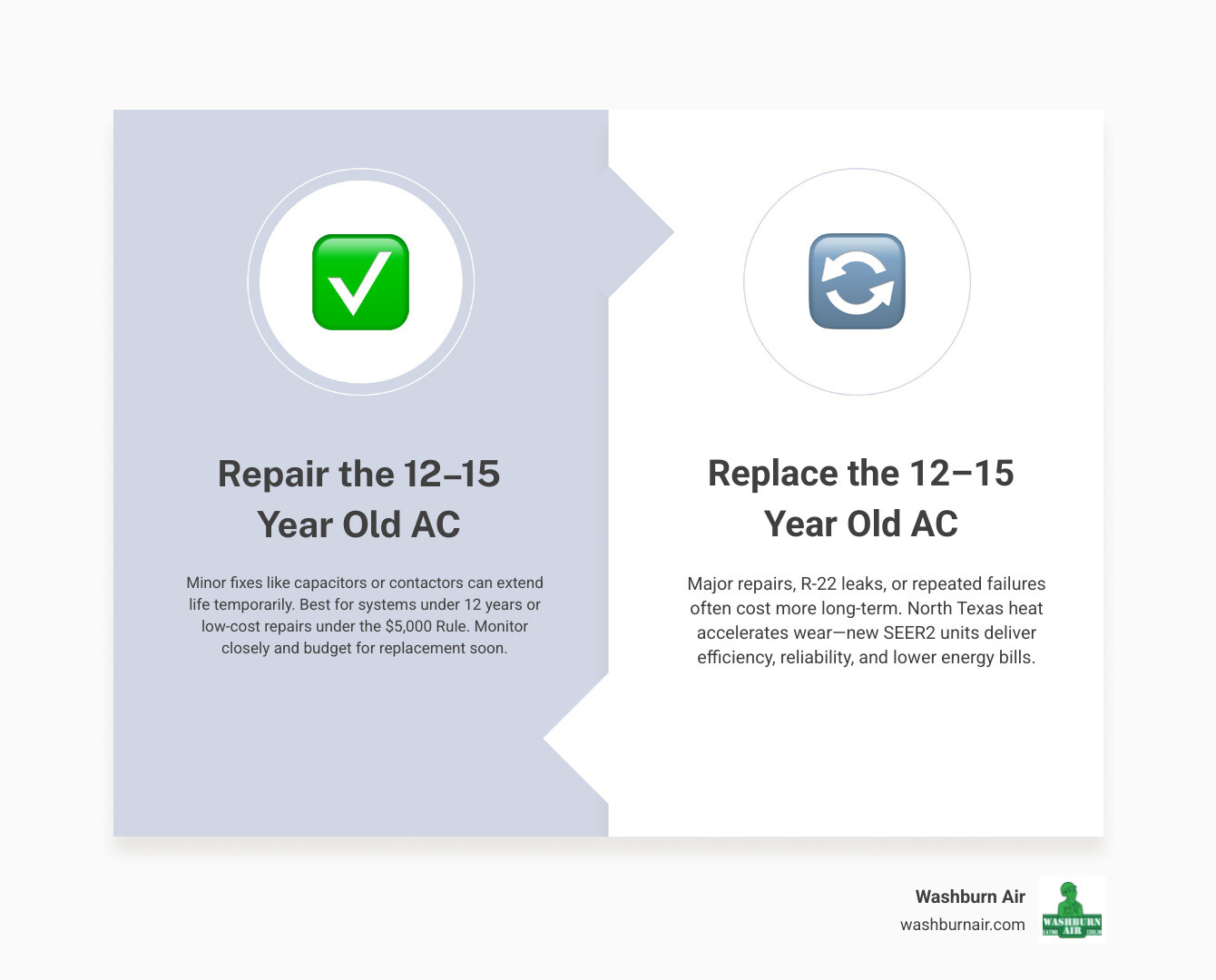
Is a 12 to 15 year old AC worth fixing in a North Texas climate? The short answer: it depends on a few key factors — but in most cases, a system in this age range is approaching or already past its practical lifespan for the DFW area, and a major repair deserves serious scrutiny before you say yes.
North Texas homeowners face a problem that most national HVAC advice doesn’t account for. While the standard guidance says a central air conditioner lasts 15 to 20 years, that number assumes a much gentler climate than what we deal with here. In the Dallas-Fort Worth area, your AC runs nearly twice as many hours per year as systems in moderate climates. By the time a unit hits 12 to 15 years old in North Texas, it has often experienced the equivalent wear of a system that’s 18 to 20 years old elsewhere.
That gap matters enormously when you’re deciding whether to approve a costly repair or start planning for a replacement.
Quick Answer: Should You Fix a 12–15 Year Old AC in North Texas?
- Under 12 years old, minor repair (capacitor, contactor, etc.): Almost always worth fixing
- 12–15 years old, minor repair: Usually worth it — but monitor closely
- 12–15 years old, major repair (compressor, coil, etc.): Apply the $5,000 Rule and 50% Rule before deciding — replacement is often the smarter move
- 12–15 years old, R-22 refrigerant leak: Replace rather than recharge — refrigerant costs make repair impractical
- 12–15 years old, third repair in two years: Strong signal to replace
- 15+ years old, any major repair: Replacement is almost always the better long-term investment
The sections below walk through each of these scenarios in detail, so you can make a confident, financially sound decision — not a rushed one in the middle of a July heat wave.
Why the North Texas Climate Shortens AC Lifespan

When we talk about air conditioning in places like Dallas, Fort Worth, Arlington, or Grapevine, we aren’t talking about a luxury appliance. We are talking about a critical piece of home safety equipment. The sheer intensity of our local weather is the primary reason why equipment degrades so rapidly here.
To understand why a 12-to-15-year-old system is often on its last legs, we have to look at the climate data:
- Cooling Degree Days (CDDs): The Dallas-Fort Worth area experiences approximately 2,756 cooling degree days per year. That is a staggering 2.3 times higher than the national average. This metric directly correlates to how hard and how long your system has to work to keep your home liveable.
- Annual Operating Hours: In milder northern states, an air conditioner might run for 800 to 1,200 hours a year. In North Texas, our systems routinely log between 2,200 and 2,500 runtime hours annually.
- Thermal Stress: The extreme heat swings of a DFW summer, where outdoor temperatures routinely exceed 100°F for weeks at a time, cause rapid thermal expansion and contraction of electrical and mechanical components. This accelerates metal fatigue in coils and places immense stress on the compressor.
- Humidity Management: High humidity levels during late spring and early summer force your system to work double-time. It cannot just cool the air; it must simultaneously extract gallons of water from your indoor atmosphere. This constant moisture exposure accelerates rust and corrosion on crucial internal parts.
Because of these factors, the average lifespan of an AC system in Arlington, TX and surrounding areas is compressed to just 10 to 12 years, compared to the 15-to-20-year lifespan quoted in national home improvement guides. If you want to dive deeper into how our summers strain your equipment, check out our guide on Understanding HVAC Dallas Fort Worth Summer and learn about finding the right balance with our resource on What AC Temperature in Summer?.
Is a 12 to 15 year old ac worth fixing in a north texas climate?
When your cooling system crosses the 12-year threshold, every service call becomes a strategic fork in the road. At this age, operational wear is no longer isolated to a single part. Instead, the entire system has experienced systemic wear.
The compressor, fan motors, electrical contactors, and coils have been subjected to over a decade of brutal North Texas summers. Even if a technician replaces one failed part, the remaining original components are still the same age and carry the same risk of failure.
Furthermore, efficiency degradation is a silent cash drain. On average, a 12-year-old system in the DFW area operates at 20% to 30% below its original efficiency rating due to internal scaling, motor wear, and coil degradation. This means you are paying significantly more on your monthly electric bills for subpar cooling performance.
When deciding whether to sink more money into an aging unit, we recommend using two industry-standard financial tests. To explore this topic further, you can read our comprehensive analysis on Should I Repair or Replace My AC in North Texas?.
Using the $5,000 Rule: Is a 12 to 15 Year Old AC Worth Fixing in a North Texas Climate?
The $5,000 Rule is a straightforward mathematical formula that helps homeowners remove the emotion from their decision.
To apply this rule, you multiply the age of your system (in years) by the estimated cost of the repair. If the resulting score is over 5,000, the math strongly suggests that replacing the system is the more financially responsible choice. If the score is under 5,000, proceeding with the repair is generally a reasonable gamble.
Let’s look at how this applies to a 13-year-old unit:
- Scenario A (Minor Repair): Your 13-year-old system needs a new capacitor. The score is well under the 5,000 threshold. In this case, you should absolutely opt for AC Repair to keep the system running.
- Scenario B (Major Repair): Your 13-year-old system has a failed compressor or a major refrigerant leak in the evaporator coil. The cost of this major repair multiplied by 13 will yield a score far exceeding 5,000. Sinking that much capital into a degraded, out-of-warranty system rarely makes sense when that money could be better spent as a down payment on a modern, highly efficient unit.
Using the 50% Rule: Is a 12 to 15 Year Old AC Worth Fixing in a North Texas Climate?
The 50% Rule is another excellent benchmark. It states that if the cost of a single repair exceeds 50% of the value of a brand-new, comparable replacement system, you should bypass the repair and proceed directly to AC Replacement.
For systems in the 12-to-15-year bracket, we often adjust this threshold down to 40% because of the high probability of sequential failures. If you pay for an expensive repair today, there is no guarantee that a different, equally expensive component won’t fail next month. A new system, on the other hand, resets your warranty coverage to zero, protecting you from unexpected out-of-pocket expenses for the next decade.
Key Warning Signs Your Aging AC is Nearing End-of-Life
Your air conditioner will usually tell you when it is preparing to retire. Recognizing these warning signs early can save you from a catastrophic breakdown in the middle of a triple-digit heatwave.
- Frequent Breakdowns: If you have had to call for service more than twice in the last 24 months, your system is entering a period of general decline. Each repair is simply a temporary band-aid on a systemic issue.
- Weak Airflow and Uneven Temperatures: If some rooms in your Southlake or Highland Park home remain uncomfortably warm while others are freezing, or if the air coming out of your vents feels weak, your blower motor or compressor is struggling to move air effectively.
- Short Cycling: This occurs when your AC turns on and off rapidly without ever completing a full cooling cycle. This places immense strain on the compressor and electrical components, dramatically increasing energy consumption.
- Consistently Rising Utility Bills: If your monthly electric bills are climbing year-over-year, but your local utility rates have remained relatively stable, your system is losing its efficiency and running longer to achieve the same indoor temperatures.
- Strange Noises or Odors: Squealing, grinding, or clanking sounds indicate mechanical failure in the motor or compressor. Musty smells point to biological growth inside the dark, damp evaporator coil area, which compromises your indoor air quality.
Neglecting these warning signs doesn’t just lead to discomfort; it can cause catastrophic damage to other parts of your home. To learn more about the consequences of delayed action, read about The Impact of Neglecting AC Inspections and Repairs on Your System.
Refrigerant Transitions and Efficiency Standards (R-22 vs. R-410A)
One of the most critical factors in the repair-versus-replace decision is the type of refrigerant your system uses.
If your air conditioner was installed before 2010, it almost certainly uses R-22 (commonly known as Freon). The EPA completely banned the production and import of R-22. While it is still legal to service these systems using reclaimed or stockpiled refrigerant, the supply is extremely limited, making any leak repair or recharge incredibly expensive. If your 12-to-15-year-old system has an R-22 leak, repairing it is financially impractical.
Even if your system uses R-410A (the refrigerant that replaced R-22), you should be aware of ongoing industry shifts. The HVAC industry is currently transitioning to newer, environmentally friendly low-GWP (Global Warming Potential) refrigerants like R-454B and R-32. This means R-410A will eventually face its own phasedown, making older R-410A systems more expensive to service as the decade progresses.
Upgrading to a modern system also yields massive energy savings due to updated SEER2 (Seasonal Energy Efficiency Ratio 2) standards implemented in 2023.
| System Generation | Typical SEER/SEER2 Rating | Relative Energy Consumption |
|---|---|---|
| Older System (12-15 Years Old) | 10 to 13 SEER | 100% (Baseline) |
| Standard Modern System | 14.3 to 16 SEER2 | 30% to 40% Savings |
| High-Efficiency Variable-Speed | 18 to 22+ SEER2 | 50% to 60% Savings |
By replacing a degraded, low-SEER system with a modern SEER2 unit, you can significantly lower your summer cooling costs. Over the lifespan of the new system, these monthly savings can offset a large portion of your initial investment. To explore the financial dynamics of this decision, refer to our guide on the Cost to Replace Air Conditioner.
Ductwork, Airflow, and Comfort Considerations
When evaluating an aging air conditioner, many homeowners focus entirely on the outdoor condenser unit. However, your HVAC system is an interconnected network, and your ductwork plays a massive role in overall comfort and efficiency.
In older homes across Irving, Grapevine, and Trophy Club, ductwork can deteriorate over time. Seams unravel, insulation falls away, and flexible ducts can crimp or collapse. If you install a brand-new, high-efficiency AC system into a home with leaky, poorly designed ductwork, you will not achieve the comfort or energy savings you paid for.
During our comprehensive HVAC Services assessments, we evaluate:
- Duct Integrity: Checking for leaks that pull hot, dusty attic air into your living spaces.
- Static Pressure: Ensuring your duct system is sized correctly to handle the airflow of a modern variable-speed blower motor.
- Indoor Air Quality: Assessing whether accumulated dust, pollen, and pet dander inside older ducts are circulating through your home.
Addressing ductwork issues at the same time as system replacement ensures your new equipment operates under optimal conditions, maximizing its lifespan and protecting your indoor air quality.
Best Times of Year to Replace Your AC in DFW
If you have decided that replacement is the smartest path forward, timing your purchase can yield significant financial and practical advantages.
The worst time to replace an air conditioner is during a mid-summer emergency when temperatures are soaring, local technicians are booked solid, and you are forced to make a rushed decision just to restore cooling. Instead, planning a proactive replacement during the “shoulder seasons” is highly beneficial:
- Spring (March through May): This is the ideal window. HVAC manufacturers routinely offer their best promotional rebates during these months, and utility providers like Oncor roll out seasonal incentives. Additionally, technician schedules are more flexible, allowing you to choose an installation date that fits your calendar.
- Fall (September through November): Similar to spring, the autumn months offer mild weather and excellent pricing opportunities as manufacturers clear out inventory before winter.
By planning ahead, you can stack manufacturer rebates, federal tax credits, and local utility incentives to significantly reduce the net investment of your upgrade. To keep your current system limping along until a planned replacement window, regular AC Maintenance is absolutely essential.
Frequently Asked Questions about Aging AC Units
How long does an AC system typically last in the Dallas-Fort Worth area?
Due to our extreme summer heat, high humidity, and extended cooling season (which often stretches from April through October), central air conditioners in the DFW area typically last 10 to 15 years. In contrast, the national average lifespan is 15 to 20 years. Regular annual maintenance is the single most effective way to push your system toward the upper end of that 15-year mark.
What incentives or tax credits are available for DFW homeowners upgrading their AC?
Under the Energy Efficient Home Improvement Credit (Section 25C), homeowners can claim federal tax credits of up to 30% of the cost for qualifying high-efficiency AC systems and heat pumps. Additionally, local electric transmission companies like Oncor offer rebates for upgrading to high-SEER2 equipment, and major manufacturers provide promotional financing or instant rebates during the spring and fall seasons.
What should a trustworthy professional AC evaluation include?
A reliable evaluation should never consist of a technician simply glancing at your outdoor unit and hand-delivering a replacement quote. It must include:
- A written diagnostic report explaining the exact cause of any current failures.
- An assessment of the system’s remaining components, including electrical readings and refrigerant levels.
- A static pressure test of your ductwork to ensure proper airflow.
- A Manual J load calculation to verify the correct system size for your home’s unique square footage, insulation levels, and window orientations.
Conclusion
Deciding whether to repair or replace a 12-to-15-year-old air conditioner in North Texas doesn’t have to be a guessing game. By applying logical frameworks like the $5,000 Rule, assessing your system’s refrigerant type, and factoring in the compounding wear caused by our brutal DFW summers, you can make a choice that protects both your family’s comfort and your financial bottom line.
At Washburn Air, we provide 24/7 local expertise and full-service support across Grapevine, Southlake, Westlake, Trophy Club, Arlington, Irving, Dallas, and Fort Worth. We believe in providing honest, transparent evaluations. If a simple repair is all you need to safely get through the season, we will tell you. If a replacement is the only logical choice, we will help you navigate your options without high-pressure sales tactics.
Don’t wait for your system to quit on the hottest day of the year. Schedule one of our thorough HVAC Tune-Ups or contact us today for an honest, professional second opinion on your aging system. Whether you need an expert AC Repair or a complete system upgrade, our team is ready to keep your home comfortable year-round.
{“@context”: “https://schema.org”, “@graph”: [{“@type”: “Article”, “headline”: “Is a 12-15 Year Old AC Worth Fixing? | Washburn Air”, “description”: “Ask: is a 12 to 15 year old AC worth fixing in a North Texas climate? Learn repair vs. replacement factors. Call Washburn Air.”, “author”: {“@type”: “Person”, “name”: “Washburn Air”}, “publisher”: {“@type”: “Organization”, “name”: “Washburn Air”, “logo”: {“@type”: “ImageObject”, “url”: “https://washburnair.com/wp-content/uploads/2024/09/washburn-air-logo-800-400×261.png”}}, “datePublished”: “2026-07-10T02:31:53+00:00”, “dateModified”: “2026-07-10T02:32:07.929630”, “mainEntityOfPage”: {“@type”: “WebPage”, “@id”: “https://washburnair.com/blog/how-to-decide-repair-vs-replace-for-a-12-15-year-old-ac/”}, “image”: “https://images.bannerbear.com/direct/4mGpW3zwpg0ZK0AxQw/requests/000/150/373/536/PwAV5rMNq6OWJPPv6kBm274Op/827c5a0431534692059ff39eef429852256ea0e3.jpg”}, {“@type”: “FAQPage”, “mainEntity”: [{“@type”: “Question”, “name”: “Is a 12 to 15 year old AC worth fixing in North Texas?”, “acceptedAnswer”: {“@type”: “Answer”, “text”: “It depends on the repair, but in most cases a 12 to 15 year old AC in North Texas is near or past its practical lifespan. Minor repairs are usually worth considering, while major repairs should be carefully evaluated because replacement is often the smarter long-term choice.”}}, {“@type”: “Question”, “name”: “Why do air conditioners wear out faster in the Dallas-Fort Worth area?”, “acceptedAnswer”: {“@type”: “Answer”, “text”: “AC systems in North Texas run far more hours than systems in moderate climates because of the intense local heat. The Dallas-Fort Worth area has about 2,756 cooling degree days per year, which is roughly 2.3 times the national average.”}}, {“@type”: “Question”, “name”: “When should I replace a 12 to 15 year old AC instead of repairing it?”, “acceptedAnswer”: {“@type”: “Answer”, “text”: “Replacement is often recommended if the system needs a major repair such as a compressor or coil, has an R-22 refrigerant leak, or has needed three repairs in two years. For systems 15 years or older, any major repair is usually a sign that replacement is the better investment.”}}, {“@type”: “Question”, “name”: “Are minor AC repairs worth it on an older unit in North Texas?”, “acceptedAnswer”: {“@type”: “Answer”, “text”: “Minor repairs, such as replacing a capacitor or contactor, are almost always worth doing on systems under 12 years old and are usually worth it on 12 to 15 year old systems. However, older systems should be monitored closely after any repair.”}}, {“@type”: “Question”, “name”: “Should I recharge an older AC with an R-22 refrigerant leak?”, “acceptedAnswer”: {“@type”: “Answer”, “text”: “For a 12 to 15 year old AC with an R-22 refrigerant leak, the article recommends replacing the system rather than recharging it. The cost of R-22 refrigerant makes this type of repair impractical.”}}]}]}