Why Your Oncor Bill Spikes Every Summer — and What a Tune-Up Can Do About It
If you’ve ever wondered how much can an ac tune-up reduce your electricity bill in dfw, here’s the short answer: a well-maintained system can cut your annual cooling costs by 15 to 30 percent compared to a neglected one.
Quick Answer: AC Tune-Up Savings in DFW
| Situation | Estimated Energy Savings |
|---|---|
| Regularly maintained system vs. neglected | 15-30% reduction in annual cooling costs |
| Clean air filter vs. dirty/clogged filter | Up to 15% reduction in energy use |
| Super tune-up on a 7-10 year old neglected system | 15-25% efficiency recovery |
| Combined tune-up + smart thermostat strategies | Up to 30-40% total reduction |
| Dirty outdoor coils alone | $50-80/month in wasted energy |
North Texas summers are brutal on HVAC equipment. DFW averages 20 days above 100°F each summer, and your air conditioner can run 10 to 16 hours a day just to keep up. When your system is even slightly out of tune — dirty coils, low refrigerant, restricted airflow — it burns through significantly more electricity to deliver the same cooling. For many DFW homeowners, that inefficiency shows up directly on their Oncor bill every month from June through September.
The good news is that most of that waste is preventable. A professional AC tune-up restores your system’s efficiency by addressing the exact components that cause it to overwork — and the savings often show up on the very next billing cycle.
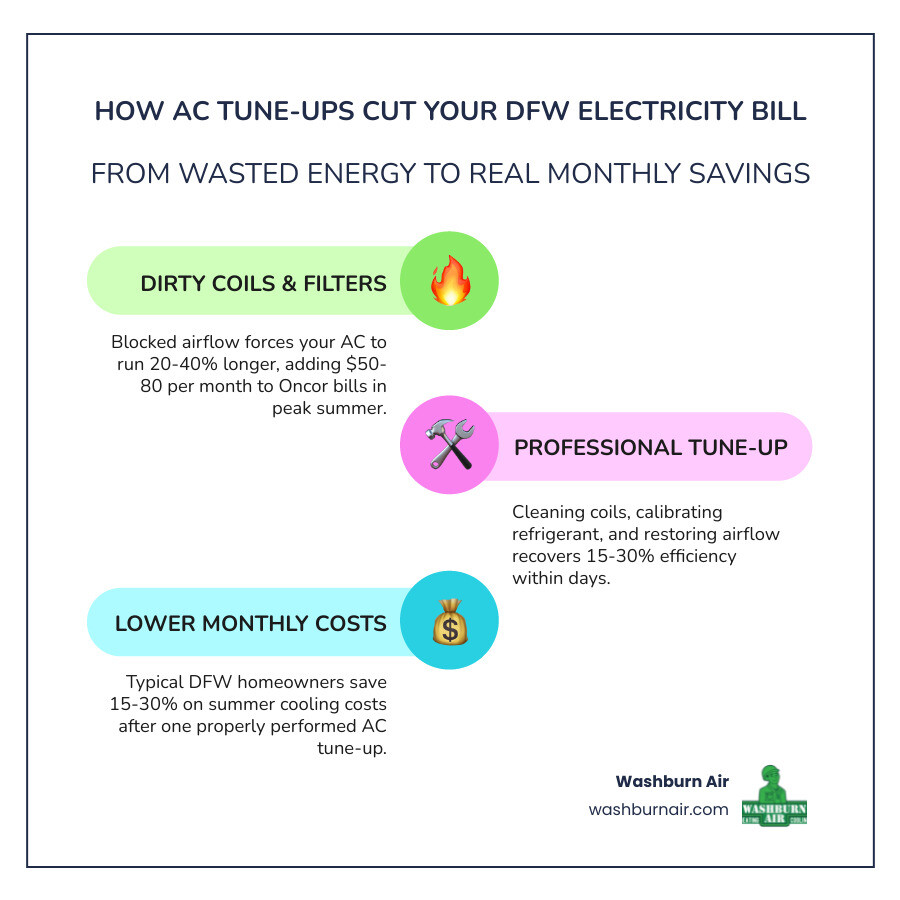
How Much Can an AC Tune-Up Reduce Your Electricity Bill in DFW?
When we look at the numbers for a typical home in our service areas — whether a modern estate in Southlake, a suburban home in Arlington, or a historic property in Highland Park — the financial impact of a tune-up is substantial. In Texas, air conditioners account for at least 18 percent of your total annual energy costs, but during the peak summer months of June, July, and August, that number often climbs to over 50 percent.
A professional AC tune-up can reduce your annual cooling costs by 15 to 30 percent. If your average summer electric bill is several hundred dollars, a 15 to 30 percent reduction represents a significant amount of money back in your pocket. Over a single summer season, this easily offsets the cost of the maintenance itself, making a seasonal tune-up one of the highest-ROI home maintenance decisions you can make.
To truly understand why these savings are so dramatic in the Dallas-Fort Worth metroplex, we have to look at the unique climate demands of our region. The urban heat island effect in core areas like Dallas and Fort Worth keeps overnight temperatures exceptionally high. Your air conditioner rarely gets a break.
Furthermore, many DFW homes feature attic-mounted HVAC systems. During a 100°F July day, attic temperatures in Grapevine or Irving can climb to a staggering 130°F to 160°F. If your system is neglected, it has to fight against this ambient attic heat while struggling with internal inefficiencies.
By ensuring your system is running at peak efficiency, you minimize the extra runtime required to cool your home. To learn more about how our local weather patterns dictate your system’s performance, read our guide on Understanding HVAC Dallas Fort Worth Summer.
Calculating the Impact of a Neglected System on Your Monthly Bill
Without proper maintenance, HVAC systems use more energy to do the same amount of cooling. Over time, dust, pollen, and outdoor debris coat the internal components of your system. This buildup creates thermal resistance and restricts airflow, forcing the system to run longer cycles to reach the temperature set on your thermostat.
In Texas, inefficient or neglected HVAC systems are responsible for 40 to 60 percent of home energy bills. When airflow is restricted by clogged air filters or dust-covered blower wheels, the system’s static pressure increases. Your blower motor has to draw more amps to push air through the ductwork, which directly increases your kilowatt-hour (kWh) consumption.
Replacing or cleaning filters every one to three months can reduce energy use by up to 15 percent, but a filter change is only the first step. When the entire system is neglected, the cumulative effect of dirty coils, worn electrical contacts, and slightly off refrigerant levels can cause your system to waste a massive amount of power. For a deep dive into how skipping regular checks hurts your wallet and your equipment, explore The Impact of Neglecting AC Inspections and Repairs on Your System.
How Much Can an AC Tune-Up Reduce Your Electricity Bill in DFW for Older vs. Newer Units?
The age and SEER (Seasonal Energy Efficiency Ratio) rating of your air conditioner play a massive role in how much energy a tune-up can recover.
- Older Systems (10+ Years Old / Low SEER): Older systems, especially those with 13 or 14 SEER ratings, are highly susceptible to efficiency degradation. According to the U.S. Department of Energy, a neglected air conditioner can lose roughly 5 percent of its original operating efficiency every single year it goes without professional service. For a 10-year-old system, that could mean a massive loss in cooling capacity. A comprehensive “super tune-up” on an older, neglected system can recover 15 to 25 percent of this lost efficiency, resulting in an immediate drop in your monthly utility bills.
- Newer Systems (High SEER / Variable-Speed): If you have a modern, high-efficiency system (such as an 18 to 21 SEER unit) in Westlake or Trophy Club, you might think maintenance isn’t as urgent. However, high-efficiency systems rely on precise sensor calibrations, clean variable-speed blower motors, and exact refrigerant charges to achieve their advertised energy savings. Even a minor issue can cause a high-SEER system to drop back down to standard efficiency levels, erasing the energy savings you paid a premium for.
Eventually, every system reaches a point where maintenance can no longer offset the wear and tear of old age. If your unit is in its mid-to-late teens and requiring frequent repairs, it may be time to look at replacement options. You can read more about these considerations in our article on the Cost to Replace Air Conditioner.
Specific Maintenance Tasks That Directly Lower Cooling Costs
A professional AC tune-up is not a simple visual inspection. It is a hands-on, multi-point optimization process designed to restore your system to its original factory specifications. When we perform a professional tune-up, several key tasks directly target the physical mechanisms of energy waste.
- Condenser Coil Cleaning: Your outdoor unit’s condenser coils are responsible for releasing the heat collected from inside your home. In DFW, these coils quickly become coated with grass clippings, dirt, and spring cottonwood pollen. Dirty condenser coils make your system overheat and struggle to cool, forcing the compressor to work twice as hard and consume far more electricity. Cleaning these coils is one of the most effective ways to lower your bill.
- Refrigerant Level Verification: An air conditioner is designed to operate with a very specific weight of refrigerant. If the system is even slightly undercharged (often due to tiny, pinhole leaks) or overcharged, the thermodynamic cycle is disrupted. Low refrigerant causes the evaporator coil to run too cold—often leading to ice buildup—which restricts airflow and can permanently damage the compressor.
- Condensate Drain Line Flush: High humidity during North Texas summers means your AC removes gallons of water from your indoor air daily. We flush the condensate drain line to prevent algae buildup and blockages that can cause water damage or trigger safety float switches, which shut your system down entirely during a heat wave.
- Thermostat Calibration: If your thermostat is miscalibrated, it may read the indoor temperature as warmer than it actually is, causing the AC to run longer than necessary. Calibrating the thermostat ensures your system only runs when it truly needs to.
To see our full checklist of maintenance procedures, visit our dedicated page on AC Maintenance.
Restoring Airflow and Heat Transfer Efficiency
At its core, air conditioning is about heat transfer. Your system takes heat from inside your home and dumps it outside. For this process to work efficiently, air must move freely across both the indoor evaporator coil and the outdoor condenser coil.
When dust coats the indoor blower wheel, it reduces the wheel’s aerodynamic efficiency. This forces the blower motor to run hotter and draw more electrical current (measured in amps) to move the same volume of air. During a professional tune-up, we measure the blower motor’s amp draw to ensure it is operating within the manufacturer’s safe limits.
We also test all electrical connections, capacitors, and contactors. Weak capacitors are the single most common cause of AC breakdowns in Dallas-Fort Worth during extreme heat. When a capacitor begins to fail, it forces the compressor and fan motors to draw excessive start-up and running amps, spiking your electricity bill and putting extreme stress on the motors.
By catching these issues early, you protect your system from catastrophic failure. Read more about preparing your system for the summer peak in our article, Get Ready for the Heat: The Importance of an AC Tune-Up.
Maximizing Savings: Combining Maintenance with Smart Cooling Strategies
While a professional tune-up sets the foundation for peak energy efficiency, you can maximize your savings by combining professional maintenance with smart daily cooling habits.
| Cooling Method | Energy Consumption | Best Practice / Benefit |
|---|---|---|
| Central Air Conditioning | 100% (Base Energy Consumer) | Keep tuned up to prevent a 5% annual efficiency loss. |
| Ceiling Fan | ~10% of Central AC consumption | Use only in occupied rooms; creates a wind-chill effect that makes the room feel 4°F cooler. |
| Smart Thermostat Schedule | Reduces AC runtime by 10-15% | Adjusts temperatures automatically when you are asleep or away from home. |
| Pre-Cooling Strategy | Shifts energy load to off-peak hours | Cools the home during cheaper overnight hours on time-of-use plans. |
Every degree counts when it comes to energy consumption and lowering your AC bill in summer. The U.S. Department of Energy notes that you can save up to 3 percent on your cooling bill for every single degree you raise your thermostat setting during the summer. We recommend setting your thermostat to 78°F when you are at home, and raising it a few degrees when you are away. To understand the ideal settings for our hot humid summers, check out our guide on What AC Temperature in Summer.
Another highly effective strategy is utilizing ceiling fans. A fan will spread the air released from the AC unit across the room and help you create a cool breeze in the room in a shorter duration, allowing you to save on electricity bills. Because a ceiling fan consumes only about 10 percent of the energy of running a central air conditioning unit, you can raise your thermostat by up to 4 degrees without sacrificing comfort. Just remember: fans cool people, not rooms, so turn them off when you leave the room!
Additionally, if you are on a time-of-use electricity plan in Arlington, Irving, or Dallas, you can practice “pre-cooling.” This involves lowering your thermostat temperature during the early morning hours when electricity rates and outdoor temperatures are low, and then letting the thermostat rise during peak demand hours (typically 2 PM to 8 PM) to avoid high-rate electricity consumption.
How Much Can an AC Tune-Up Reduce Your Electricity Bill in DFW When Paired with Smart Thermostats?
Smart and programmable thermostats are excellent tools for managing your summer energy use, but they can only do so much if the mechanical system they control is dragging. When you pair a smart thermostat with a freshly tuned air conditioner, you unlock the maximum possible savings.
A smart thermostat can save you up to 10 percent annually on heating and cooling costs by automatically adjusting the temperature based on your daily routine. When your AC has been professionally serviced, it can respond to these thermostat commands rapidly and efficiently. A tuned system recovers your home’s target temperature quickly without drawing excessive power or running extended, inefficient cycles. Learn more about how we optimize these settings during our HVAC Tune-Ups.
Frequently Asked Questions About DFW AC Tune-Up Savings
How often should I schedule an AC tune-up in North Texas to maintain peak efficiency?
We highly recommend scheduling professional maintenance twice a year: a spring AC tune-up (typically in March or April) before the extreme summer heat arrives, and a fall heating check (in September or October) before the winter cold snaps.
Because of the intense runtime demands of our local climate, twice-a-year maintenance is essential to prevent rapid system wear and tear. Enrolling in a maintenance plan can extend the life of your AC, reduce your energy bills, and keep your home comfortable all the time. To find a plan that fits your home’s needs, explore our HVAC Maintenance Plans.
What are the signs that my air conditioner is running inefficiently and wasting electricity?
Several common warning signs indicate your air conditioner is struggling and driving up your Oncor bill:
- A Sudden, Unexplained Spike in Your Electric Bill: If your billing history shows much higher kWh usage compared to the same month last year under similar weather conditions, your system is losing efficiency.
- Long, Constant Run Cycles: If your AC runs continuously without ever cycling off, it is struggling to satisfy the thermostat.
- Uneven Cooling or Hot Spots: Rooms that remain warm while others are freezing suggest airflow restrictions or ductwork issues.
- Weak Airflow from Vents: This is often a sign of a dirty air filter, a failing blower motor, or a clogged evaporator coil.
Does regular maintenance protect my manufacturer warranty?
Yes! Almost all major HVAC manufacturers (including Trane, Carrier, Lennox, and Rheem) require documented annual professional maintenance to keep your parts warranty valid. If a major component like your compressor fails in its early years, the manufacturer may deny your warranty claim if you cannot provide proof of regular professional tune-ups. Skipping maintenance is also why most systems start failing in the early teens instead of lasting up to 20 years.
Conclusion
A professional AC tune-up is not a luxury expense — it is a smart, self-funding investment that keeps your hard-earned money from flying out of your attic. By restoring heat transfer efficiency, clearing airflow restrictions, and ensuring your system’s electrical components draw minimal power, a tune-up directly lowers your monthly Oncor bills during our punishing North Texas summers.
At Washburn Air, we are proud to be your local HVAC contractor in Grapevine, TX. We provide top-tier heating, cooling, and indoor air quality services across the entire Dallas-Fort Worth area, including Grapevine, Southlake, Westlake, Trophy Club, Highland Park, Dallas, Fort Worth, Arlington, and Irving. Our team provides 24/7 local expertise and full-service support to keep your home perfectly comfortable year-round.
A full tune-up is best left to the professionals who know how to service your equipment safely while maximizing the performance of the system. When a professional from our team services your air conditioning system, they’ll take a look at any system and parts that could cause you future problems, saving you from expensive emergency breakdowns on a 105-degree afternoon.
Don’t let an inefficient air conditioner run up your electricity bills this summer. Read more about our Reliable HVAC Maintenance Services in Dallas and discover why homeowners across the metroplex Trust Washburn Air: Your AC Tune-Up Specialists.
Ready to restore your system’s efficiency and start saving? Schedule your AC repair and optimization service today with the comfort experts at Washburn Air!