What to Do When Your Circuit Breaker Trips Every Time the AC Turns On
If you’re dealing with a circuit breaker tripping when ac turns on what to do next is straightforward — here’s the short answer:
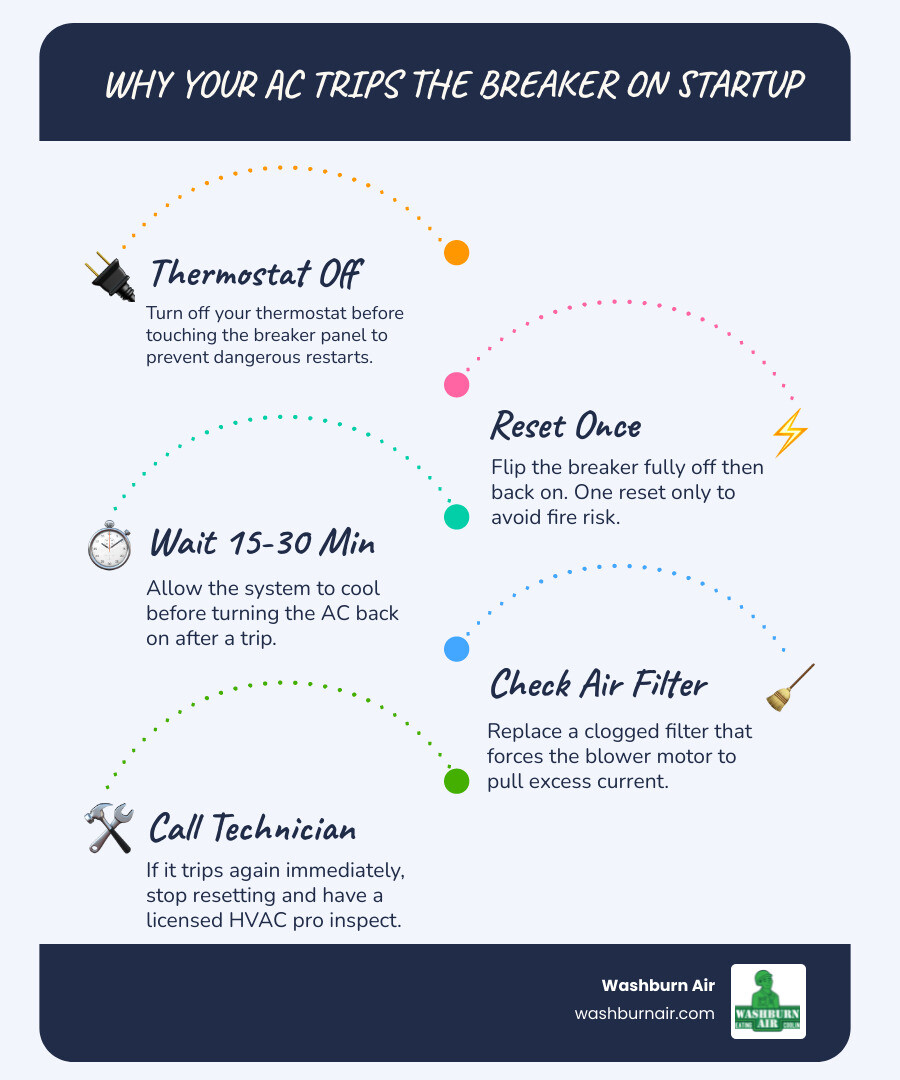
- Turn your thermostat off before touching the breaker panel.
- Reset the breaker once — flip it fully off, then back on.
- Wait 15–30 minutes before turning the AC back on.
- Check your air filter — a clogged filter forces the system to work harder and draw more current.
- Look at the outdoor unit — dirty condenser coils trap heat and strain the compressor.
- If it trips again immediately, stop resetting and call an HVAC technician. Repeated resets can destroy your compressor or create a fire hazard.
It’s a familiar scenario for homeowners across the Dallas-Fort Worth area: temperatures climb into the triple digits, you flip on the AC, and within seconds — silence. The breaker has tripped again.
This isn’t just an inconvenience. Your circuit breaker is doing exactly what it was designed to do — protecting your home’s wiring from dangerous levels of electrical current. A typical central air conditioner can pull three to five times its normal running amperage the moment it starts up, briefly spiking well past 60 amps on a circuit rated for far less. When something in the system is struggling — a weak capacitor, a dirty coil, a failing compressor — that startup surge becomes too much for the breaker to allow through.
The good news: some causes are simple fixes you can handle today. Others are serious electrical faults that need a licensed HVAC technician right away. Knowing the difference is what this guide is all about.
Understanding Overloads vs. Short Circuits in AC Systems
To understand why your air conditioner is misbehaving, it helps to look at how your electrical panel protects your home. Circuit breakers serve as overcurrent protection devices. They monitor the flow of electricity through your copper or aluminum wires. If the electrical current exceeds the breaker’s rated capacity, the internal switch flips, cutting off power before the wires can overheat, melt their insulation, or start a fire.
When your cooling system trips the breaker, the issue generally falls into one of two categories: an electrical overload or a short circuit. Distinguishing between these two can help you spot Air Conditioner Repair Warning Signs before major component damage occurs.
An electrical overload happens when your AC is forced to work too hard, gradually drawing more current than the circuit is designed to handle. Think of it as a slow build-up of electrical resistance and heat. If your system runs for 10, 15, or 30 minutes and then trips the breaker, you are likely dealing with an overload. This is often caused by restricted airflow, mechanical friction in a motor, or extreme outdoor heat forcing the compressor to work overtime.
A short circuit (or a ground fault), on the other hand, is an instantaneous event. A short circuit occurs when an active, current-carrying “hot” wire accidentally comes into direct contact with a neutral wire or a grounded portion of the system. Because electricity always seeks the path of least resistance, this direct connection causes the electrical current to bypass the normal appliance load and spike instantly. A grounded compressor, for example, can instantly draw over 100 amps upon startup, causing an immediate breaker trip within a fraction of a second of the unit turning on.
| Characteristic | Electrical Overload | Short Circuit / Ground Fault |
|---|---|---|
| Trip Timing | Gradual (takes 5 to 30+ minutes of operation) | Instantaneous (trips the millisecond the AC starts) |
| Primary Cause | Restricted airflow, mechanical strain, extreme weather | Exposed wires, failed motor windings, grounded compressor |
| Amperage Spike | Slightly above the breaker’s rated limit | Extreme spike (often exceeding 100+ amps instantly) |
| Risk Level | Moderate (damaging to AC parts if ignored) | High (immediate fire hazard and severe component damage) |
| Typical Solution | Clean coils, change filters, replace weak capacitors | Replace shorted motors, repair wiring, replace compressor |
Circuit Breaker Tripping When AC Turns On What to Do
When you are faced with a circuit breaker tripping when ac turns on what to do first is prioritize electrical safety. It is tempting to simply walk over to your electrical panel, flip the switch back to “On,” and hope for the best. However, repeatedly resetting a tripped breaker without investigating the root cause can lead to catastrophic failure of your compressor or even an electrical fire.
Before you touch your breaker panel, you should always adjust your thermostat settings. Turn the thermostat completely to the “Off” position. This prevents the air conditioner from trying to start up the exact millisecond you restore power, which can cause dangerous arcing inside the electrical panel.
Once the thermostat is off, you can safely inspect your home’s air filter. A heavily clogged filter acts like a wall, restricting the air your blower motor needs to pull through the system. This lack of airflow causes the motor to work significantly harder, spiking its electrical draw and contributing to a tripped circuit breaker.
For more tips on handling these situations during our intense Texas summers, check out our guide on How to Fix AC Breaker Trips in North Texas Heat Waves.
Step-by-Step Guide: Circuit Breaker Tripping When AC Turns On What to Do
To safely diagnose and address a tripping breaker, we recommend following this strict step-by-step protocol. This ensures you protect both your home’s electrical system and your expensive cooling equipment.
- Step 1: Turn Off the Thermostat. Go to your indoor thermostat and switch the system from “Cool” to “Off.”
- Step 2: Locate Your Electrical Panel. Find your main breaker panel, which is typically located in a garage, utility closet, basement, or on the exterior of your home. Locate the double-pole breaker labeled “AC,” “Air Conditioner,” or “HP” (Heat Pump).
- Step 3: Follow the One-Reset Rule. If the breaker has tripped, the switch will be stuck in a middle position between “On” and “Off.” To reset it, firmly push the switch all the way to the “Off” position until you hear a distinct click, then flip it back to “On.” Never reset a breaker more than once. If it trips again immediately or shortly after, leave it off.
- Step 4: Check and Replace the Air Filter. If the breaker stays on, go to your indoor return vents or furnace closet and inspect your air filter. If you cannot see light through the filter, replace it immediately with a fresh one.
- Step 5: Inspect the Outdoor Unit. Walk outside and ensure your condenser unit has at least two feet of clear space around it. Clear away any leaves, grass clippings, or overgrown bushes that might block airflow.
- Step 6: Wait 30 Minutes Before Restarting. Allow the system’s internal pressures to equalize and any warm components to cool down. After 30 minutes, turn your thermostat back to “Cool” and set it a few degrees below the room temperature.
- Step 7: Monitor the System. If the air conditioner starts up and runs smoothly, keep a close eye on it. If the breaker trips again, turn the thermostat off immediately and call a professional.
For a deeper dive into common issues you can resolve yourself, read our article on Common AC Issues and How to Troubleshoot Them Effectively.
Airflow Restrictions and Maintenance Culprits
Many homeowners are surprised to learn that simple maintenance neglect can cause major electrical failures. When your air conditioner cannot breathe, its mechanical components must work twice as hard to move air and heat, which directly translates to a higher draw of electrical current.
A dirty air filter is the most common culprit behind an overworked blower motor. When a filter is clogged with dust, pet dander, and debris, the blower motor must spin against immense resistance. This restriction can increase the blower motor’s electrical current draw by 20% to 30%, pushing your indoor circuit past its safe limit.
Similarly, dirty condenser coils on your outdoor unit can easily trip your breaker. The outdoor unit’s job is to release the heat collected from inside your home. If the metal fins of the condenser are coated in dirt, pollen, or mud, they act like a thick wool sweater, trapping heat inside the unit. Because the heat cannot escape, the refrigerant pressures inside the system spike. This forces the compressor to work incredibly hard to pump the refrigerant, causing its electrical draw to climb until the breaker trips.
Furthermore, restricted airflow can lead to frozen evaporator coils on your indoor unit. When the indoor coil drops below freezing, ice forms on the metal fins, blocking airflow completely. This can cause a dangerous mechanical condition known as liquid flood-back. Instead of receiving vaporized refrigerant, your compressor receives liquid refrigerant. Compressors are designed to compress gas, not liquid. Trying to compress a liquid places extreme mechanical strain on the compressor, causing its startup amperage to skyrocket and instantly trip the breaker.
Electrical Component Failures That Trigger Trips
While airflow issues are relatively simple to address, many breaker trips are caused by failing electrical components inside the outdoor condenser unit. Over years of surviving hot Texas summers in Grapevine, Southlake, or Irving, these parts naturally degrade and lose their efficiency.
The most common electrical failure point is the run capacitor or start capacitor. Capacitors act like temporary batteries, storing up electrical energy and releasing it in a quick burst to help the compressor and fan motors start spinning. Run capacitors typically last 8 to 12 years, but intense summer heat can significantly shorten that lifespan. When a capacitor weakens or fails, the compressor will struggle to start, drawing massive amounts of current as it hums in place before eventually tripping the breaker.
To assist aging compressors, we often install a hard-start kit. A hard-start kit consists of an additional start capacitor and a relay that can reduce compressor startup current by 50% to 75%, allowing the system to kick on quickly without causing a massive power surge.
A far more serious issue is a grounded compressor. Over time, the protective insulation surrounding the electrical motor windings inside your compressor can break down or melt. When this happens, the energized copper coils come into direct contact with the metal frame of the compressor. This creates a direct short to ground, allowing current to bypass all resistance. A grounded compressor can instantly draw over 100 amps upon startup, causing an immediate breaker trip. This is a terminal failure that usually requires replacing the entire compressor or the outdoor unit.
Additionally, a shorted fan motor in your outdoor unit can trigger a trip. If the motor windings in the outdoor fan fail, the excess current draw will shut down the entire circuit to prevent an electrical fire.
Finally, even a refrigerant leak can indirectly cause electrical trips. When your system is low on refrigerant, it must run continuously to try and cool your home. This continuous operation leads to compressor overheating, which degrades the motor insulation and increases current draw until the system shuts down.
Component Failures: Circuit Breaker Tripping When AC Turns On What to Do
When an internal component fails, your air conditioner will often hit its locked rotor amps (LRA). LRA is the maximum current a motor will draw when its rotor is completely stopped and cannot spin. If a bad capacitor or mechanical failure prevents the compressor from turning, it will pull its full LRA rating — often exceeding 100 amps — until the breaker cuts the power.
Another common electrical issue is contactor arcing. The contactor is an electrical switch that closes to send 240-volt power to your compressor and outdoor fan. Over time, the silver-plated contacts can become pitted, dirty, or burned. This causes electrical arcing, which creates high resistance, voltage drops, and can eventually weld the contacts shut or trip the breaker.
If you suspect an electrical component has failed inside your outdoor unit, it is time to call in the experts. Our team at Washburn Air can quickly diagnose and replace worn capacitors, contactors, and motors to restore your home’s comfort safely. Explore our full range of HVAC Services to see how we keep local systems running efficiently.
Modern GFCI and AFCI Breaker Sensitivity
If your home was built or remodeled recently in North Texas, your electrical panel likely features modern AFCI (Arc Fault Circuit Interrupter) or GFCI (Ground Fault Circuit Interrupter) breakers. While these advanced safety devices are excellent for preventing shocks and electrical fires, they are highly sensitive and can sometimes lead to what we call nuisance trips.
Standard breakers only trip when the current exceeds a specific amperage limit. AFCI breakers, however, use microprocessors to analyze the electrical waveform of the circuit. They look for the unique, sputtering signature of an electrical arc — such as a loose wire sparking behind a wall. GFCI breakers monitor the balance of current between the hot and neutral wires, tripping if they detect a leakage of even 4 to 6 milliamperes.
Modern air conditioners, especially those utilizing variable-speed motors or inverter technology, can naturally produce minor waveform distortion and high-frequency electrical noise during startup. Sensitive AFCI and GFCI breakers can sometimes misinterpret this normal electrical signature as a dangerous arc or ground fault, leading to repeated nuisance trips even when nothing is wrong with your AC.
Furthermore, older homes that have been retrofitted with newer panels can run into issues with shared neutrals (multi-wire branch circuits). While standard breakers are forgiving of these shared wiring configurations, modern AFCI breakers are fundamentally incompatible with them and will trip immediately under load. If you suspect your modern breaker is being overly sensitive, a licensed technician can perform advanced diagnostics to determine if you need a breaker replacement or a minor wiring adjustment.
Frequently Asked Questions About AC Breaker Issues
Can a refrigerant leak cause my AC circuit breaker to trip?
Yes, a refrigerant leak can absolutely cause your circuit breaker to trip. Refrigerant is responsible for carrying heat away from your indoor air, but it also serves a secondary purpose: it cools the compressor motor itself. When your system has a leak and is low on charge, the compressor must run continuously to try and reach your desired thermostat setting. This continuous operation, combined with the lack of cooling from the returning refrigerant gas, causes the compressor to overheat. As the compressor gets hotter, its electrical resistance increases, forcing it to draw more and more current until it exceeds the breaker’s limit and trips.
Is it safe to keep resetting a tripping breaker?
No, it is highly unsafe to repeatedly reset a tripping breaker. Circuit breakers are safety devices designed to prevent electrical fires. If a breaker trips, it is warning you that there is a dangerous level of current flowing through your wires. Flipping the switch back on over and over again forces high currents through damaged components and household wiring. This can quickly melt wire insulation, destroy the expensive compressor motor inside your outdoor unit, and create a severe fire hazard behind your walls. Always follow the “one-reset rule” — if it trips a second time, leave it off and call a professional.
Why do my lights dim when the AC turns on?
It is completely normal for your lights to dim very briefly (for less than a second) when your air conditioner kicks on. This happens because of inrush current. The moment your compressor starts spinning, it draws a massive spike of electricity — often 3 to 5 times its normal running current — to overcome inertia. This brief surge causes a temporary voltage drop across your home’s electrical system, making your lights flicker. However, if your lights dim dramatically, stay dim for several seconds, or if you hear buzzing or crackling sounds, you may have loose wiring connections or an aging compressor that needs a soft start kit or a professional inspection.
Conclusion
Dealing with an air conditioner that keeps cutting power can be incredibly frustrating, especially during our intense summer heat. While a quick filter change or a gentle rinse of your outdoor coils can sometimes resolve the issue, repeated breaker trips are usually a sign of a deeper mechanical or electrical problem that requires professional attention.
At Washburn Air, we provide top-tier heating, cooling, and indoor air quality services across the Dallas-Fort Worth area, including Grapevine, Southlake, Westlake, Trophy Club, Highland Park, Dallas, Fort Worth, Arlington, and Irving. With our 24/7 local expertise and commitment to honest, transparent service, we can quickly diagnose whether your system needs a simple capacitor replacement, a hard-start kit, or a more extensive repair.
Don’t let a tripping breaker leave you stranded in the Texas heat. Contact us today to schedule your professional AC Repair and get your home back to cool, comfortable safety.
{“@context”: “https://schema.org”, “@graph”: [{“@type”: “Article”, “headline”: “AC Circuit Breaker Tripping? What to Do | Washburn Air”, “description”: “Circuit breaker tripping when AC turns on what to do? Learn safe reset steps, warning signs, and when to call Washburn Air for AC repair.”, “author”: {“@type”: “Person”, “name”: “Washburn Air”}, “publisher”: {“@type”: “Organization”, “name”: “Washburn Air”, “logo”: {“@type”: “ImageObject”, “url”: “https://washburnair.com/wp-content/uploads/2024/09/washburn-air-logo-800-400×261.png”}}, “datePublished”: “2026-07-16T02:33:17+00:00”, “dateModified”: “2026-07-16T02:33:26.380647”, “mainEntityOfPage”: {“@type”: “WebPage”, “@id”: “https://washburnair.com/blog/how-to-fix-ac-breaker-tripping-when-ac-turns-on/”}, “image”: “https://images.unsplash.com/photo-1576446468729-7674e99608f5?crop=entropy&cs=tinysrgb&fit=max&fm=jpg&ixid=M3w2MTMxNjF8MHwxfHNlYXJjaHw5fHxjaXJjdWl0JTIwYnJlYWtlciUyMHRyaXBwaW5nJTIwd2hlbiUyMEFDJTIwdHVybnN8ZW58MHwwfHx8MTc4MjU2Mjc5Nnww&ixlib=rb-4.1.0&q=80&w=1080”}, {“@type”: “FAQPage”, “mainEntity”: [{“@type”: “Question”, “name”: “What should I do if my circuit breaker trips when the AC turns on?”, “acceptedAnswer”: {“@type”: “Answer”, “text”: “Turn the thermostat off before touching the breaker panel, then reset the breaker once by flipping it fully off and back on. Wait 15–30 minutes before turning the AC on again, and if it trips immediately, stop resetting it and call an HVAC technician.”}}, {“@type”: “Question”, “name”: “Why does my AC trip the circuit breaker when it starts?”, “acceptedAnswer”: {“@type”: “Answer”, “text”: “A central air conditioner can draw three to five times its normal running amperage at startup, briefly creating a large surge. If something is wrong, such as a weak capacitor, dirty coil, or failing compressor, the surge can become too much for the breaker.”}}, {“@type”: “Question”, “name”: “Can a dirty air filter cause the AC breaker to trip?”, “acceptedAnswer”: {“@type”: “Answer”, “text”: “Yes. A clogged air filter forces the AC system to work harder and draw more current, which can contribute to the breaker tripping.”}}, {“@type”: “Question”, “name”: “Why should I stop resetting the breaker if the AC keeps tripping it?”, “acceptedAnswer”: {“@type”: “Answer”, “text”: “Repeatedly resetting the breaker can damage the compressor or create a fire hazard. The breaker is protecting your home’s wiring from dangerous electrical current, so repeated trips should be inspected by a licensed HVAC technician.”}}, {“@type”: “Question”, “name”: “What is the difference between an AC electrical overload and a short circuit?”, “acceptedAnswer”: {“@type”: “Answer”, “text”: “An electrical overload happens when the AC is forced to work too hard and draws more current than the breaker can safely allow. A short circuit is another type of electrical fault, and both issues can cause the breaker to trip to prevent overheating or fire.”}}]}]}