Why Verifying Your HVAC Contractor’s License in Texas Protects Your Home and Wallet
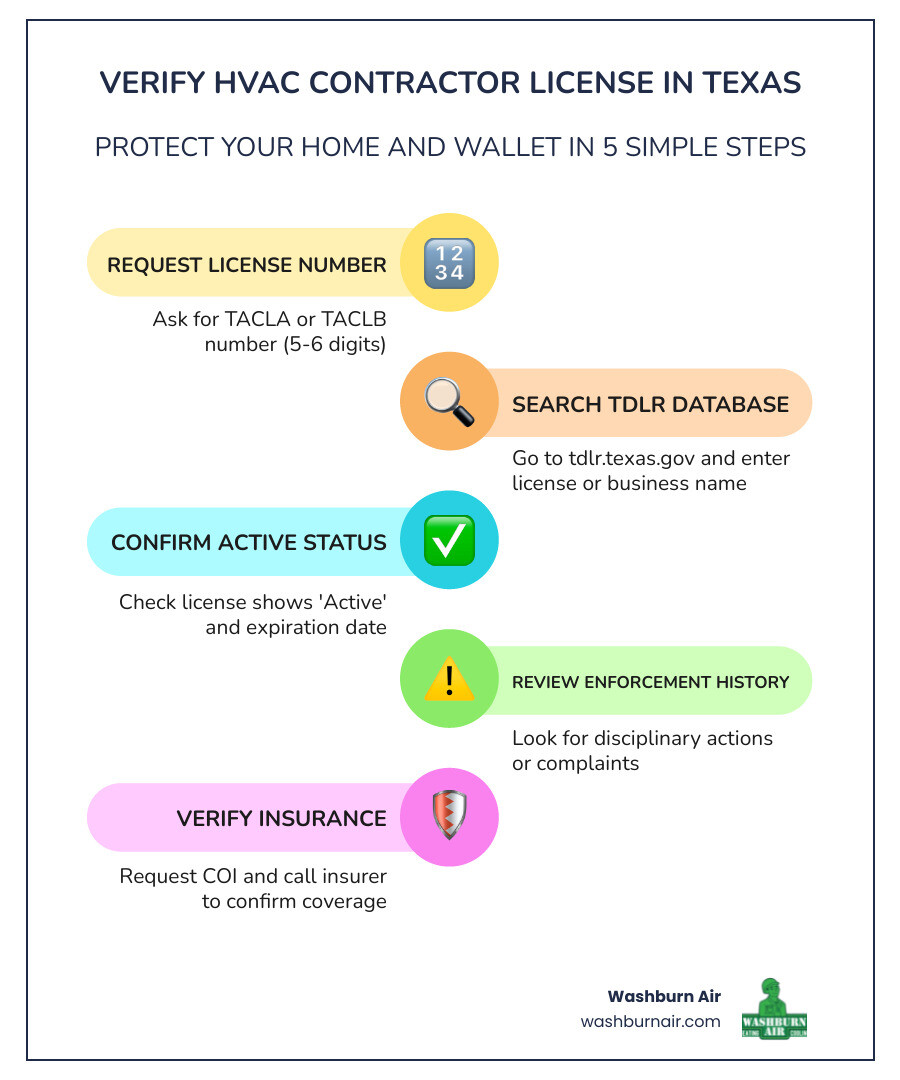
Knowing how to verify an HVAC contractor is licensed in Texas takes less than 10 minutes — and it could save you thousands of dollars. Here’s the fastest way to do it:
- Ask the contractor for their TDLR license number (format: TACLA or TACLB followed by 5-6 digits).
- Go to tdlr.texas.gov/LicenseSearch and search by license number or business name.
- Confirm the license status shows “Active” and that the expiration date has not passed.
- Check the enforcement section for any disciplinary actions, penalties, or suspensions.
- Request a Certificate of Insurance and call the insurer directly to confirm coverage is current.
That’s the core process. The sections below walk you through each step in detail — including what to do if something doesn’t look right.
Texas summers are no joke. When your AC goes down during a heat wave, the pressure to hire someone fast is real. That urgency is exactly what unlicensed contractors count on. According to available data, an estimated 3 out of every 10,000 Texas homeowners fall victim to home improvement scams each year, with many losing more than $2,200 in the process.
Unlike most trades in Texas — where licensing is handled at the city level or not required at all — HVAC work is one of the few specialties that requires a state-issued license through the Texas Department of Licensing and Regulation (TDLR). That means there’s a clear, publicly searchable record for every legitimate HVAC contractor operating in the state. You just need to know where to look and what to look for.
For more guidance on choosing the right HVAC company, see our Honest Advice on Picking an HVAC Company.
What is the Texas HVAC Licensing Framework?
In Texas, the state regulatory body in charge of protecting consumers and overseeing trade professionals is the Texas Department of Licensing and Regulation (TDLR). Under Texas Occupations Code Chapter 1302, anyone who installs, alters, repairs, services, or maintains air conditioning, heating, or refrigeration systems must hold an active state license.
This strict framework exists for a very good reason. Your heating and cooling systems are complex machines that combine high-voltage electricity, pressurized chemical refrigerants, and sometimes natural gas or propane. In our demanding North Texas climate, the average equipment lifespan of HVAC systems is 12 to 15 years. However, a system that is poorly installed or incorrectly serviced by an unlicensed individual can suffer from premature failure, high utility bills, and even pose severe safety risks like carbon monoxide leaks or electrical fires.
To ensure your home comfort system achieves its full lifespan safely, you should only trust verified professionals. When you invest in professional HVAC Services, you are paying for technical expertise that complies with strict state safety codes.
Class A vs. Class B Texas HVAC Licenses
When you look up a contractor’s license, you will notice that the license number begins with either TACLA or TACLB. These prefixes represent the two distinct classes of Air Conditioning and Refrigeration (ACR) licenses in Texas. Understanding the difference between the two is vital to ensuring your contractor is legally allowed to work on your specific system.
- Class A (TACLA): A Class A license allows the contractor to work on any size system. There are absolutely no cooling capacity or heating capacity limits. This class is required for large commercial projects, but Class A contractors are also fully authorized to perform residential work.
- Class B (TACLB): A Class B license is slightly more restricted. Contractors holding a Class B license can work on cooling systems of 25 tons and under, and heating systems of 1.5 million BTUs per hour and under. Because a typical residential AC unit is only between 2 and 5 tons, a Class B license is more than sufficient for virtually any residential home in the Dallas-Fort Worth metroplex.
Both license classes require the applicant to meet rigorous experience requirements (typically 36 to 48 months of documented practical experience under a licensed supervisor), pass a comprehensive state exam, and undergo a criminal background check.
Here is a quick comparison of the scope and state-mandated insurance minimums for both license classes:
| License Type | Cooling Capacity Limit | Heating Capacity Limit | Minimum General Liability Insurance |
|---|---|---|---|
| Class A (TACLA) | Unlimited | Unlimited | $300,000 per occurrence / $600,000 aggregate |
| Class B (TACLB) | 25 Tons and Under | 1.5 Million BTUs/hr and Under | $100,000 per occurrence / $200,000 aggregate |
Step-by-Step: How to Verify an HVAC Contractor is Licensed in Texas
Do not rely on verbal promises or a logo on a truck. Taking a few minutes to actively verify a contractor’s credentials is the single best way to protect your home. Follow this simple three-step verification process before signing any contract or allowing a technician to touch your HVAC system.
Step 1: Request the TACLA or TACLB License Number
A reputable, licensed Texas HVAC contractor will never hesitate to provide their license number. In fact, state law requires licensed contractors to display their license number on:
- All service vehicles (in clear, readable lettering)
- Business cards and printed invoices
- Proposals, contracts, and written estimates
- Company websites and promotional materials
The license format is straightforward. It will always start with TACLA or TACLB, followed by a five- or six-digit number, and end with an alphabetical endorsement letter (such as “E” for Environmental Air Conditioning, or “C” for Commercial Refrigeration). If a contractor claims they “left their card in the truck” or makes excuses about why they cannot provide their number immediately, treat this as an immediate red flag.
Step 2: Search the TDLR Database to Verify an HVAC Contractor is Licensed in Texas
Once you have the license number or the official registered business name, head directly to the state’s official lookup tool.
- Navigate to the TDLR Active License Data Search portal.
- Select Air Conditioning and Refrigeration Contractors from the license type dropdown menu.
- Enter the license number (digits only) or search by the contractor’s legal name or business name.
- Review the search results carefully.
When looking at the results, verify that the License Status is marked as Active. If the status shows as Expired, Suspended, Revoked, or Inactive (note: Texas does not actually offer an official inactive status for HVAC licenses, so any non-active status is a problem), do not hire them. Additionally, check that the business name listed on the state database matches the name on the contract or proposal you were given.
Step 3: Check for Disciplinary Actions and Enforcement History
An active license status is great, but it does not tell the whole story. You also want to make sure the contractor has a clean history of ethical work.
The TDLR maintains a separate, public database for administrative penalties, violations, and enforcement actions. From the TDLR homepage, navigate to the Enforcement Actions search portal. Here, you can search by the contractor’s name or license number to see if they have been fined, cited, or disciplined for safety violations, working without permits, or performing substandard work in the past. A history of repeated consumer complaints or state penalties is a clear sign to look elsewhere.
Verifying Insurance, Bonding, and Municipal Permits
While a state license proves a contractor has the technical knowledge to do the job, active insurance coverage protects you from financial ruin if something goes wrong. If an uninsured worker is injured on your property, or if they accidentally trigger a fire or water leak that damages your home, you could be held liable.
To maintain an active license with the TDLR, Texas HVAC contractors must submit proof of commercial general liability insurance. However, because policies can lapse or be canceled after a contractor registers with the state, you should always request a current Certificate of Insurance (COI) directly from the contractor.
To be absolutely sure, do not just look at the piece of paper. Call the insurance agency listed on the COI to confirm that the policy is active, paid up, and carries sufficient coverage limits. For residential projects, we highly recommend working with a contractor who carries at least $500,000 in general liability coverage, along with workers’ compensation insurance to protect their technicians.
For more information on what to expect during a professional installation or repair, check out our HVAC FAQ.
Local City Registrations and Mechanical Permits
State licensing is only the first step. In Texas, local municipalities hold the authority over building codes, permits, and inspections. Even though a contractor holds a valid state TDLR license, they must still register with the local city building department and pull a mechanical permit before installing or replacing an HVAC system.
This is a critical step that many homeowners overlook. If you live in Dallas, Fort Worth, Arlington, Irving, Grapevine, Southlake, Westlake, Trophy Club, or Highland Park, your local city hall requires a permit for any complete system changeout.
- Who pulls the permit? The licensed HVAC contractor is legally responsible for pulling the permit in their own name. Never allow a contractor to ask you, the homeowner, to pull a homeowner’s permit for HVAC work. If they ask you to do this, it usually means they are unlicensed, unregistered in that city, or trying to avoid a professional inspection.
- Why permits matter: Once the installation is complete, a municipal city inspector will visit your home to review the work. They verify that the system complies with current local building and energy codes. This inspection is your ultimate safety net, ensuring the job was done perfectly.
Red Flags of an Unlicensed or Out-of-Scope Contractor
Scammers and unlicensed operations have developed clever ways to bypass state laws. To protect your home and family, keep a close eye out for these common warning signs:
- Unmarked service vehicles: Legitimate companies take pride in their brand. Vehicles that lack permanent company decals, logos, or the mandatory TDLR license number are a massive red flag.
- Cash-only or high down payments: If a contractor demands payment entirely in cash, or asks for more than a 30% deposit upfront before any equipment arrives, walk away.
- No physical business address: If the contractor only lists a P.O. Box or refuses to provide a physical shop address, they may be difficult to track down if the system fails.
- Refusing to sign a written contract: A professional will always provide a detailed, written contract outlining the scope of work, equipment models, warranty details, and payment milestones.
- “We don’t need a permit”: Any contractor who claims a permit is “just an unnecessary city tax” or tries to convince you to skip the inspection is likely trying to hide substandard work.
- High-pressure sales tactics: Be wary of technicians who use scare tactics to pressure you into making an immediate decision on a high-cost system replacement without allowing you to verify their credentials.
Hiring an unlicensed contractor is not just a risk to your home — it can carry legal consequences. In Texas, hiring an unlicensed individual for specialized trade work like electrical can be classified as a Class C misdemeanor, carrying fines of up to $500. Additionally, most manufacturers will immediately void their equipment warranties if the system was not installed by a licensed professional.
What to Do If You Hired an Unlicensed Contractor
If you realize mid-project that the contractor you hired does not hold an active state license, take these steps immediately:
- Stop all work: Instruct the crew to stop working and leave your property immediately. Do not allow them to make further adjustments to your electrical panel, gas lines, or refrigerant loops.
- Do not pay any remaining balance: Withhold any outstanding payments. Unlicensed contracting is illegal in Texas, and they have no legal standing to demand payment for unlicensed trade work.
- File a formal complaint with the TDLR: Use the TDLR’s online complaint portal to report the individual and the business for performing unlicensed ACR work. Provide copies of invoices, text messages, and photos of their vehicles.
- Contact local code enforcement: Call your local city building department (whether you are in Grapevine, Southlake, Fort Worth, or Dallas) to report the unpermitted work. They can guide you on how to get the system inspected and brought up to code safely.
Frequently Asked Questions about Texas HVAC Licensing
Can an unlicensed person perform any AC maintenance in Texas?
Yes, but their legal scope of work is extremely limited. An unlicensed individual or a general handyman is only allowed to perform basic, non-invasive maintenance. This includes replacing air filters, cleaning accessible outdoor condenser coils with a garden hose, or clearing away leaves and debris.
Any work that involves opening the electrical cabinet, diagnosing electrical components, connecting gauges to check refrigerant pressures, repairing gas lines, or replacing components requires a TDLR license. Furthermore, anyone handling chemical refrigerants must hold a personal EPA Section 608 certification in addition to working under a licensed contractor.
How do I verify an HVAC contractor is licensed in Texas if they only have a city registration?
A city registration is not a substitute for a state HVAC license. While general contractors (who handle drywall, painting, or framing) are only registered at the municipal level, mechanical trades like HVAC, plumbing, and electrical must hold a state-level license.
If a contractor shows you a city registration certificate but cannot provide a TACLA or TACLB state license number, they are operating illegally. Always verify their credentials through the state TDLR portal first, then confirm they are registered to pull permits in your specific city.
Does Texas reciprocate HVAC licenses with other states?
Yes, but only under very strict guidelines. As of 2026, Texas only has active license reciprocity agreements for HVAC contractors with two states: Georgia and South Carolina.
An out-of-state contractor from any other state must go through the full Texas application process, prove their experience, and pass the TDLR exam before they can legally perform HVAC work in Texas.
Protect Your Comfort with Verified DFW Experts
When it comes to keeping your home cool in the blistering Texas heat, there is no room for shortcuts. Verifying that your HVAC contractor is fully licensed, insured, and registered locally is the single best investment of time you can make as a homeowner.
At Washburn Air, we believe in complete transparency and absolute compliance with all Texas state laws and local DFW building codes. Based in Grapevine, Texas, we provide premier heating, cooling, and indoor air quality services across the entire Dallas-Fort Worth metroplex — including Dallas, Fort Worth, Arlington, Irving, Grapevine, Southlake, Westlake, Trophy Club, and Highland Park.
Our team brings 24/7 local expertise and full-service support to ensure your year-round home comfort. We display our licensing proudly, maintain robust insurance coverage, and handle all city permit filings and inspections on your behalf.
To learn more about our commitment to quality, visit our About Us page. Ready to experience the peace of mind that comes with hiring verified, local professionals? Contact Us today to schedule your next service or system evaluation!
{“@context”: “https://schema.org”, “@graph”: [{“@type”: “Article”, “headline”: “Verify HVAC Contractor License in Texas | Washburn Air”, “description”: “Learn how to verify an HVAC contractor is licensed in Texas with TDLR steps, insurance checks, and red flags. Protect your home—read now.”, “author”: {“@type”: “Person”, “name”: “Washburn Air”}, “publisher”: {“@type”: “Organization”, “name”: “Washburn Air”, “logo”: {“@type”: “ImageObject”, “url”: “https://washburnair.com/wp-content/uploads/2024/09/washburn-air-logo-800-400×261.png”}}, “datePublished”: “2026-07-09T02:32:55+00:00”, “dateModified”: “2026-07-09T02:33:07.670396”, “mainEntityOfPage”: {“@type”: “WebPage”, “@id”: “https://washburnair.com/blog/how-to-verify-an-hvac-contractor-license-in-texas/”}, “image”: “https://images.bannerbear.com/direct/4mGpW3zwpg0ZK0AxQw/requests/000/150/373/522/KZA1qL8r0zleMoo26epakDXbM/62bde09e330d4e5951ff85bbb488b556e7be27d3.jpg”}, {“@type”: “FAQPage”, “mainEntity”: [{“@type”: “Question”, “name”: “How do I verify an HVAC contractor license in Texas?”, “acceptedAnswer”: {“@type”: “Answer”, “text”: “Ask the contractor for their TDLR license number, which should start with TACLA or TACLB followed by 5-6 digits. Then go to tdlr.texas.gov/LicenseSearch, search by license number or business name, and confirm the license is active and not expired.”}}, {“@type”: “Question”, “name”: “What should I check when verifying a Texas HVAC license?”, “acceptedAnswer”: {“@type”: “Answer”, “text”: “Confirm the license status shows \”Active\” and that the expiration date has not passed. You should also check the enforcement section for disciplinary actions, penalties, or suspensions.”}}, {“@type”: “Question”, “name”: “Why is it important to verify an HVAC contractor’s license in Texas?”, “acceptedAnswer”: {“@type”: “Answer”, “text”: “Verifying a license helps protect your home and wallet from unlicensed contractors and home improvement scams. The article notes that some Texas homeowners lose more than $2,200 to these scams.”}}, {“@type”: “Question”, “name”: “Who regulates HVAC contractors in Texas?”, “acceptedAnswer”: {“@type”: “Answer”, “text”: “HVAC contractors in Texas are regulated by the Texas Department of Licensing and Regulation (TDLR). Under Texas Occupations Code Chapter 1302, anyone who installs, alters, repairs, services, or maintains air conditioning, heating, or refrigeration systems must hold an active state license.”}}, {“@type”: “Question”, “name”: “Should I ask a Texas HVAC contractor for proof of insurance?”, “acceptedAnswer”: {“@type”: “Answer”, “text”: “Yes, you should request a Certificate of Insurance from the contractor. The article recommends calling the insurer directly to confirm that the coverage is current.”}}]}]}