Facing a Dead AC in 100-Degree Weather: Quick Fix or Fresh Start?
Are you sitting in a rapidly warming house right now, wondering if your air conditioning system is completely dead or just sidelined by a single faulty part? When your cooling system shuts down suddenly during a peak July heatwave, the first thing on your mind is getting the cold air flowing again. However, making the choice between Replacing a Capacitor vs. Buying a Whole New Unit During Peak Texas Heat requires looking past the immediate panic of a hot house.
In our years of keeping Grapevine homes cool, the Washburn Air team often finds that the diagnosis for a sudden summer breakdown is a blown dual run capacitor. This small, relatively simple component is one of the most common failure points in extreme weather. But when your system is aging, that single broken part forces a much larger decision. You must choose between the immediate relief of a quick part replacement and the long-term reliability of a completely new system.
The core challenge: Making this decision while your home is sweltering can feel overwhelming. It is easy to authorize a quick fix just to get through the night, or conversely, to panic-buy a new system out of fear. The best approach is to step back, evaluate the overall health of your equipment, and use objective criteria to determine whether your system just needs a fresh part or if it is finally time for a fresh start.
Why Extreme Summer Heat Destroys AC Capacitors
To understand why you are facing this breakdown, it helps to understand what this component actually does. The capacitor acts as a massive battery for your air conditioner. It stores an electrical charge and delivers a powerful jolt of energy to jump-start the compressor and fan motors every time a cooling cycle begins. Because it handles high voltage, it is highly susceptible to failure under intense thermal and electrical load.
Texas heatwaves force continuous AC cycling, which is the primary cause of electrical component fatigue. During peak July conditions, our technicians see exactly how extreme summer temperatures break down this critical part in the field:
- Continuous Runtime and Thermal Saturation: During a peak July heatwave, your air conditioner rarely gets a chance to rest. Because the system runs constantly to combat 100-degree outdoor temperatures, the internal components never cool down. This severe thermal stress literally bakes the sensitive internal oils and wiring inside the capacitor.
- Electrical Grid Strain: Extreme summer heat means every home in your neighborhood is running their AC at full blast. This massive demand can cause subtle voltage drops and fluctuations on the local electrical grid. Your capacitor has to work much harder to store and deliver the correct voltage to your compressor when the incoming power supply is inconsistent.
- Internal Pressure Buildup: As the capacitor absorbs both the ambient outdoor heat and the heat generated by its own electrical resistance, the chemical fluids inside begin to expand. Eventually, this causes the top of the component to bulge outward, breaking the internal connections and causing a total failure.
- Motor Drag: If your fan motor or compressor is old and dirty, it requires more energy to start up. This forces the capacitor to deliver a larger electrical charge than it was designed to handle, accelerating its deterioration.
A critical safety warning: Because these components store lethal amounts of electrical charge even when the main power is disconnected, testing and replacing a dual run capacitor requires a licensed professional. Never attempt to open the condenser panel or touch high-voltage electrical parts yourself.
Is It Just a Bad Part, or System-Wide Fatigue?
When a capacitor blows, it is tempting to view it as an isolated incident. However, our team at Washburn Air always advises shifting your perspective from a single broken part to the overall health of the entire cooling system. The capacitor and the compressor have a deeply intertwined relationship, and the failure of one often signals severe fatigue in the other.
The Problem: A blown capacitor stops your system from running, but the underlying issue may actually be a failing compressor. As an air conditioner ages, the mechanical bearings inside the compressor begin to wear down. This wear creates physical resistance, meaning the compressor requires substantially more electrical power to start turning.
The Cause: To overcome this mechanical resistance, the capacitor has to work overtime, delivering massive spikes of electricity. Eventually, the capacitor burns out from the strain. In these cases, the blown capacitor is not the root problem; it is merely a symptom of a dying compressor that is pulling too much power.
The Solution: You must evaluate the “relative cost burden” of the repair. This means weighing the cumulative frequency of your recent repair bills against the system’s remaining lifespan. If fixing the immediate issue only buys you a few weeks before another major component fails, a simple part replacement is no longer a sound investment.
The Danger of ‘Band-Aid’ Repairs on Stressed Compressors
If your system has a failing capacitor, there is a high probability that the compressor has been struggling to start for weeks or even months prior to the total breakdown. This phenomenon is known as a “hard start.” Every time a compressor struggles to turn on without the proper electrical support, it draws excess amperage, which generates massive amounts of internal heat.
Restoring power with a brand-new capacitor might get the system blowing cold air again today, but it cannot undo the hidden thermal damage that the compressor has already sustained. A “Band-Aid” repair on a highly stressed system often leads to a catastrophic compressor failure later in the summer—leaving you stranded in the heat once again.
When Replacing the Capacitor is the Smart Choice
A failed electrical component does not automatically mean your entire air conditioner belongs in the scrapyard. There are many scenarios where a simple repair is the most logical, cost-effective, and safe path forward. You should feel confident authorizing a capacitor replacement if your system meets the following objective criteria:
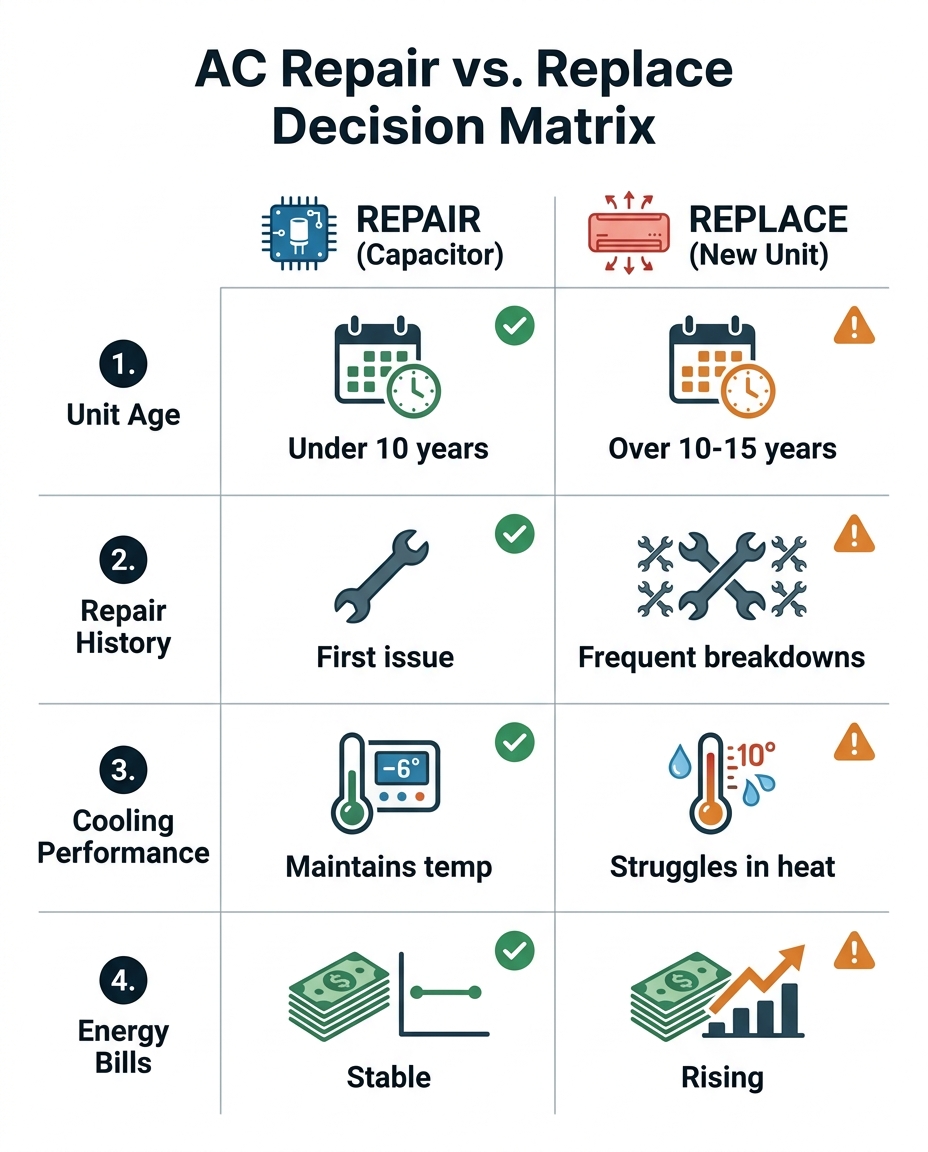
- The system is under 10 years old: If your unit is relatively young and has been generally well-maintained with annual tune-ups, a blown capacitor is likely just a routine wear-and-tear issue rather than a sign of systemic failure.
- This is the first major component failure: If your air conditioner has a clean history with no prior breakdowns, fixing this single part is usually a very safe bet. Systems that do not have a history of frequent breakdowns are generally healthy overall.
- Historical cooling performance is excellent: If the air conditioner has historically had no trouble maintaining comfortable indoor temperatures, even on the hottest days of the year, the core components (like the compressor and coils) are likely still in great shape.
- Energy bills have remained stable: A system that is quietly failing will draw excess power, driving up your monthly utility costs. If your overall energy bills have remained consistent and stable over the past few summers, it indicates the unit is still running efficiently.
If your system checks all these boxes, the decision is straightforward. A quick part replacement by a licensed technician will restore your comfort rapidly without requiring a massive long-term investment.
When Buying a Whole New Unit Provides Better Long-Term Value
There comes a tipping point where the constant cycle of fixing an aging, heat-stressed system outweighs the benefits of keeping it running. Air conditioners in hot climates like Texas often have a shorter lifespan of roughly 10 to 15 years due to increased runtime and high thermal loads compared to national averages. If your system is heavily fatigued, investing in a replacement is often the superior choice.
Based on the patterns we see in local neighborhoods, consider the pros and cons of replacing the entire unit if you are facing these realities in Grapevine TX:
- The unit is 10-15+ years old: According to ENERGY STAR guidelines, systems in this age bracket are prime candidates for replacement, especially if they are relying on outdated, phased-out refrigerants that make future repairs exponentially more difficult.
- A history of multiple repairs: If you have already replaced fan motors, contactors, or dealt with refrigerant leaks over the last few cooling seasons, a blown capacitor is a massive red flag that the system is entering a phase of cascading failures.
- Uneven or inadequate cooling: If the AC struggles to cool the home evenly, which is often why older Grapevine homes struggle with upstairs cooling, a new part will not fix the underlying capacity or airflow issues.
- Access to high-efficiency technology: Newer units offer vastly improved energy efficiency. This is critical when your system runs constantly during Texas summers. Upgrading to a modern system significantly reduces the daily electrical load required to cool your home.
Additionally, general energy rebates or federal tax credits may be available for high-efficiency heat pump and air conditioning upgrades. While you should always verify current local programs with your utility provider or a tax professional, these incentives can make a full replacement much more viable.
The Hidden Costs of Keeping an Obsolete System
Choosing to repair a dying system often carries hidden financial burdens that extend far beyond the immediate invoice. First, you face rising utility bills due to degraded efficiency; an old, struggling compressor consumes significantly more electricity just to provide the same amount of cooling. Second, you carry the constant risk of a catastrophic compressor failure later in the summer, which would force a full replacement anyway. Finally, holding onto an obsolete system deprives you of the peace of mind that comes with a comprehensive new manufacturer warranty.
Side-by-Side Comparison: Repair vs. Replace Decision Matrix
To help synthesize this information, we have created a clear, scannable comparison table. This matrix empowers you to evaluate your options based on objective criteria rather than fear or the immediate pressure of a hot house.
| Decision Factor | Capacitor Replacement (Repair) | System Replacement (New Unit) |
|---|---|---|
| Immediate Relief | Fastest way to restore cooling today, assuming no other parts are damaged. | Requires scheduling an installation, but permanently resolves the breakdown. |
| Long-Term Reliability | Low to moderate. Does not prevent aging compressors or motors from failing next. | High. A brand-new system provides a clean slate with zero accumulated heat stress. |
| Energy Efficiency | Maintains the current efficiency of your aging system; will not lower utility bills. | Drastically improves efficiency, reducing the daily electrical load during peak summer. |
| Future Breakdown Risk | High on systems over 10 years old; cascading part failures are common. | Very low, backed by comprehensive manufacturer warranties for peace of mind. |
The key takeaway is that repairs offer fast, short-term solutions, while replacements offer guaranteed performance and warranty protection. Always base your choice on the age, history, and overall performance of your specific equipment.
Frequently Asked Questions About AC Failures in Extreme Heat
Is it worth replacing a capacitor on an old AC?
It depends heavily on the overall condition of the system. If the air conditioner is over 15 years old and has a history of struggling to cool your home, replacing the part might only buy you a few weeks of comfort. However, if the old unit has been rigorously maintained and this is its very first breakdown, a simple replacement is often a worthwhile and effective fix.
Does extreme heat cause AC capacitors to fail?
Yes, extreme ambient temperatures are the leading cause of electrical component failure in HVAC systems. When the outdoor temperature spikes, the air conditioner runs continuously, preventing the capacitor from dissipating its own internal heat. This severe thermal stress breaks down the internal chemicals, eventually causing the part to bulge, leak, and fail completely.
How do I know if I need a new AC or just a repair?
You can make this determination by looking at a combination of age, repair frequency, and cooling history. If your unit is under a decade old, cools perfectly, and has never broken down before, a repair is the right call. If the system is older, requires frequent service calls, and leaves certain rooms in your house feeling warm, it is time to consider a full replacement.
How long does an AC last after replacing the capacitor?
If the rest of the system is healthy, replacing this component can keep your air conditioner running smoothly for several more years. However, if the original part blew because the compressor is failing and drawing too much electrical current, the new capacitor might burn out again in a matter of weeks. A thorough diagnostic by a professional will determine the true health of the system.
Can a bad capacitor permanently ruin my compressor?
Yes, it absolutely can. When this component fails, it can no longer provide the massive electrical boost the compressor needs to start turning. The compressor will repeatedly try to turn on without adequate power, a condition known as a “hard start,” which generates extreme internal heat and can permanently damage the compressor’s mechanical bearings and electrical windings.
Get an Honest Assessment for Your Struggling AC
Ultimately, making the right choice about Replacing a Capacitor vs. Buying a Whole New Unit During Peak Texas Heat comes down to having all the facts. A blown electrical component does not always mean the end of your air conditioner, but it certainly warrants a much closer look at the system’s overall health, age, and repair history.
At Washburn Air, we believe in providing honest, transparent assessments to ensure you are never pressured into buying a whole new system if a simple repair is safe and reliable. Our technicians will evaluate your unit’s cooling history and mechanical condition to give you clear, objective criteria for your next steps. If you are sitting in a hot house and need answers today, reach out to schedule a professional diagnostic and get the pressure-free options you deserve.