Should I Repair or Replace My Air Conditioner in North Texas? Here’s What You Need to Know First
If you’re trying to figure out should I repair or replace my air conditioner in North Texas, the short answer depends on three things: your system’s age, the cost of the repair, and how hard the Texas climate has already worked it.
Here’s a quick decision guide:
| Situation | Likely Best Move |
|---|---|
| System is under 8 years old, minor repair needed | Repair |
| System is 8–12 years old, moderate repair cost | Evaluate using the 50% Rule |
| System is 12+ years old, major component failure | Replace |
| System uses R-22 refrigerant and needs a recharge | Replace |
| You’ve had 3+ repairs in the past 2 years | Replace |
| Energy bills keep climbing year over year | Replace |
North Texas is one of the hardest places in the country to own an air conditioner. The Dallas-Fort Worth area sees 2,756 cooling degree days per year — that’s 2.3 times the national average. While a well-maintained AC in a northern climate might last 15 years or more, systems here typically give out somewhere between 10 and 13 years. Your unit isn’t just cooling your home four months a year — it’s running hard for seven months straight.
That kind of workload changes the math on every repair decision you’ll ever face. A repair that makes perfect sense in Minnesota might be throwing good money after bad in Grapevine or Southlake.
This guide walks you through exactly how to think about it — step by step, without the sales pressure.
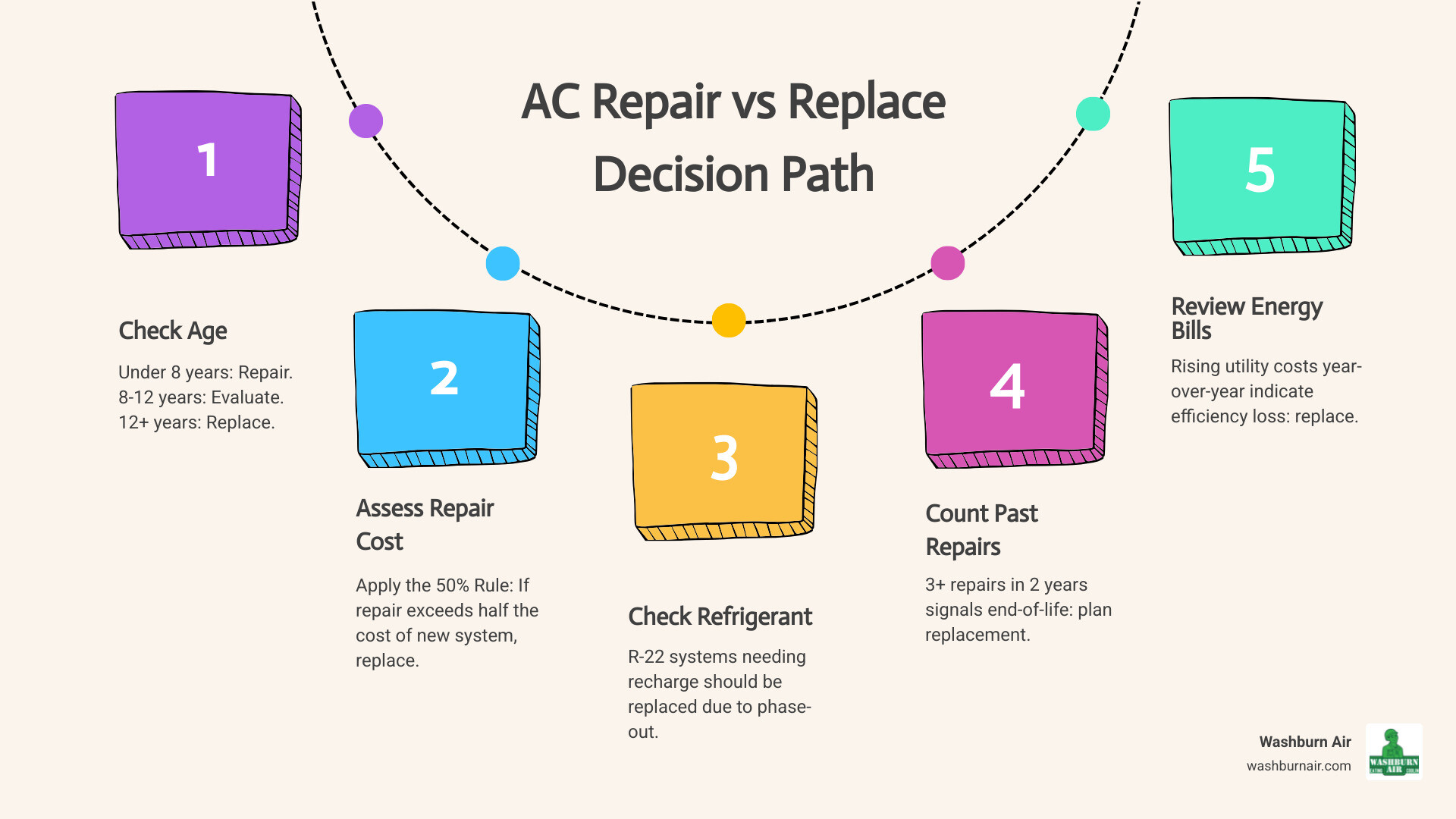
Key Factors: Should I Repair or Replace My Air Conditioner in North Texas?

When your cooling system begins to struggle in the middle of a hot summer afternoon, it is easy to panic. However, making a rushed choice can lead to years of unnecessary utility costs or repeated service calls. The choice between scheduling an AC Repair and investing in a full AC Replacement comes down to evaluating the long-term value of your equipment.
As the old saying goes, you do not want to put a high-priced saddle on a low-value horse. Spending a significant amount of money to patch up a system that is already near the end of its useful life is rarely a sound financial decision. In North Texas, our extreme summer temperatures accelerate equipment degradation, which means minor component wear can rapidly turn into a total system breakdown.
To make an objective decision, we recommend looking at several key factors:
- The severity of the issue: Is it a simple electrical fix, or is a critical component like the compressor or coil failing?
- The frequency of breakdowns: Have you had multiple service calls over the last two cooling seasons?
- The overall system efficiency: Are your monthly energy bills climbing even though you have not changed your cooling habits?
How Age and Climate Affect Whether Should I Repair or Replace My Air Conditioner in North Texas
The climate in the Dallas-Fort Worth metroplex is uniquely demanding. Because our systems run for approximately seven months out of the year—compared to only four months in cooler northern states—an air conditioner in Arlington or Irving accumulates wear and tear at an accelerated rate.
While national averages suggest a central air conditioner can last up to 15 or 20 years, the reality in North Texas is different. Most local systems have a typical lifespan of 12 to 13 years, even with regular professional maintenance. By the time a system reaches its tenth year in our climate, it has logged equivalent operating hours to a 15-year-old system in a milder state.
Understanding this difference is crucial when planning your home comfort strategy. You can read more about how our local weather patterns place unique demands on your equipment in our guide on Understanding HVAC Dallas Fort Worth Summer.
Using the 50% Rule to Decide: Should I Repair or Replace My Air Conditioner in North Texas?
One of the most reliable frameworks used by industry professionals is the 50% Rule. The rule is simple: if the cost of repairing your current air conditioner is more than 50% of the cost of a brand-new system, replacement is almost always the smarter financial move.
In demanding climates like North Texas, many homeowners find that a tighter 40% threshold is actually more appropriate for systems that are over 10 years old. If an aging system requires a major intervention, such as an AC Compressor Replacement, the likelihood of subsequent component failures in the near future is high.
Another helpful math-based tool is the Age-Times-Repair formula. Multiply the age of your system by the repair quote you received. If the resulting number exceeds a standard threshold of 5,000, it strongly indicates that replacing the unit will provide a better return on your investment over time.
Warning Signs Your North Texas AC is Nearing End of Life
An air conditioner rarely fails completely without giving off a few warning signs first. Recognizing these indicators early allows you to make a planned decision rather than an emergency choice in the middle of a triple-digit heatwave.
Some of the most common Air Conditioner Repair Warning Signs include:
- Inconsistent temperatures: Certain rooms in your home remain warm while others are freezing.
- Frequent cycling: The outdoor unit turns on and off rapidly without ever completing a full, steady cooling cycle.
- Excessive noise: Banging, squealing, or grinding sounds coming from the outdoor condenser or indoor air handler.
- Physical deterioration: Visible rust, corrosion, or persistent moisture pooling around the base of the equipment.
Refrigerant Phase-Outs and Older Systems
The type of refrigerant your air conditioner uses is one of the most critical factors in the repair-versus-replace equation. Older systems manufactured before 2010 rely on R-22 refrigerant (commonly known as Freon). Due to environmental regulations, the production and import of R-22 was completely phased out in 2020.
As a result, the cost of R-22 has increased by over 500% because HVAC companies must rely entirely on limited, recycled supplies. If your older system develops a leak, recharging it can be incredibly expensive. Furthermore, patching a leak on an aging coil is often a temporary fix, as older copper coils naturally corrode over time.
Modern systems transitioned to R-410A, which is also currently undergoing phase-downs as the industry shifts toward newer, low-GWP (Global Warming Potential) A2L refrigerants. If your system still runs on R-22, any refrigerant-related failure is an automatic trigger for system replacement, as repairing these obsolete units is no longer economically viable. To learn more about why these issues occur, explore our resource on Understanding Refrigerant Leaks: Causes and Solutions.
Efficiency Loss and Rising Utility Bills
Even if your old air conditioner is still technically running, it might be costing you a fortune in hidden operating expenses. Like any mechanical system, an air conditioner loses efficiency as it ages. A system that is 15 years old can consume up to 57% more energy than it did when it was first installed, simply due to motor wear, coil degradation, and duct leakage.
Upgrading to a modern system with a high SEER2 (Seasonal Energy Efficiency Ratio) rating can dramatically lower your monthly utility costs. Upgrading from an older, low-SEER system to a modern 16-18 SEER2 system can reduce your cooling-related electricity usage by 30% to 50%.
If you notice that your summer energy bills are spiking despite normal usage, it is a clear sign your system is working too hard to deliver basic comfort. You can learn more about identifying these operational inefficiencies in our guide on Common AC Issues and How to Troubleshoot Them Effectively.
Strategic Timing: Proactive vs. Emergency Replacement
Most homeowners do not think about their air conditioner until it stops blowing cold air. Unfortunately, this means many replacements happen as emergencies during the peak of summer.
When your system fails in July or August, you lose almost all of your decision-making leverage. You may face longer wait times for installation because local contractors are fully booked. Additionally, you might have to settle for whatever equipment is currently in stock rather than selecting the highly efficient, properly matched system your home actually needs.
By contrast, planning a proactive replacement allows you to control the timeline. You can research your options, evaluate different efficiency ratings, and schedule the installation at a time that is convenient for you. To keep your current system running smoothly while you weigh your options, consider enrolling in one of our HVAC Maintenance Plans.
Benefits of Planning Ahead
The ideal times to replace an air conditioner in North Texas are during the shoulder seasons—specifically spring (March and April) or fall (October and November). During these milder months, you can easily live without heating or cooling for the day or two it takes to complete the installation.
Planning ahead also ensures that your contractor has the time to perform a proper Manual J load calculation. This industry-standard calculation determines the exact heating and cooling capacity your home requires based on its square footage, insulation levels, window orientation, and local climate.
Installing a system that is too large or too small leads to short-cycling, high humidity levels, and premature system wear. Taking the time to get these details right ensures long-term comfort and optimal energy savings. If you are located in the Dallas area, you can learn more about setting up a proactive system assessment through our Reliable HVAC Maintenance Services in Dallas.
Frequently Asked Questions about North Texas AC Decisions
How long does a typical air conditioner last in the Dallas-Fort Worth area?
Due to our long, intense cooling seasons, most residential air conditioners in the DFW metroplex last between 10 and 15 years, with 12 to 13 years being the typical average. Systems that receive annual professional maintenance and regular filter changes tend to last closer to the 15-year mark, while neglected systems can fail much sooner.
What is the 50% rule for HVAC systems?
The 50% rule states that if the cost of repairing your air conditioner exceeds half of the cost of purchasing and installing a new system, you should replace it. For older systems in North Texas, we often recommend applying a tighter 40% threshold because of the extreme workload our summers place on aging components.
Why does the type of refrigerant in my AC matter for repairs?
Older systems use R-22 refrigerant, which has been phased out completely due to environmental regulations. Because R-22 is no longer produced, recharging a system with a leak is highly expensive and unsustainable. Modern systems use more eco-friendly refrigerants that are readily available and far more cost-effective to service.
Conclusion
Deciding whether to repair or replace your air conditioner is a major homeownership milestone. At Washburn Air, we believe in providing honest, diagnostic-first recommendations to homeowners across Grapevine, Southlake, Westlake, Trophy Club, Highland Park, Dallas, Fort Worth, Arlington, and Irving.
We never push unnecessary replacements. Our goal is to give you the clear, factual information you need to make the best decision for your family’s comfort and budget. If you are facing an expensive repair or want a professional, pressure-free second opinion on your system’s health, contact us today to schedule an expert AC Repair diagnostic visit.