The Late-Summer Struggle: Uneven Cooling in Two-Story Homes
Your downstairs thermostat reads a perfectly comfortable 72 degrees, but the moment you walk up the stairs, you hit a physical wall of heat. The second-floor bedrooms feel stifling, the air is heavy, and your air conditioning system seems to run constantly without ever making a dent in the upstairs temperature. If you are researching Single-Stage vs. Variable-Speed AC Upgrades for Southlake’s Two-Story Homes, you are already intimately familiar with this frustrating dynamic.
Whether you need comprehensive HVAC services or are actively considering an AC replacement, understanding the root cause of this temperature imbalance is the first step toward true indoor comfort.
At Washburn Air, our team frequently sees homeowners with multi-level properties experiencing a frustrating 5 to 10-degree temperature differential between their ground floor and their upper levels. This issue does not happen by accident, and in our experience, it almost always peaks during the brutal August late-summer weather as families transition back to school. When your cooling system faces heavy daily wear and extreme outdoor humidity, the flaws in standard air distribution become glaringly obvious. The intense late-summer Texas heat beats down on your roof, radiating into your attic and pressing down on your second-floor ceilings, severely exacerbating the natural tendency of heat to rise.
This brings homeowners to a critical decision point. When an aging air conditioner begins to fail, you have to choose whether to replace it with a standard, traditional cooling unit or upgrade to advanced staging technology. Solving the hot upstairs problem requires more than just buying a larger air conditioner; it requires a fundamental shift in how your system manages airflow and humidity. Making an informed choice means looking past the basic equipment labels and understanding exactly how different compressor technologies interact with the unique architecture of your home.
The Physics of Air Stratification in Multi-Level Architecture
To understand why your second floor feels like a sauna while your living room feels like a refrigerator, we have to look at the basic physics of air movement within Southlake multi-level homes. The primary culprit is a scientific principle known as the stack effect. Warm air is naturally less dense and more buoyant than cold air. As a result, heat naturally rises to the highest point in your home, while heavy, dense, cold air pools on the ground floor.
In our years of servicing homes across Grapevine and Southlake, we’ve found that large architectural layouts create incredibly complex airflow challenges. The two-story homes our technicians visit daily often feature vaulted ceilings, open staircases, and expansive foyers. While these features are aesthetically beautiful, they act as massive interior chimneys. The conditioned air your system produces on the first floor easily spills out of the upstairs rooms, cascades down the open staircase, and settles on the ground floor. Meanwhile, the heat from the day pushes upward, trapping hot air exactly where your family sleeps.
Another major factor is thermostat placement. In most traditional home setups, the main thermostat is located in a downstairs hallway or living room. This location creates a massive blind spot for your HVAC system. The thermostat only measures the air immediately surrounding it. Because cold air sinks, the downstairs thermostat sits in a pool of comfortable air, completely unaware that the bedrooms upstairs are sweltering. It reads 72 degrees and shuts the system down, leaving the second floor unconditioned.
Overcoming this physics problem requires specific air distribution mechanics, not just a larger air conditioner. In fact, we often warn customers that installing an oversized unit frequently makes the temperature imbalance worse. True comfort in a multi-level home relies on continuous air mixing, precise fan control, and technology designed to fight back against the natural buoyancy of warm air.
Why Standard Single-Stage Systems Short-Cycle Downstairs
For decades, the standard for residential cooling has been the single-stage air conditioner. While these systems are reliable and straightforward, our team at Washburn Air consistently finds that their underlying technology is fundamentally mismatched for the complex airflow demands of a two-story home. A single-stage unit operates exactly like a light switch: it is either 100% on or 100% off. It has only one speed, which is maximum capacity.
The Problem: The 100% Capacity Blast
When your downstairs thermostat detects that the temperature has risen above your set point, it signals the single-stage compressor to turn on. The system immediately blasts cold air into the home at its absolute maximum speed. Because the thermostat is located downstairs, and because cold air naturally sinks, the ground floor cools down incredibly fast.
The Cause: Rapid Short-Cycling
This rapid cooling creates a phenomenon known as short-cycling. The system blasts cold air, quickly satisfies the downstairs thermostat in just ten to fifteen minutes, and abruptly shuts off. The problem is that ten minutes is simply not enough time for the blower motor to push heavy, dense, conditioned air all the way up the long ductwork runs to your second-floor bedrooms. The system shuts down before the upstairs ever receives adequate cooling.
The Result: Sticky, Uncomfortable Indoor Conditions
Beyond the frustrating temperature differences, short-cycling creates a severe lack of latent cooling, which is the process of dehumidification. During the sticky, humid conditions of an August late-summer afternoon, your air conditioner needs to run for extended periods to extract moisture from the air. Because the single-stage unit shuts off so quickly, it leaves the indoor air feeling damp, heavy, and uncomfortable, even if the downstairs temperature technically reads as cool.
How a Variable-Speed Compressor Solves Airflow Challenges
If a single-stage system is like a simple light switch, a Variable-speed compressor is like a highly precise dimmer switch. Instead of blasting at full capacity and abruptly shutting off, variable-speed technology can adjust its cooling output in tiny increments to exactly match the real-time needs of your home. This fundamental change in operation completely transforms how air moves through a two-story property.
- Precision Capacity Ramping: Variable-speed systems rarely operate at 100% capacity. Instead, they can ramp down and operate at capacities as low as 25% to 30%. By running at a lower speed, the system provides a gentle, steady flow of cooling rather than a harsh blast of cold air.
- Continuous Air Mixing: Because the system operates at a lower capacity, it runs for much longer cycles. This extended operation allows the indoor blower fan to run continuously, constantly mixing the air throughout the entire house. This continuous circulation breaks up the stack effect, pulling hot air down from the second floor and pushing conditioned air up.
- Targeted Upstairs Airflow: Longer, slower run cycles are the secret to successfully pushing conditioned air to the second story. By keeping the blower motor engaged for 45 minutes to an hour at a low speed, the system finally has the time and sustained pressure needed to force cold air through the long vertical duct runs and into the upstairs bedrooms.
- Enhanced Energy Management: Despite running for longer periods, these systems consume significantly less electricity because they avoid the massive energy spikes associated with constantly starting and stopping a large compressor. Because of their high efficiency, these systems often qualify for federal tax credits or utility incentives (we always recommend checking with your local utility provider or a tax professional for current, applicable programs).
For a broader look at how these systems compare across different types of properties, you can review our guide to single-stage vs variable-speed AC.
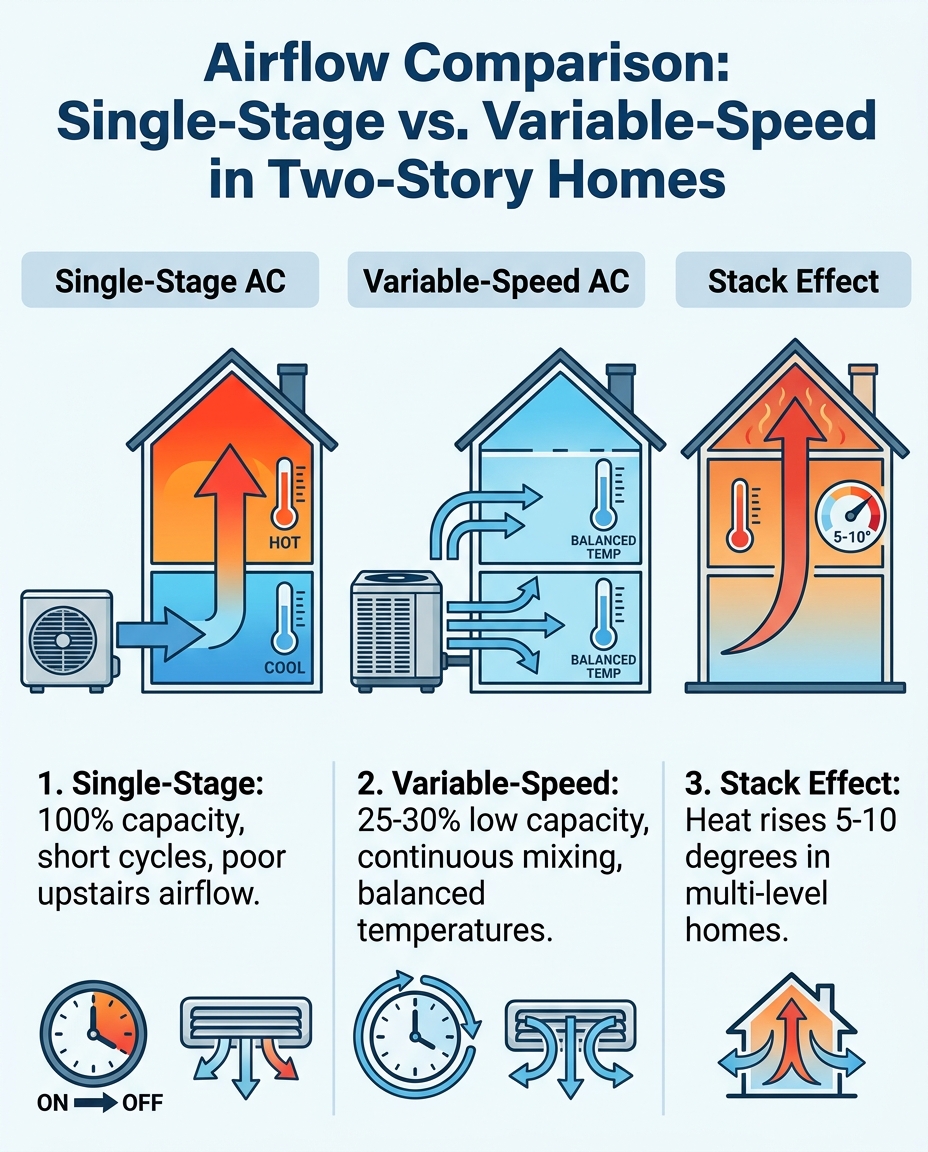
Side-by-Side Comparison: Single-Stage vs. Variable-Speed Performance
When weighing your options for a multi-level home, seeing a direct breakdown of how each technology performs makes the decision much clearer. A Variable-speed compressor excels in areas where traditional systems struggle, specifically regarding consistent air distribution and moisture management.
| Performance Metric | Standard Single-Stage AC | Variable-Speed AC |
|---|---|---|
| Temperature Zoning | Uneven cooling; downstairs freezes while upstairs remains hot due to short run times. | Consistent floor-to-floor cooling; continuous fan operation mixes air evenly throughout the home. |
| Humidity Control | Poor latent cooling; system shuts off before adequately removing indoor moisture. | Excellent moisture removal; long, slow cycles wring humidity out of the air continuously. |
| Energy Efficiency | Lower SEER2 ratings; consumes high amounts of power during frequent, hard start-ups. | High SEER2 ratings; steady, low-capacity consumption avoids massive electrical spikes. |
| Noise Levels | Loud, noticeable start-ups and shutdowns; blower runs at maximum volume. | Ultra-quiet operation; low-speed continuous running is often virtually silent indoors. |
While single-stage systems have a lower initial installation footprint, their inability to solve the specific architectural challenges of a two-story home often leaves homeowners frustrated with their investment. The advanced staging of variable-capacity units directly addresses the physics of air stratification.
Mastering Latent Cooling and Moisture Removal
In North Texas, controlling the temperature is only half the battle. Maintaining true indoor comfort requires mastering latent cooling, which is the technical term for moisture removal. Sensible cooling refers to simply dropping the temperature on the thermometer. Latent cooling is the process of wringing the heavy, sticky humidity out of the indoor air.
When an August late-summer heat wave hits, the outdoor humidity climbs, and that moisture inevitably infiltrates your home. Sticky air actually holds heat against your skin, preventing your body from cooling itself naturally. This is why a room at 74 degrees with high humidity feels significantly hotter and more suffocating than a room at 76 degrees with crisp, dry air.
Standard single-stage systems leave the upstairs feeling damp and warm because their short cycles do not allow enough air to pass over the indoor evaporator coil. The evaporator coil acts like a glass of ice water on a hot day—as warm air blows across it, moisture condenses on the cold metal and drains away. However, this condensation process takes time.
Continuous circulation is the key to superior dehumidification. Because a variable-capacity system runs at a low speed for extended periods, it continuously pulls indoor air over that freezing-cold evaporator coil. Hour after hour, it slowly and steadily wrings the moisture out of your home. This constant latent cooling leaves the air feeling crisp, light, and incredibly comfortable, completely eliminating the stagnant, sticky feeling that plagues the second floor of so many homes during the summer.
Making the Right Choice for Your Multi-Level Home
Upgrading your cooling system is a significant decision, and the right choice ultimately depends on the severity of the upstairs heat problem in your specific home. If your Southlake multi-level homes architecture features soaring ceilings, large upstairs windows facing the afternoon sun, and an open floor plan, standard cooling technology will always struggle to keep up.
To achieve ultimate zoning and comfort, many of our Grapevine and Southlake customers choose to integrate advanced cooling technology with modern controls. Pairing a variable-capacity system with smart thermostats and strategically placed remote room sensors allows the system to monitor the temperature exactly where you sleep, rather than just relying on the downstairs hallway reading.
Before any equipment is selected, our technicians always perform a proper load calculation and a thorough ductwork assessment. Even the most advanced compressor cannot overcome crushed, leaking, or improperly sized ductwork. At Washburn Air, we believe in providing transparent pricing and honest advice—ensuring that homeowners get the exact system their architecture requires without ever being oversold on features they do not need. We evaluate the static pressure of your home, the condition of your insulation, and your family’s specific comfort goals before making a recommendation.
While advanced staging technology represents a different tier of equipment, the long-term comfort, the elimination of the “hot upstairs” battle, and the steady energy management often justify the technology upgrade for two-story homeowners.
Frequently Asked Questions
Is a variable speed AC worth it for a two-story house?
Yes, it is often the most effective solution for multi-level homes. Because variable-speed systems run continuously at lower capacities, they constantly mix the air between the first and second floors. This steady airflow prevents cold air from pooling downstairs and successfully pushes conditioned air up to the highest points of the house.
How do I fix a hot upstairs and cold downstairs?
The most comprehensive fix is upgrading to a system with variable-capacity staging and continuous fan operation. Additionally, ensuring your attic is properly insulated, sealing any leaky ductwork, and utilizing smart thermostats with remote room sensors can dramatically improve the temperature balance between floors.
Does a variable speed AC help with humidity?
Absolutely. Variable-speed technology provides superior latent cooling (dehumidification) compared to standard systems. By running for longer, slower cycles, the system continuously pulls indoor air across the cold evaporator coil, extracting significantly more moisture from the air and leaving your home feeling crisp and dry.
Why is my upstairs so hot in the summer?
Your upstairs gets hot due to the “stack effect,” a physics principle where buoyant warm air rises and dense cold air sinks. Furthermore, standard air conditioners often short-cycle, meaning they cool the downstairs quickly and shut off before the blower motor has enough time to push cold air all the way up to the second floor.
Do I need a dual-zone system if I upgrade my AC compressor?
Not necessarily. While physical zoning (using mechanical dampers in the ductwork) offers the ultimate precise control, simply upgrading to a variable-speed compressor often resolves mild to moderate upstairs temperature issues on its own by providing continuous air mixing and eliminating short-cycling.
Choosing Your Comfort Strategy
When you are ready to stop battling the thermostat and finally solve the uneven temperatures in your two-story home, having a technical but accessible explanation of your options is vital. By upgrading to a variable-speed system, you can eliminate the hot upstairs and enjoy crisp, dehumidified air all summer long. Reach out to your Southlake cooling experts today to schedule a thorough evaluation of your home’s unique airflow needs.