The Deceptive Danger of a Sweet Odor in Your Home
Diagnosing the sweet chemical smell coming from your vents starts with recognizing that this odor is an urgent warning sign, not just a passing nuisance. You walk into your living room after a long shift and notice something off—a faint, sweet, almost chloroform-like scent lingering in the air. Your air conditioner is running constantly, blowing air through the house, but that strange ether-like smell keeps getting stronger. Many homeowners assume this is just a dirty filter or a normal byproduct of heavy use, but that assumption can lead to serious consequences.
During the peak of late-summer August cooling, your HVAC system is under immense stress. If you notice this specific chemical scent, you have reached a critical decision point. You must decide whether to ignore the odor or immediately shut off the HVAC system for your health and equipment safety. Ignoring it allows toxic fumes to circulate and forces your equipment to run in a dangerous state. Taking fast action protects your household and limits the damage. If you are dealing with this symptom right now, securing professional HVAC services is your next step, specifically targeting AC repair to safely resolve the issue.
What Causes a Sweet Chemical Smell in Your AC Vents?
To understand why this smell is happening, you have to look at how your air conditioning actually works. Central air conditioners operate on a closed-loop system. The refrigerant—often referred to by brand names like Freon or Puron—travels in a continuous circle between the indoor evaporator coil and the outdoor condenser unit. Its job is to absorb heat from inside your house and release it outside.
Here is the most important fact to remember: refrigerant does not deplete, evaporate, or get “used up” naturally over time. If your system is low on refrigerant, or if you can smell it in the air, there is a physical breach in the copper lines or coils. A sweet, chloroform-like smell guarantees that this chemical is escaping its pressurized loop and leaking into your home’s air supply. Especially in areas like Grapevine, TX, where systems run heavily for months, the wear and tear on these lines is significant.
Differentiating HVAC Odors
Not all strange smells mean you have a refrigerant leak. It helps to know exactly what you are dealing with before panicking. Here is a quick breakdown of common HVAC odors and what they usually mean:
| Smell Type | Likely Cause | Severity Level |
|---|---|---|
| Sweet, chloroform, or ether | Refrigerant leak in the coils or lines | High (Requires immediate shutdown) |
| Musty, damp, or “dirty socks” | Biological growth on the indoor coil or in the drain pan | Medium (Requires cleaning and maintenance) |
| Burning plastic or electrical | Overheating blower motor or burnt wiring | High (Requires immediate shutdown) |
| Dusty or burning hair | Normal dust burning off the furnace (usually in fall) | Low (Usually fades in a few hours) |
If your vents are emitting that distinct sweet chemical scent, you are dealing with a breached line. For more detailed background on how these closed loops fail, understanding refrigerant leaks can help you see exactly why this happens.
Health Risks: Is It Dangerous to Breathe Refrigerant Fumes?
The short answer is yes. Breathing in refrigerant fumes is a serious health hazard that requires immediate attention. Refrigerant is a toxic chemical compound designed to stay inside sealed metal pipes, not in your lungs. When a leak occurs indoors, the health risks escalate quickly because the HVAC blower actively circulates these toxic fumes throughout every room in the house.
Physical symptoms of exposure often start small but can worsen rapidly. If you or your family members are breathing in these fumes, you might experience:
- Dizziness and lightheadedness: A feeling of being off-balance or foggy.
- Headaches: Sudden, unexplained headaches that worsen while the AC is running.
- Nausea: An upset stomach or feeling sick without a clear cause.
- Respiratory irritation: Coughing, a scratchy throat, or shortness of breath.
The Centers for Disease Control and Prevention (CDC) and the National Institute for Occupational Safety and Health (NIOSH) maintain strict guidelines regarding refrigerant exposure. In severe, concentrated cases, inhaling these chemicals can lead to chemical poisoning or even asphyxiation. Refrigerant gases are heavier than air, meaning they tend to settle near the floor. This makes the fumes especially dangerous for pets, toddlers, and anyone sleeping in lower-level rooms.
During heavy late-summer August cooling, your windows are likely locked tight to keep the heat out. This traps the fumes inside, creating a concentrated, hazardous environment. Protecting your household occupants and pets must be the absolute priority. Addressing the root cause is a vital part of maintaining safe indoor air quality for your family.
Why Extreme Heat Triggers Late-Summer Refrigerant Leaks
You might wonder why this failure is happening right now, just when you need your air conditioner the most. The answer comes down to cumulative system fatigue after months of continuous, high-pressure operation. Your air conditioner has been working tirelessly since the spring, and that workload takes a physical toll on the metal components.
The intense Grapevine summer heat forces units to run non-stop, often operating at maximum capacity just to keep the indoor temperature bearable. When the outside temperature spikes, the pressure inside the refrigerant lines elevates dramatically. The system has to compress the refrigerant much harder to release the heat outside.
The Physics of High-Pressure Cooling
This sustained, extreme pressure exposes any hidden weaknesses in your HVAC system. Weak solder joints where copper pipes connect are often the first to give way. Additionally, the indoor evaporator coil is constantly exposed to moisture and airborne volatile organic compounds (VOCs). Over time, this combination causes formicary corrosion—microscopic pinhole leaks that slowly weaken the metal.
For most of the summer, those pinholes might hold up. But by the time August arrives in Grapevine, TX, the continuous high-pressure cycles finally push the weakened metal past its breaking point. The coil ruptures, the pressurized refrigerant escapes into the ductwork, and that sweet chemical smell floods your home. These end-of-season failures are highly probable because the system simply has no downtime to recover from the stress.
Additional Warning Signs of a Compromised System
While the sweet odor is a primary indicator, a refrigerant leak rarely happens without other physical symptoms. Helping homeowners confirm the diagnosis involves looking and listening for accompanying signs of a struggling system. If you suspect a leak during your late-summer August cooling cycles, check your equipment for these secondary red flags:
- Hissing or bubbling sounds: Listen closely to the indoor air handler or the outdoor condenser. A pressurized gas leak often creates a distinct hissing noise. If the leak is occurring where condensation has pooled, you might hear a bubbling sound.
- Warm air from the vents: Check the air coming out of your supply registers. Without enough refrigerant to absorb heat, your system will start blowing room-temperature or slightly warm air, even though the thermostat is set to cool.
- Visible ice buildup: Look at the indoor evaporator coils (if accessible) and the copper refrigerant lines running to the outdoor unit. Low refrigerant causes the coil’s temperature to drop below freezing, turning normal condensation into a solid block of ice.
- Sudden energy bill spikes: Note any unexplained increases in your recent utility bills. When refrigerant levels drop, the system has to run twice as long to achieve the same cooling result, causing your electricity usage to skyrocket.
If you notice the sweet smell combined with any of these symptoms, the diagnosis is practically certain. Your system has suffered a breach and needs immediate professional intervention.
Immediate Steps to Take If Your AC Smells Sweet
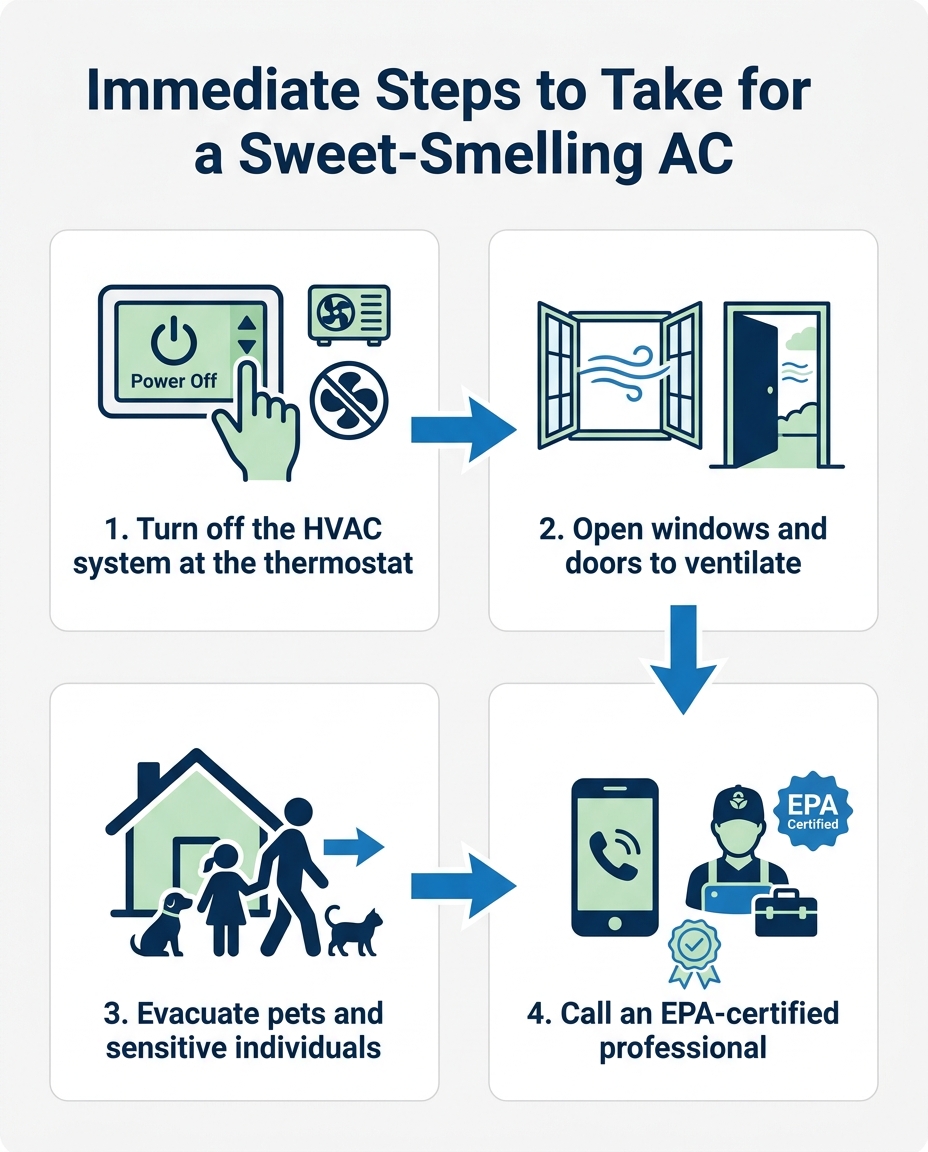
When you encounter a sweet chemical smell coming from your vents, you need to act quickly. This is not a situation where you can wait a few days to see if it gets better. Follow these immediate, actionable safety steps to protect your home and family in Grapevine, TX:
- Turn off the HVAC system immediately: Go to your thermostat and switch the system to “Off.” Do not just raise the temperature; ensure the blower motor stops completely. This halts the active circulation of toxic fumes through your ductwork.
- Open windows and doors: Ventilate the area as much as possible. Even if it is hot outside, opening windows allows fresh air to dilute the concentrated chemical gases and push them out of your living space.
- Evacuate pets and sensitive individuals: Move dogs, cats, toddlers, and anyone with asthma or respiratory issues out of the immediate area. Because refrigerant gas is heavy and settles low to the ground, pets are highly vulnerable to the fumes.
- Do not attempt a DIY patch: Never try to locate the leak with soapy water or patch it with tape or sealants. Handling, recovering, and repairing pressurized refrigerant lines requires specialized training, heavy-duty equipment, and federal licensing.
The Hidden Cost of ‘Getting Through the Heatwave’
It is completely understandable to feel reluctant about shutting off your air conditioning during peak summer temperatures. When the thermometer reads triple digits, the thought of sitting in a hot house is miserable. Many homeowners try to tough it out, hoping the system will just “get through the heatwave” before they have to call for repairs.
However, running a leaking system is one of the most destructive things you can do to your HVAC equipment. The refrigerant does more than just cool your home’s air; it also cools the heavy-duty compressor motor sitting inside your outdoor unit. When the refrigerant leaks out, the compressor is forced to run dry and hot. Without that vital cooling effect, the motor will rapidly overheat.
What starts as a fixable leak in a copper line can quickly escalate into a catastrophic compressor burnout. Replacing a compressor is often so expensive that it makes more sense to replace the entire outdoor unit. During late-summer August cooling, pushing a broken system past its limits almost guarantees a total system replacement. Physical safety and long-term equipment preservation must supersede temporary comfort. Shutting the system down now saves you from a massive financial burden later.
Why Professional EPA-Licensed Intervention is Mandatory
Fixing a refrigerant leak is strictly regulated by federal law. Handling, recovering, and disposing of HVAC refrigerants requires mandatory EPA Section 608 certification. It is illegal for an unlicensed individual to vent these chemicals into the atmosphere or attempt to recharge a system. This is why calling a professional is not just a recommendation—it is a legal and technical requirement.
Licensed professionals use highly specialized equipment to do the job safely. They utilize electronic leak detectors that sniff out the exact location of the chemical breach. Once the system is empty, they pump pressurized nitrogen into the lines to confirm the leak’s exact location and ensure no other weak spots exist. After brazing the hole shut, they use a heavy-duty vacuum pump to remove all air and moisture from the lines before carefully weighing in the exact factory charge of new refrigerant.
Professional intervention ensures the underlying cause of the leak is permanently fixed, not just temporarily patched with a “stop-leak” chemical that ruins your compressor. In Grapevine, TX, Washburn Air stands out as a transparent, rapid-response authority that prioritizes your family’s safety over high-pressure sales. When you are dealing with scary, urgent HVAC failures, you need a team that arrives fast, explains the problem clearly, and performs the repair by the book. Scheduling a thorough HVAC inspection with certified experts is the only way to guarantee your system is safe to operate again.
Securing Your Home’s Safety and Comfort
A sweet chemical smell is a definitive sign of a refrigerant leak that requires immediate action. By turning off the system and opening your windows, you are making the right choice to protect your household from toxic fumes. Validating this symptom early prevents minor wear and tear from destroying your expensive compressor during the harsh late-summer August cooling demands.
Do not wait for the fumes to clear on their own, because a closed-loop system cannot heal itself. Diagnosing the sweet chemical smell coming from your vents properly requires specialized tools and federal licensing. We encourage you to schedule a professional evaluation immediately to locate the breach, repair the copper lines, and restore your home’s air quality and cooling efficiency safely.
Frequently Asked Questions
What does a Freon leak smell like?
A Freon or refrigerant leak typically smells like sweet chemicals, similar to chloroform, ether, or nail polish remover. Some people also describe it as a faint, sickly-sweet automotive coolant odor. If you notice this distinct scent coming from your vents, it indicates a physical breach in your closed-loop AC system.
Is a sweet smell from the AC dangerous?
Yes, a sweet smell from the AC is dangerous because it means toxic refrigerant gases are leaking into your breathable air. Inhaling these fumes can cause dizziness, headaches, nausea, and respiratory issues. Prolonged exposure in a tightly sealed house poses a serious health risk to people and pets.
Should I turn off my AC if I smell chemicals?
You should immediately turn off your AC at the thermostat if you smell chemicals. Leaving the system running will continue to pump toxic fumes into your living space through the ductwork. Shutting it down protects your health and prevents the compressor from burning out due to low refrigerant.
Can I still run my AC with a refrigerant leak?
You cannot safely run your AC with a refrigerant leak. Doing so forces the compressor to run without the chemical cooling it needs, which quickly leads to catastrophic motor failure. Furthermore, running the system actively pushes hazardous chemical fumes into every room of your home.
Why does my AC smell like paint thinner or chloroform?
An AC smelling like paint thinner or chloroform is a classic indicator of leaking refrigerant. The chemicals used to cool your home’s air have this specific, harsh-yet-sweet odor when they escape their pressurized copper lines. This is vastly different from a musty smell, which usually indicates biological growth.
What are the health symptoms of inhaling refrigerant fumes?
The health symptoms of inhaling refrigerant fumes include sudden headaches, dizziness, nausea, coughing, and throat irritation. Because the gas is heavier than air, it settles near the floor, making small children and pets especially vulnerable to these symptoms. If anyone experiences these signs, evacuate the area and ventilate the home.