Why AC Bill Spikes in a Texas Summer Hit DFW Homeowners So Hard
ac bill spikes in a texas summer are one of the most common — and frustrating — shocks facing homeowners in Grapevine and across the Dallas-Fort Worth area. If your electricity bill nearly doubled between May and August, you’re not imagining things, and you’re definitely not alone.
Here’s a quick breakdown of why it happens:
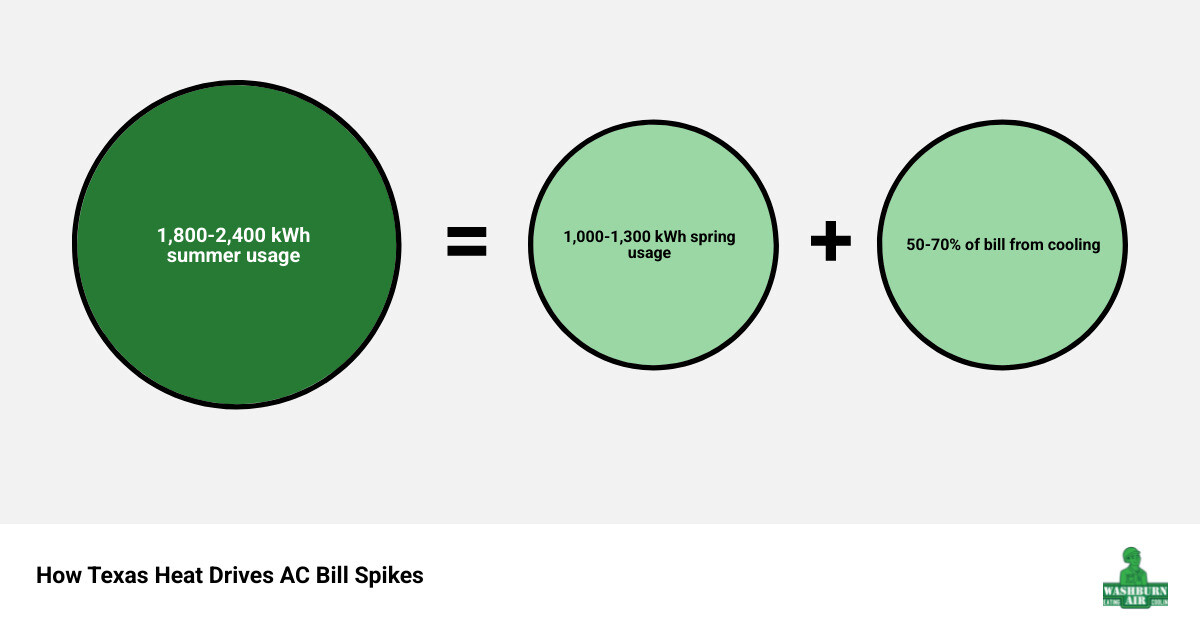
- Air conditioning dominates your bill. In a Texas summer, cooling accounts for 50–70% of your total electricity use.
- Your kWh usage surges. A typical DFW home uses around 1,000–1,300 kWh in spring but can jump to 1,800–2,400 kWh in July and August.
- Hidden HVAC problems make it worse. Leaky ducts, low refrigerant, dirty coils, and failing components force your system to run longer and harder.
- Your electricity plan may work against you. Plans priced for 1,000 kWh usage can become significantly more expensive once your summer usage doubles.
- Texas nights are getting hotter. Rising overnight temperatures mean your AC gets less recovery time, keeping it running well into the evening.
The result? A bill that feels completely out of control — even when you’ve been doing everything right.
This guide breaks down exactly what’s driving those spikes, what you can fix yourself, and when it’s time to call in a professional to stop the bleeding for good.
Why Your Electricity Usage Skyrockets Between Spring and Summer

In the Dallas-Fort Worth metroplex, we are lucky to experience beautiful, mild spring weather. During March and April, your air conditioner barely runs, and your monthly utility bills are highly manageable. The average monthly electricity usage in Texas sits around 1,146 kWh per household, which translates to a normal spring bill of about $168 to $193.
However, as we move into June, July, and August, the entire West South Central region of the United States experiences a massive climate shift. In fact, our region averages about 1,490 kWh per month during the peak summer months — far exceeding the national summer average of roughly 1,100 kWh. For larger or older homes in cities like Southlake, Arlington, and Irving, it is not uncommon to see usage soar past 2,500 or even 3,000 kWh during a severe heat wave.
This extreme jump in kilowatt-hour (kWh) consumption is directly tied to the indoor-outdoor temperature difference. When it is 75°F outside, your AC has an easy job. When the afternoon sun beats down at 103°F, your system must work continuously to maintain a comfortable indoor temperature. If you are wondering how to manage your thermostat settings to mitigate this, check out our guide on What AC Temperature Should You Set in Summer? to balance comfort and efficiency.
Why Cooling Degree Days (CDDs) Cause AC Bill Spikes in a Texas Summer
To understand why your bill behaves the way it does, it helps to understand a metric used by meteorologists and utility companies: Cooling Degree Days (CDDs). A Cooling Degree Day measures how much and for how long the outdoor air temperature remains above a baseline of 65°F.
For every degree that the daily mean temperature rises above 65°F, you accumulate one CDD. For example, if the average temperature on a hot July day in Fort Worth is 95°F, that single day registers 30 CDDs.
The relationship between CDDs and your electricity bill is almost perfectly linear. As the summer progresses, the cumulative CDDs for July and August skyrocket. This is also when the Electric Reliability Council of Texas (ERCOT) faces its greatest challenges. During a historic heat wave on August 10, 2023, ERCOT set an all-time peak demand record of 85,508 MW. As we look at the grid’s load projection, peak demand is expected to approach 92,000 MW. This immense statewide demand increases wholesale electricity pressure, which can indirectly impact retail rates and trigger conservation appeals.
How Retail Electricity Plan Math Changes During AC Bill Spikes in a Texas Summer
Texas operates under a unique deregulated energy market. While this gives homeowners in Arlington, Grapevine, and Irving the power to choose their retail electric providers (REPs), it also introduces complex pricing structures that can catch you off guard.
Many homeowners shop for electricity plans based on the advertised rate at the 1,000 kWh usage tier. However, if you read your plan’s Electricity Facts Label (EFL), you will find that the price per kWh can change dramatically depending on your actual usage:
- The 1,000 kWh Illusion: A plan might look incredibly cheap at exactly 1,000 kWh because of a built-in bill credit (e.g., a $50 credit that only triggers when usage is between 999 and 1,500 kWh).
- The Summer Surpass: Once your AC pushes your usage to 2,000 kWh or more in July, that bill credit disappears, or you enter a higher rate tier. A plan optimized for moderate spring usage can easily cost you an extra $50 to $100 per month in the summer compared to a plan optimized for high-volume usage.
- Minimum Usage Fees: Conversely, some plans penalize you with extra fees if you do not use enough electricity, which can impact your bills during the shoulder seasons.
- Fixed-Rate vs. Variable and Indexed Plans: Fixed-rate plans protect you from market volatility. If you are on a variable-rate or indexed plan during an ERCOT demand spike, your rate can jump overnight, compounding the financial impact of your increased summer usage.
Hidden HVAC Issues Driving Up Your Summer Energy Bills
While weather and rate plans play a massive role, your physical cooling system is often the primary culprit behind an unexpectedly high bill. If your system has underlying mechanical issues, it will run much longer than necessary to cool your home, leading to severe ac bill spikes in a texas summer.
A simple example is a clogged air filter. When your filter is caked with dust and pet dander, it restricts airflow. Your blower motor has to work twice as hard to pull air through the system, and the reduced airflow makes it take much longer to cool your home. To understand more about how these issues develop, read about Common AC Issues and How to Troubleshoot Them Effectively.
Leaky Ductwork and Attic Heat Transfer
Did you know that the average Texas home loses 20% to 30% of its cooled air through duct leaks before it ever reaches the living spaces?
In cities like Grapevine and Trophy Club, many homes have ductwork running through unconditioned attic spaces. During a July afternoon, your attic can easily reach temperatures between 140°F and 160°F. If your ducts have loose joints, tears, or degraded insulation (which can drop from an R-6 value down to R-2 after 15 years of exposure to extreme heat), two devastating things happen:
- Conditioned Air Escapes: Cold air that you paid to cool leaks directly into your empty attic.
- Superheated Air is Pulled In: Return duct leaks can pull 150°F attic air directly into your AC system, forcing it to work significantly harder to cool down that hot air.
Sealing your ductwork with professional mastic sealant (which is rated to withstand high attic temperatures) and ensuring proper insulation is one of the most effective ways to lower your energy bills.
Refrigerant Leaks and Failing Components
Another major source of energy waste is an incorrect refrigerant charge. Your air conditioner does not “consume” refrigerant; it circulates it in a closed loop to transfer heat out of your home. If your system is running low on refrigerant, it means you have a leak.
A system running just 20% low on refrigerant can experience a 30% to 40% drop in cooling efficiency. Because the system cannot absorb heat effectively, it will run constantly without ever reaching your thermostat’s setpoint. This places immense strain on your compressor and can lead to water damage. Learn more about this issue by reading Why Your AC Is Leaking Water & How to Fix It.
Additionally, electrical components like run capacitors degrade over time. A failing capacitor can cause your compressor or outdoor fan motor to draw excessive electrical current, running hotter and consuming more power. Left unaddressed, this can cause your system to overheat and shut down entirely. If you are experiencing this, read our article on Why Your Outdoor AC Unit Keeps Shutting Off.
Practical Steps to Lower Your Summer Electricity Consumption
Fortunately, you do not have to sit by and accept high summer bills. There are several highly effective, practical steps you can take to lower your electricity consumption without sacrificing your indoor comfort.
First, let’s look at behavioral adjustments and timing. ERCOT peak demand hours typically run from 2:00 PM to 9:00 PM on hot summer weekdays. By shifting heavy energy usage — such as running your dishwasher, doing laundry, or running your pool pump — to the morning or late evening hours, you reduce strain on the grid and can take advantage of off-peak pricing if your plan supports it. Installing and properly configuring Smart Thermostats can automate these temperature adjustments seamlessly.
Optimizing Thermostat Settings and Airflow
To maximize your savings, we recommend following a few simple airflow and temperature strategies:
- The 4-by-4 Rule: If you are going to be away from home for more than four hours, raise your thermostat setting by 4 degrees. Every degree you raise your thermostat can save you 3% to 5% on your daily cooling costs.
- Counterclockwise Ceiling Fans: Ensure your ceiling fans are rotating counterclockwise during the summer. This creates a wind-chill effect that makes the room feel up to 4 degrees cooler than it actually is, allowing you to set your thermostat higher without feeling warm. Remember to turn fans off when you leave the room, as fans cool people, not empty spaces!
- Block the Sun: Close your blinds, drapes, or solar screens, especially on south- and west-facing windows, by midday. This simple step can reduce solar heat gain in your home by up to 30%.
- Set to AUTO, Not ON: Always keep your fan setting on “AUTO” rather than “ON.” Leaving it on “ON” runs your indoor blower fan continuously, which can re-introduce humidity back into your home and increase your electricity usage.
For more specialized advice tailored to our local climate, refer to our detailed article on Understanding HVAC in Dallas-Fort Worth Summer.
Whole-Home Energy Management and Efficiency Upgrades
If you want to take your savings to the next level, consider whole-home energy management and electrical optimization:
- LED Lighting Upgrades: Traditional incandescent light bulbs waste 90% of their energy as heat. Upgrading to LED bulbs throughout your home uses 75% to 80% less energy and eliminates an unnecessary internal heat source, reducing the workload on your AC.
- Power Factor Optimization: Many motorized appliances (like older AC compressors and pool pumps) suffer from poor power factor, meaning they draw more current from the grid than they actually convert into useful work. A whole-home energy management system can help optimize this power flow, reducing electrical waste.
- Insulation and Air Sealing: Adding blown-in fiberglass or cellulose insulation to your attic and sealing gaps around doors and windows with weatherstripping prevents cool air from escaping and hot air from entering.
When to Repair vs. Replace Your Cooling System
Deciding whether to repair an aging air conditioner or invest in a new system can be a difficult financial decision. To help you weigh your options, we have put together a comparison table based on system age, efficiency, and performance:
| Decision Factor | When to Repair | When to Replace |
|---|---|---|
| System Age | Under 10 years old | 10 to 15+ years old |
| Repair Cost | Minor issues (e.g., contactor, capacitor) | Major component failure (e.g., compressor, leaking coil) |
| Efficiency Rating | System is already 14 to 16 SEER | System is an old 10 SEER unit |
| Energy Bills | Bills are consistent with seasonal averages | Bills are 30%+ higher than previous summers |
| Comfort Level | Even cooling throughout the home | Hot upstairs rooms, high humidity, frequent cycling |
If you are struggling with a system that constantly breaks down or fails to keep your home cool, ignoring the problem will only lead to higher costs. Read more about The Impact of Neglecting AC Inspections and Repairs on Your System to understand the long-term risks.
The Benefits of Proactive AC Maintenance
The absolute best way to avoid emergency breakdowns and keep your summer bills low is through regular, proactive maintenance. Just like your car needs regular oil changes, your cooling system needs professional attention before the summer heat hits.
Our comprehensive AC Maintenance services include cleaning the outdoor condenser coils, checking refrigerant levels, testing electrical connections, and clearing the condensate drain line. By enrolling in our structured HVAC Maintenance Plans, you can ensure your system remains in peak condition year-round, extending its lifespan and keeping your monthly bills as low as possible.
Upgrading to High-Efficiency Systems
If your system is more than a decade old, upgrading to a modern, high-efficiency system can deliver massive financial returns.
In 2023, the Department of Energy transitioned to new SEER2 (Seasonal Energy Efficiency Ratio 2) standards, which require higher minimum efficiencies for all new installations. While an older system from 2005 to 2010 might only have a 10 SEER rating, modern systems routinely range from 16 to over 20 SEER2.
Upgrading from a 10 SEER system to a modern 16.5 SEER2 system can reduce your cooling electricity usage by roughly 50%. Over our long Texas cooling seasons, those monthly savings add up quickly. Furthermore, modern inverter-driven, variable-speed systems provide superior humidity control and run at lower, ultra-efficient speeds for most of the day, keeping your home incredibly comfortable. Learn how to prepare your home for the transition by reading Get Ready for the Heat: The Importance of an AC Tune-Up.
Hidden HVAC Problems That Trigger AC Bill Spikes in a Texas Summer
Often, the issues that cause your energy bills to skyrocket are completely invisible to the untrained eye. Here are a few common hidden mechanical issues we regularly diagnose in North Texas homes:
- Dirty Condenser Coils: Your outdoor unit’s job is to release the heat collected from inside your home. If the outdoor coils are covered in dirt, grass clippings, or pollen, the heat gets trapped, forcing the compressor to run hotter and draw significantly more electricity.
- High Static Pressure: If your ductwork is poorly designed or too small for your AC unit, it creates high static pressure. This acts like a blockage in your system, restricting airflow and forcing your blower motor to run at maximum power, which wastes energy and shortens the motor’s lifespan.
- Airflow Imbalances: Over time, registers can become unbalanced, leading to hot rooms that cause you to lower your thermostat even further, compounding your energy waste.
- Oversized or Undersized Systems: A system that is too large will “short-cycle,” turning on and off rapidly without dehumidifying your home. A system that is too small will run continuously without ever reaching your desired temperature. Both scenarios cause severe energy waste.
Frequently Asked Questions About Texas Summer AC Bills
Why is my electric bill so high when my AC is running in Texas?
Your electric bill is high primarily because cooling accounts for up to 70% of your home’s energy usage during a hot Texas summer. If your bill is significantly higher than last year under similar weather conditions, it is likely driven by restricted airflow (such as a dirty filter), a refrigerant leak, leaky ductwork in a hot attic, or an aging, inefficient system that is running much longer than it should to keep your home cool.
How much does air conditioning impact my summer electricity bill?
During the peak summer months of June, July, and August, air conditioning is the single largest consumer of electricity in your home, accounting for 50% to 70% of your total utility bill. While your household appliances, electronics, and lighting remain relatively constant year-round, your AC usage rises dramatically to combat outdoor temperatures that regularly exceed 100°F.
Will upgrading my thermostat or sealing my ducts really lower my bill?
Yes, absolutely. Installing a smart thermostat can easily reduce your cooling costs by 10% or more annually by optimizing your temperature settings when you are away. Sealing leaky ductwork is even more impactful, as the average Texas home loses 20% to 30% of its cooled air to the attic. Professional duct sealing can lower your summer bills by 15% to 25% and significantly improve your indoor air quality.
Conclusion
Managing your electricity usage and avoiding ac bill spikes in a texas summer requires a combination of smart habits, proper energy plan selection, and a well-maintained HVAC system.
At Washburn Air, we are proud to provide expert, 24/7 HVAC services to homeowners across Grapevine, Dallas, Fort Worth, Arlington, Irving, Southlake, Westlake, Trophy Club, and Highland Park. Whether you need a quick system tune-up, professional duct sealing, or a complete system replacement, our team has the local expertise to keep your home comfortable and your energy bills under control.
If you are ready to stop overpaying for electricity and ensure your cooling system is running at peak efficiency, contact us today to schedule your professional ac-repair or maintenance service!
{“@context”: “https://schema.org”, “@graph”: [{“@type”: “Article”, “headline”: “AC Bill Spikes in a Texas Summer Guide | Washburn Air”, “description”: “Learn why AC bill spikes in a Texas summer hit DFW homes, what HVAC issues raise costs, and how to lower usage. Call Washburn Air today.”, “author”: {“@type”: “Person”, “name”: “Washburn Air”}, “publisher”: {“@type”: “Organization”, “name”: “Washburn Air”, “logo”: {“@type”: “ImageObject”, “url”: “https://washburnair.com/wp-content/uploads/2024/09/washburn-air-logo-800-400×261.png”}}, “datePublished”: “2026-07-08T02:31:47+00:00”, “dateModified”: “2026-07-08T02:31:57.281816”, “mainEntityOfPage”: {“@type”: “WebPage”, “@id”: “https://washburnair.com/blog/the-easiest-way-to-fix-high-ac-bill-spikes-in-a-texas-summer/”}, “image”: “https://images.pexels.com/photos/5849566/pexels-photo-5849566.jpeg?auto=compress&cs=tinysrgb&h=650&w=940”}, {“@type”: “FAQPage”, “mainEntity”: [{“@type”: “Question”, “name”: “Why does my AC bill spike during a Texas summer?”, “acceptedAnswer”: {“@type”: “Answer”, “text”: “AC bills spike in Texas summers because air conditioning can account for 50–70% of total electricity use. As temperatures rise, the system runs longer and harder to keep the home comfortable, causing kWh usage to increase sharply.”}}, {“@type”: “Question”, “name”: “How much electricity does a DFW home use in summer?”, “acceptedAnswer”: {“@type”: “Answer”, “text”: “A typical DFW home may use around 1,000–1,300 kWh in spring, but usage can rise to 1,800–2,400 kWh in July and August. Larger or older homes in areas like Southlake, Arlington, and Irving may exceed 2,500 or even 3,000 kWh during severe heat waves.”}}, {“@type”: “Question”, “name”: “What HVAC problems can make my summer electric bill higher?”, “acceptedAnswer”: {“@type”: “Answer”, “text”: “Hidden HVAC issues such as leaky ducts, low refrigerant, dirty coils, and failing components can make your system run longer and work harder. These problems increase electricity use and can make summer bill spikes worse.”}}, {“@type”: “Question”, “name”: “Can my electricity plan make my summer bill more expensive?”, “acceptedAnswer”: {“@type”: “Answer”, “text”: “Yes, electricity plans priced around 1,000 kWh usage can become significantly more expensive when summer usage doubles. If your plan does not fit your peak summer consumption, your bill may rise more than expected.”}}, {“@type”: “Question”, “name”: “Why do hotter Texas nights affect AC costs?”, “acceptedAnswer”: {“@type”: “Answer”, “text”: “Hotter overnight temperatures give your AC less time to recover after a long day of cooling. This can keep the system running well into the evening and increase total electricity usage.”}}]}]}