Is Your AC Breaker Trip a Minor Glitch or a Critical Warning?
Why did my AC compressor suddenly trip the breaker after running fine all summer? At Washburn Air, this is the exact question we hear homeowners ask when their cooling system suddenly goes quiet during the late August heat and back-to-school transition. You walk over to the electrical panel, spot the flipped switch, and immediately wonder what went wrong. The system worked perfectly through June and July, keeping your home comfortable during the hottest parts of the day. Now, just as the late-summer season peaks and you need reliable cooling the most, the house is slowly starting to warm up.
When this happens, you face an immediate decision point: do you simply flip the switch back on and hope it was a temporary fluke, or do you leave the breaker off and call for professional help? For fast assistance, you can always explore your options for AC repair services or specifically look into AC compressor repair.
The short answer our technicians always give is that a tripping breaker is rarely an accident. Your electrical panel is designed to protect your home from dangerous power surges and overheating wires. When the breaker trips, it means the air conditioner pulled significantly more electricity than the circuit is designed to handle. This sudden spike in power consumption is usually a sign of cumulative wear leading to severe electrical strain. Deciding how to handle this warning sign determines whether you face a quick part replacement or a total system failure.
The Reality of Cumulative Thermal Stress on Your AC System
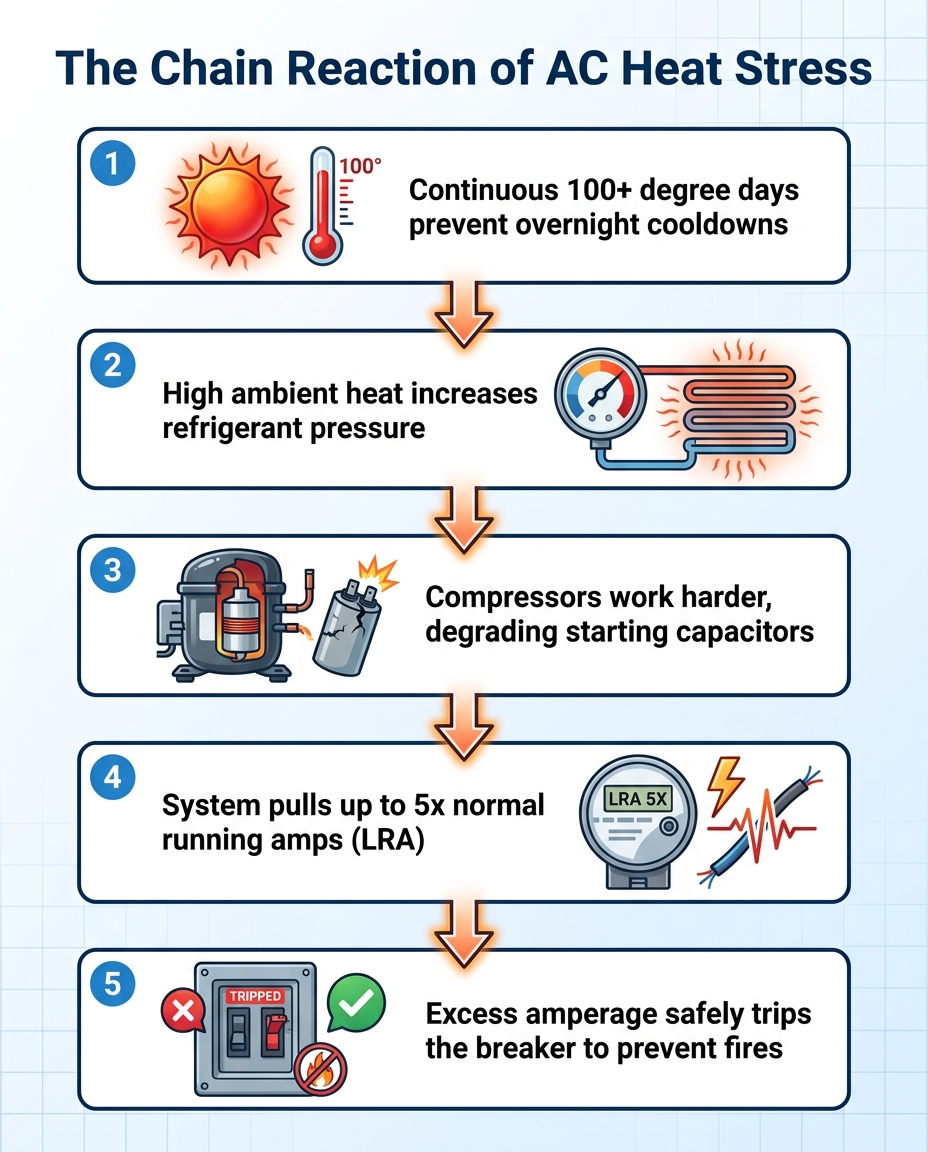
To understand why an air conditioner fails late in the season, you have to look at the mechanical reality of cumulative thermal stress. Your outdoor condensing unit houses the compressor, which is the heavy-duty engine responsible for pumping refrigerant through your home. Throughout the early summer, this compressor runs in manageable cycles. However, as the summer drags on into late August, the operating conditions become punishing.
In our years serving Grapevine, TX, and the broader DFW area, the Washburn Air team frequently sees the toll prolonged streaks of 100-degree days take on local equipment. During these intense heat waves, the outdoor temperatures rarely drop enough overnight to give the equipment a true break. This means the metal components, the internal lubricating oil, and the electrical wiring stay hot around the clock. The system never gets a chance to fully shed the heat it absorbs during the afternoon.
High ambient temperatures directly impact how hard your system has to work. As the outside air gets hotter, the pressure of the refrigerant inside the system naturally rises. When refrigerant pressure climbs, the compressor has to exert significantly more effort to pump that fluid through the lines. This continuous, high-pressure operation accelerates the breakdown of internal components. We often tell our customers that an August failure is almost never a sudden, out-of-the-blue event; it is the final result of microscopic wear that began months earlier. If you are dealing with these exact conditions, local Grapevine HVAC services can help assess the damage.
| Operating Condition | Early Summer (June) | Late Summer (August) |
|---|---|---|
| Overnight Cooldown | Temperatures drop, allowing metal components to cool completely. | Temperatures remain high, trapping heat inside the condenser cabinet. |
| Refrigerant Pressure | Normal operating pressure; compressor runs smoothly. | Elevated pressure forces the compressor motor to strain against resistance. |
| Component Health | Capacitors and wiring insulation are fresh and fully functional. | Capacitors degrade from constant heat; wire insulation becomes brittle. |
| Electrical Draw | System pulls normal startup and running amperage. | System pulls dangerously high amperage, threatening the breaker limit. |
Why Heat-Degraded Components Cause Excess Amperage Draw
When our team diagnoses an air conditioner that has tripped a breaker, the immediate cause is almost always an excess amperage draw. Amperage is the measure of electrical current flowing through the wires. Every AC system has a specific limit to how much current it can safely pull. To understand why your system suddenly exceeded this limit, we have to look at how heat degrades specific electrical components over a long summer.
The most critical moment for your air conditioner is the exact second it turns on. Compressors require a massive surge of power to start spinning. This initial burst is known as Locked Rotor Amps (LRA), and it can be up to five times higher than the power the system uses while running normally. Under perfect conditions, this spike lasts only a fraction of a second. However, when parts wear down, this electrical spike lasts longer and pulls even more power.
In our experience in the field, here is the step-by-step process of how heat degradation leads to an excess amperage draw:
- Degraded Starting Capacitors: The capacitor acts as a battery that delivers the massive jolt of electricity the compressor needs to start. Constant summer heat literally bakes the internal fluids of the capacitor, weakening its ability to hold and deliver a charge. When the capacitor fails, the compressor struggles to start, pulling a dangerous amount of electricity directly from your home’s breaker panel.
- Increased Mechanical Resistance: Inside the compressor, moving metal parts rely on specialized oil for lubrication. Months of continuous heat can cause this oil to break down and lose its slickness. Without proper lubrication, the internal motor faces severe mechanical resistance. The motor pulls more electrical current in a desperate attempt to overcome that friction and force the parts to turn.
- Thermal Breakdown of Wire Insulation: The electrical wires inside your outdoor unit are coated in protective insulation. Relentless heat makes this insulation brittle, causing it to crack or melt away. Exposed wires can touch the metal casing of the unit, creating a direct electrical short to ground. This causes an instantaneous, massive spike in amperage.
When any of these three things happen, the electrical current spikes past the safe limit. The breaker detects this dangerous excess amperage draw and immediately trips to cut the power. We always recommend keeping up with routine AC maintenance as the best way to catch these degrading components before they trigger a sudden shutdown.
The Hidden Danger of Repeatedly Resetting a Tripped Breaker
When the house is getting hot and the AC is off, one of the most common homeowner habits we see is marching straight to the electrical panel and firmly pushing the breaker back into the “ON” position. If the breaker trips again immediately, many people will try to reset it a third or fourth time, hoping the system will eventually catch and start cooling. Our technicians strongly advise against this—it is one of the most dangerous things you can do to your HVAC equipment.
Your electrical breaker is not a nuisance switch; it is a critical safety device designed to prevent electrical fires and catastrophic equipment damage. When it trips, it is doing exactly what it was engineered to do: stopping a dangerous flow of electricity before it melts wires or catches fire. A breaker trip is a symptom of a larger electrical or mechanical issue, not the root problem itself.
The internal damage of forced resets:
- Overheating electrical windings: Every time you force a failing compressor to try and start, you send a massive jolt of electricity into the motor’s copper windings. This extreme heat can melt the protective coating off the wires inside the sealed compressor shell.
- Creating a grounded compressor: Once the protective coating melts, the bare copper wires touch the metal casing. This is called a “grounded” compressor. Once a compressor is grounded, it is permanently destroyed and must be completely replaced.
- Risking an electrical fire: Forcing an excess amperage draw through your home’s wiring repeatedly can overheat the wires leading from the panel to the outdoor unit, creating a severe fire hazard inside your walls.
If your breaker trips, you must resist the urge to force the system to run. We have seen too many cases where repeatedly resetting the breaker turns a simple, inexpensive part replacement into a fatal compressor death. Leave the switch off and seek professional diagnostics immediately to protect your home and your equipment.
Frequently Asked Questions About Late-Summer AC Breaker Trips
Understanding exactly how your system reacts to late-summer heat can help you make the right decisions when things go wrong. If you want to dive deeper into troubleshooting, you can read more about how to fix AC breaker trips in North Texas heat waves. Here are the most common questions homeowners ask our Washburn Air technicians when dealing with a tripping breaker during the late August / end-of-summer heat.
Is it safe to reset a tripped AC breaker?
We generally tell customers it is safe to reset a tripped AC breaker exactly once to rule out a random, temporary power surge from the grid. However, if the breaker immediately trips a second time, it is highly unsafe to reset it again. Repeated resets force the system to pull dangerous amounts of electricity, which risks electrical fires and permanent compressor death. Always leave the switch in the off position if the problem persists and wait for a professional evaluation.
Why does my AC draw too many amps in the summer?
Your AC draws too many amps in the summer because high ambient heat significantly increases the internal pressure of the system. This forces the compressor motor to work much harder against that elevated pressure just to pump refrigerant. Additionally, we often find that degraded capacitors force the system to pull more power from the panel to start, and failing fan motors draw excess current to overcome internal mechanical resistance caused by worn bearings.
What happens when an AC compressor overheats?
When an AC compressor overheats, internal thermal overload switches may engage, shutting the entire unit down to protect the motor from melting. If the heat continues unabated, the specialized oil inside the compressor can break down, heavily reducing vital lubrication for the moving metal parts. Eventually, the intense heat will cause the electrical windings to melt together, causing a fatal electrical short to ground that ruins the equipment completely.
Why is my AC tripping the breaker after a few minutes of running?
An AC tripping the breaker after a few minutes of running indicates the issue is likely a running amp overload rather than a startup spike. In our field experience, this specific timing often points to a failing outdoor fan motor, extremely dirty condenser coils that cannot release heat, or a compressor that is slowly overheating as it runs. Because the system successfully starts but fails shortly after, it requires professional testing of the running load under normal operating conditions.
How do I know if my AC compressor is bad?
You will know your AC compressor is bad if it trips the breaker instantly upon startup every single time you try to run it. Other clear warning signs we look for include loud grinding, screeching, or hard starting noises coming from the outdoor unit when it attempts to turn on. If the system blows warm air inside despite the indoor fan running normally, it often means the compressor has failed to engage. A licensed technician must perform specialized electrical testing to confirm a total failure.
Why Proper Diagnosis Requires Professional Electrical Testing
When you are dealing with a cooling system that shuts down your electrical panel, guessing at the problem is incredibly risky. Diagnosing an excess amperage draw and determining the true health of a compressor is strictly a job for licensed professionals. Modern air conditioning systems operate on high voltage, and the outdoor condenser unit stores lethal amounts of electricity inside its capacitors even after the power is shut off at the breaker.
Proper diagnosis requires specialized tools that the average homeowner does not own. Our technicians at Washburn Air use professional-grade multimeters to safely measure the exact amperage the system pulls the moment it starts. We also use tools called megohmmeters to test the integrity of the electrical windings inside the sealed compressor shell. This “megging” process sends a high voltage charge through the wires to detect microscopic breakdowns in the insulation before they turn into a catastrophic short circuit.
DIY attempts to diagnose high-voltage outdoor units are highly dangerous and often lead to misdiagnosis. A professional with local North Texas HVAC expertise understands exactly how these systems behave after being heavily heat-stressed throughout the Grapevine, TX summer. We know what to look for and can accurately distinguish between a failing capacitor and a fatal compressor failure. Relying on an expert ensures the problem is fixed safely and correctly the first time.
Get Expert Help Before the Texas Summer Ends
A tripping breaker is a clear, undeniable cry for help from your HVAC system. It is your equipment’s way of telling you that it is experiencing a dangerous excess amperage draw and cannot safely continue operating under current conditions. Ignoring this warning or trying to force the system to run will only lead to more expensive, permanent damage.
If your system is struggling to survive the late summer heat and the back-to-school season, do not wait for a complete breakdown. You need a clear explanation of what is failing and a safe path forward. Schedule a professional inspection with our Washburn Air team to safely resolve the excess amperage draw before the season ends. Contact your local experts today for accurate diagnostic testing and reliable AC compressor repair so you can restore your home’s comfort and peace of mind.